By David Bautz, PhD
NASDAQ:FBLG
READ THE FULL FBLG RESEARCH REPORT
Business Update
Phase 1/2 Diabetic Foot Ulcer Trial to Initiate in 1H26
FibroBiologics, Inc. (NASDAQ:FBLG) is preparing to initiate a Phase 1/2 clinical trial of CYWC628 in patients with refractory diabetic foot ulcers (DFUs). The planned study will enroll 120 patients across up to 10 study sites in Australia. The company has received both public and private Human Research Ethics Committee (HREC) approvals and has fulfilled all other regulatory requirements. The company will be completing the manufacturing of CYWC628 drug product in the 1Q26, with plans to dose the first patient in the 1H26. Interim data could be available by mid-2026, with the full topline results expected by the end of 2026.
The trial is a multicenter, randomized study designed to evaluate the safety, tolerability, and efficacy of FibroBiologics topically administered allogenic fibroblast therapy, CYWC628. Study subjects will receive up to 12 weeks of treatment using either standard of care (SoC) plus a high or low dose of CYWC628, or SoC alone. Study outcomes include wound healing, efficacy of response, and safety parameters. An interim analysis will be conducted after a predefined number of participants complete six weeks of treatment to assess primary safety and efficacy endpoints.
DFUs cause significant morbidity for the 6.3% of diabetic adults (~33 million) that develop them. Of those, 20% will require lower extremity amputation, and 10% will die within the first year of their first DFU. In addition, once a DFU forms, there is a high rate of recurrence, both at one year (40%) and three years (70%).
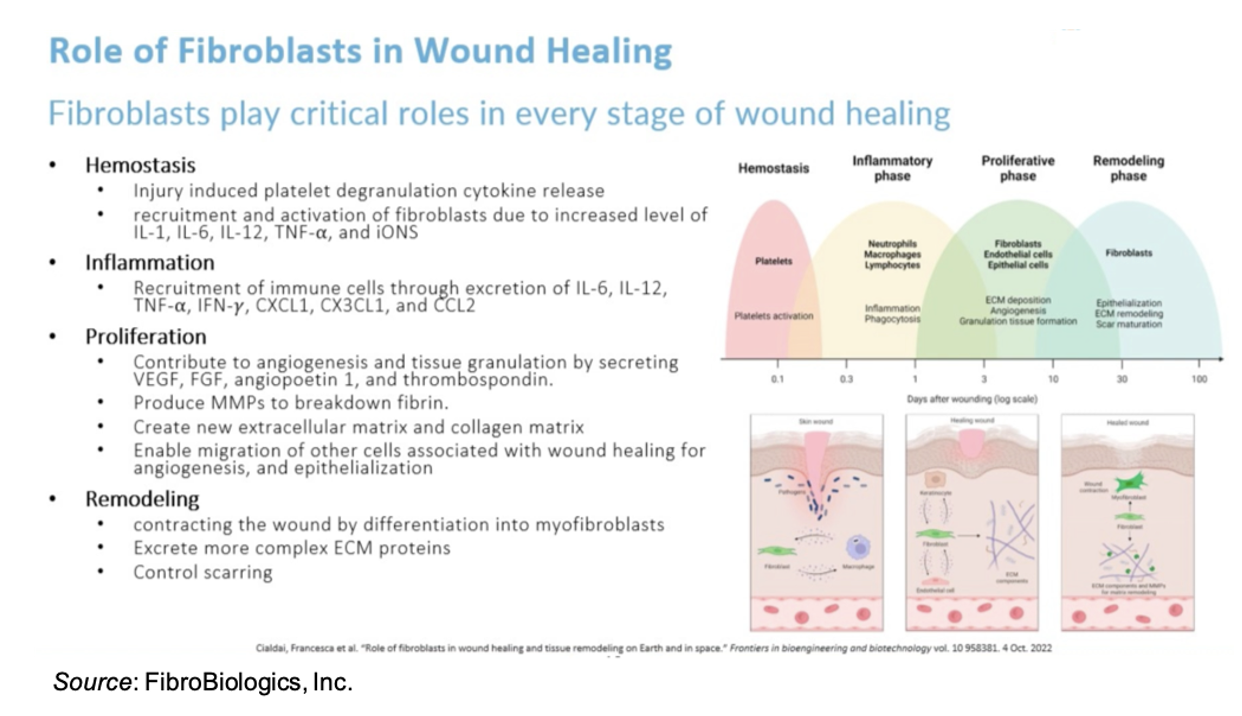
Fibroblasts have excellent therapeutic potential in the treatment of DFUs due to the critical role they play in every stage of wound healing, including hemostasis, inflammation, proliferation, and remodeling. Importantly, fibroblasts are the key cells that secrete extracellular matrix proteins that maintain all the tissues and organs in the body.
The company does not utilize single cell fibroblasts for treatment but instead a fibroblast spheroid, which is composed of approximately 3,000 fibroblasts and is administered to the top of the wound, at which time the cells migrate from the surface of the wound and release various cytokines and growth factors to initiate the wound healing process. The use of spheroids is more practical from a therapeutic perspective as they have higher viability than single cells, they don’t require pre-culturing before administration, they can be easily frozen and thawed, and they have a significantly higher potency and efficacy compared to single cells.
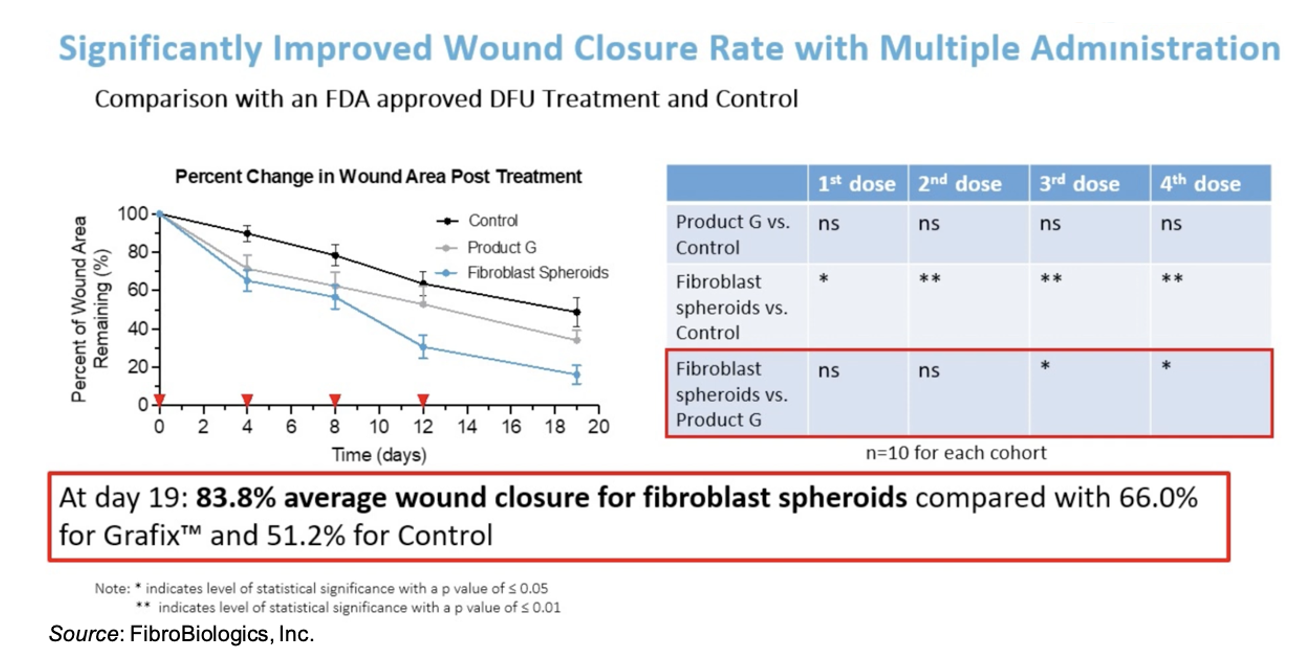
FibroBiologics has compiled a robust pre-clinical data set showing the efficacy of fibroblast spheroids in the treatment of wounds. For example, the following figure shows results using a diabetic mouse model in which administration of fibroblasts led to a statistically significant average 83.8% wound closure by Day 19 compared to 66.0% for Grafix™ and only 51.2% for control.
While wound healing is important, the quality of the wound healing is just as important. FibroBiologics has data on seven key biomarkers that are key to demonstrating the quality of the wound healing. Fibroblast treatment shows much better re-epithelialization, granulation, cell proliferation, neo-vascularization, recruitment and proliferation of fibroblasts, keratinocyte migration, and epithelial-mesenchymal transition. Intriguingly, even though the fibroblast spheroids are administered topically, there appears to be a systemic effect on cytokine levels, including IL-6, TNF-α, IL-1β, and IL-10.
The use of fibroblast spheroids for wound healing can be thought of as a platform technology. In addition to the treatment of DFUs, fibroblast spheroids could also be used for the treatment of burns and surgical wounds.
In regard to safety, the company has performed a number of experiments to examine any potential adverse events associated with fibroblast-based therapy. The cells do not graft into tissue. Following application, the cells stay on the surface of the wound and initiate the healing process before gradually dying off within four days of treatment. In addition, there is no impact on CBC, WBC, liver function, or kidney function, thus showing that administration of fibroblasts appears to be quite safe.
IND Application Filed for CYPS317 in Psoriasis
In December 2025, FibroBiologics announced the filing of an Investigational New Drug (IND) application with the U.S. FDA seeking regulatory clearance to initiate clinical trials of CYP371 for the treatment of moderate to severe psoriasis. This filing is based in part on positive IND-enabling preclinical results demonstrating the potential for fibroblast spheroids to significantly reduce psoriasis disease severity and relapse in preclinical models. For example, a single dose of CYPS317 was comparable to or better than multiple doses of an anti-IL-23 monoclonal antibody and yielded significant reduction in disease recurrence. Following regulatory clearance of the IND, FibroBiologics intends to pursue a clinical development program for CYPS317 with a near-term goal of initiating first-in-human trials.
IND Application for CYMS101 in Multiple Sclerosis Expected in 1H26
In April 2025, FibroBiologics announced preclinical results using the Cuprizone animal model (Torkildsen et al., 2008) that intravenous fibroblasts can facilitate remyelination. The myelin sheath is the insulating layer around nerve fibers and is critical for proper nerve function. It is often damaged in neurodegenerative diseases such as multiple sclerosis (MS). The company reported a statistically significant increase in myelin expression within seven weeks after both single and multiple dose fibroblast treatments. These results confirm those previously reported by the company, in which remyelination was shown in the Experimental Autoimmune Encephalomyelitis (EAE) animal model. Having a confirmed remyelination effect in two separate animal models is compelling evidence that the company’s fibroblast therapy may have an important impact on the treatment of neurodegenerative diseases.
The company continues to conduct research to fully characterize the mode of action of fibroblasts in the treatment of neurodegenerative disease. We anticipate the filing of an IND application for a Phase 1/2 clinical trial relating to MS in the U.S. in the first half of 2026. The company is likely to seek out a collaboration for the development of CYMS101 either before initiating the Phase 1/2 study or after its completion and, if successful, prior to commencing a Phase 3 program.
Positive Preclinical Results in Degenerative Disc Disease Animal Model
In January 2026, FibroBiologics announced positive preclinical results for a Fibroblast Spheroid-derived Chondrocyte (FSdC) therapy that showed superior improvement in recovering intervertebral disc integrity and preventing degeneration in animal models of degenerative disc disease. The condition affects millions of adults in the United States and is a leading cause of chronic back pain and disability.
In the current studies, the efficacy of FSdC spheroids was compared to 2D fibroblasts and fibroblast spheroids. The data showed that FSdC spheroids achieved the most statistically significant difference from control with a P value of 0.00015, compared to a P value of 0.036 for 2D fibroblasts and 0.068 for fibroblast spheroids. FSdC spheroids also showed the highest level of intervertebral disc height recovery after 12 weeks of treatment compared to the other two fibroblast therapies. These results suggest FSdC spheroids may offer disease-modifying effects and not just alleviation of symptoms, based on their ability to sustain the highest average disc size index across all time points. In addition, these results de-risk the platform as it advances toward clinical trials and support an additional pipeline indication for the company’s fibroblast-based technology.
The company is planning to amend the IND clearance with the FDA for degenerative disc disease to replace single-cell fibroblasts with fibroblast-derived chondrocyte spheroids derived from the CYWC628 master cell bank by the end of 2026.
Canadian Patent Issued Covering Fibroblast-Based Treatment for Cachexia
FibroBiologics has an extensive intellectual property portfolio that has continued to grow, with the most recently announced patent being from the Canadian Intellectual Property Office for Canadian Patent No. 3118732, titled “Treatment of Cachexia Using Fibroblast Cells and Products Thereof”. Cachexia is a metabolic syndrome characterized by severe weight loss, muscle wasting, and inflammation. It is commonly associated with diseases such as cancer, HIV/AIDS, and chronic obstructive pulmonary disease (COPD). The patent covers the use of immune-modulating fibroblasts that express specific stem cell markers and are cultured to enhance their ability to suppress inflammation.
Financial Update
On February 24, 2026, FibroBiologics announced financial results for 2025. As expected, the company did not report any revenues in 2025. Research and development expenses were approximately $7.4 million in 2025, compared to approximately $4.5 million in 2024. The increase was primarily due to increased drug product expenses and other expenses to prepare for the Phase 1/2 clinical trial in DFU patients, along with hiring of additional personnel. General and administrative expenses were approximately $9.2 million in both 2025 and 2024, with increases in professional expenses and office expenses offset by decreases in offering and listing expenses, along with decreased insurance costs.
FibroBiologics exited 2025 with approximately $4.9 million in cash and cash equivalents. During 2025, the company raised approximately $7.6 million and also repaid all outstanding debt. As of February 24, 2026, FibroBiologics had approximately 67.6 million common shares outstanding and, when factoring in stock options and warrants, a fully diluted share count of approximately 103.3 million.
Conclusion
We look forward to the initiation of the Phase 1/2 clinical trial of CYWC628 in the first half of 2026, interim results for that study potentially in mid-2026, topline results before the end of 2026, IND clearance for CYPS317 for the treatment of psoriasis, and an IND filing for CYMS101 for the treatment of MS in the first half of 2026. With no changes to our model, our valuation remains at $6.50 per share.
SUBSCRIBE TO ZACKS SMALL CAP RESEARCH to receive our articles and reports emailed directly to you each morning. Please visit our website for additional information on Zacks SCR.
DISCLOSURE: Zacks SCR has received compensation from the issuer directly, from an investment manager, or from an investor relations consulting firm, engaged by the issuer, for providing research coverage for a period of no less than one year. Research articles, as seen here, are part of the service Zacks SCR provides and Zacks SCR receives payments totaling a maximum fee of up to $50,000 annually for these services provided to or regarding the issuer. Full Disclaimer HERE.