By John Vandermosten, CFA
NASDAQ: HURA
READ THE FULL HURA RESEARCH NOTE
Interim Readout for IFx-2.0 Phase Ib/IIa Open-Label Study
TuHURA (NASDAQ:HURA) presented first data from its IFx-2.0 Phase Ib/IIa study in deep-seated Merkel cell carcinoma (MCC) patients while attending the European Society for Medical Oncology (ESMO) conference. TuHURA held a call in parallel with the event hosted by Rodman & Renshaw analyst Michael King for investors and stakeholders on October 26th to disseminate their findings.
TuHURA’s CEO, James Bianco, presented initial data from the first three patients in its open-label study of IFx-2.0 as an adjunctive therapy to Keytruda in first-line treatment of metastatic MCC. The study is listed on the clinicaltrials.gov website under the NCT06940440 designator. Each patient addressed in the presentation achieved an objective anti-tumor response, with all three responses meeting the criteria for partial response (PR) under RECIST v.1.1 criteria. All responses were durable, as each of the responses were ongoing at the protocol-specified six-month assessment.
The trial was designed to initially enroll a total of nine patients with visceral tumors including hepatic, pulmonary or retroperitoneal or other deep-seated locations using computed tomography (CT) or ultrasound guided administration where standard-size injection needles are unable to effectively administer the intended dose of IFx-2.0.
Enrolled patients present deep-seated MCC tumors and have measurable disease and no prior treatment with a checkpoint inhibitor. In the IFx-2.0 Phase Ib/IIa trial, these patients will be injected in a single lesion with IFx once per week for three consecutive weeks with the injection guided by CT and/or ultrasound. Keytruda (pembrolizumab) or avelumab were administered to the treated patients along with IFx within 48 hours of the first IFx injection.
Dr. Bianco summarized the response in three patients, including a 78-year-old male, a 79-year-old female and a 61-year-old female. The patients presented a variety of MCC tumor sites that include the gluteal region, below the jaw and in the right lower extremity. Investigators have observed similar responses in these individuals.
A fourth patient, identified as an 88-year-old male, presented a preliminary response following administration of IFx to liver lesions. Dr. Bianco felt that this patient would also be a responder when measured at the upcoming 12-week mark; however, no RECIST response was recorded.
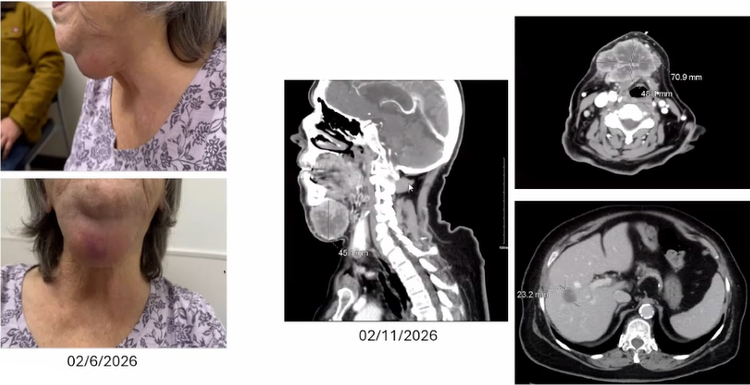
Of the patients referenced, the female patient with the tumor below her jaw showed a visually dramatic improvement following the treatment with IFx. Photographs and scans are provided on the following page, which demonstrate the marked change between the baseline, pre-treatment, CAT scan and the post-treatment scan. In the photographs on the left side of Exhibit I, the patient has a large mass below her jaw. The tumor was blocking her esophagus, making eating and swallowing difficult.
Exhibit I – Participant 1020-1, IFx-2.0 Pre-Treatment
Source: TuHURA Phase Ib/IIa Data Call at ESMO
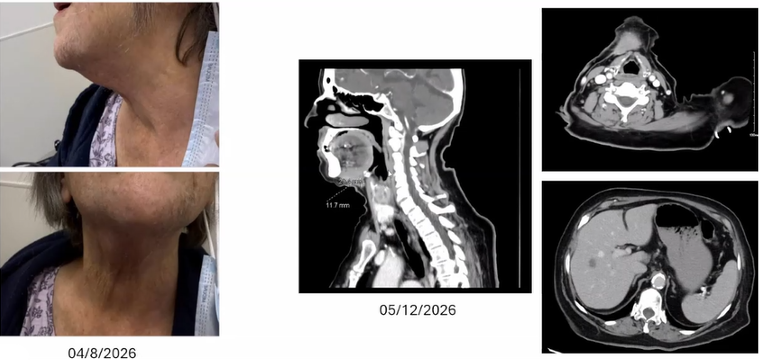
At week 12, following initial treatment, additional photographs and scans were taken. They show substantial shrinkage of the tumor. The tumor appears to be gone and the patient was able to swallow normally. Dr. Bianco asserted that this represented an example of IFx providing a true clinical benefit.
Exhibit II – Participant 1020-1, IFx-2.0 Post-Treatment
Source: TuHURA Phase Ib/IIa Data Call at ESMO
None of the four patients included in the interim update presented a serious adverse event (SAE) or suffered from immune related toxicities. Only Grade 1 and 2 non-immune related toxicities were observed. There were no Grade 3 or greater adverse events observed in the four patients evaluated as of the cutoff date.
If additional findings remain favorable, TuHURA plans to discuss the trial data with the FDA to determine whether it could support inclusion of patients with deep-seated tumors in its ongoing Phase III trial. Dr. Bianco believes that, if 80% of the patients that enroll in the trial show a meaningful response, this outcome would be sufficient to support a modification of the Phase III trial protocol to allow for an expansion of the population. The conversation would revolve around how many additional patients would be needed to show safety, feasibility and efficacy. If the supplement to the trial protocol was able to be modified at the time of the filing, the addressable population could increase by up to 30% according to management’s guidance.
TuHURA expects to have at least 12 weeks of data for the anticipated 12 patients by mid-year 2027.
IFx-2.0 Phase III Placebo-Controlled Trial
As the call concluded, TuHURA provided an update on timing for the Phase III IFx-2.0 trial. This trial is listed on the clinicaltrials.gov website under the designator NCT06947928. Dr. Bianco noted that the company was initially focusing on 25 sites and has now activated 22 of them. There are another 21 that are in the process of coming online. This effort supports the effort to complete enrollment in the second half of 2027, likely at the end of the third quarter or early in the fourth quarter. Some of the enrollment is taking place in Australia.
Hierarchical Step-Down Statistical Approach
An important statistical note related to the Phase III trial design is its hierarchical step-down, stepwise design (also described as fixed-sequence hierarchical testing) that preserves alpha. We take a proverbial sidebar in this note to explain. This approach is favored by the investigators as there is no statistical reduction from including multiple endpoints. Clinical trials usually test more than one hypothesis and each additional test raises the chance of a false positive. If an investigator runs k independent tests at α = 0.05, the family-wise error rate (FWER) climbs to roughly 1 − (0.95)k. Regulators, such as the FDA and EMA, require that the FWER be controlled at 0.05 across the hypotheses that support a claim. Hierarchical testing is one way to do that.
Before unblinding, the sponsor pre-specifies an ordered list of hypotheses in the statistical analysis plan (SAP). Hypothesis one (H1 - primary), two (H2), and three (H3) and so on. Test H1 at the full α = 0.05. If H1 is significant (p ≤ 0.05), the full α “passes down” and H2 is tested at the full 0.05. Continue down the chain. At the first failure (p > 0.05), testing stops. Everything below that point is treated as exploratory, and nominal p-values there carry no confirmatory weight.
The FWER is controlled because, under any configuration of true nulls, a false positive can only occur if the first true null in the sequence is rejected. Each hypothesis is tested only if all those before it were rejected, so the chance of a type I error is capped at 0.05 in total, not 0.05 per test. No alpha is spent on H2 and H3 unless H1 succeeds, so no alpha is taken away from H1.
For example:1
| Step | Hypothesis | Test Level | Result | Outcome |
|---|
| 1 | ORR (primary) | 0.05 | p = 0.012 | Pass; proceed |
| 2 | PFS (key secondary) | 0.05 | p = 0.031 | Pass; proceed |
| 3 | DoR | 0.05 | p = 0.048 | Pass; proceed |
| 4 | QoL score | 0.05 | p = 0.09 | Fail; stop |
Anything below step 4 would not be statistically significant. If PFS had generated a p = 0.06, the OS and ORR results, even at p = 0.001, could not be claimed as statistically significant in the confirmatory sense.
SUBSCRIBE TO ZACKS SMALL CAP RESEARCH to receive our articles and reports emailed directly to you. Please visit our website for additional information on Zacks SCR.
DISCLOSURE: Zacks SCR has received compensation from the issuer directly, from an investment manager, or from an investor relations consulting firm, engaged by the issuer, for providing research coverage for a period of no less than one year. Research articles, as seen here, are part of the service Zacks SCR provides and Zacks SCR receives payments totaling a maximum fee of up to $50,000 annually for these services provided to or regarding the issuer. Full Disclaimer HERE.
1 Endpoints 3 and 4 do not reflect TuHURA’s Phase III endpoints and are included as an illustrative example.