By John Vandermosten, CFA
NASDAQ: HURA
READ THE FULL HURA RESEARCH REPORT
Operational and Financial Results
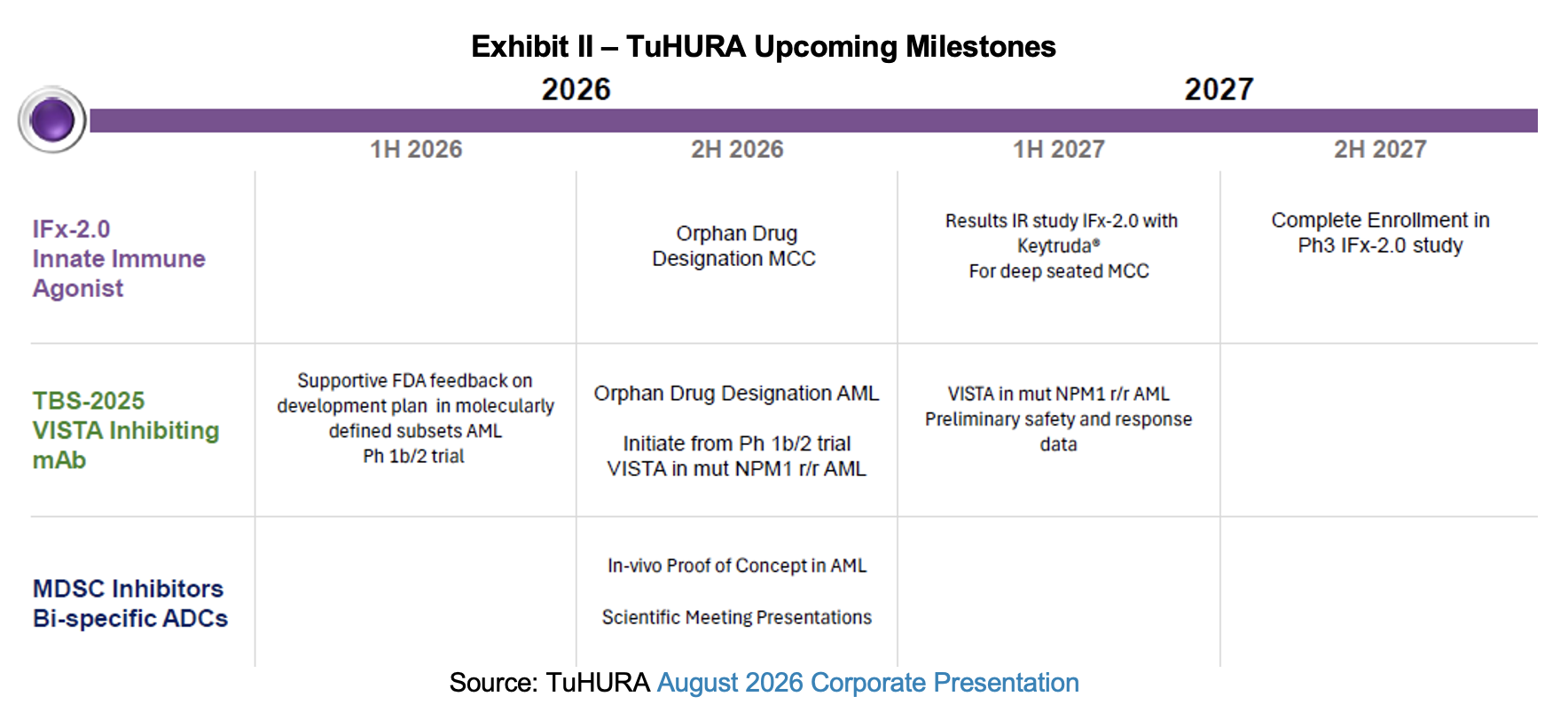
On August 14th, 2026, TuHURA Biosciences, Inc. (NASDAQ: HURA) reported 2Q:26 financial and operational results and filed its Form 10-Q with the SEC. There have been several updates since the previous update in May, most notably the filing of the Investigational New Drug (IND) application for TBS-2025 in June. In August, CEO Dr. James Bianco presented at the Canaccord Genuity Growth Conference, providing an excellent summary of TuHURA’s pipeline programs. We look ahead to the TBS-2025 IND clearance and the start of the related Phase Ib/II trial, orphan drug designation for IFx-2.0 in Merkel cell carcinoma (MCC), and initiation of antibody drug conjugate (ADC) in vivo proof-of-concept studies in 2H:26.
TuHURA generated no revenues in 2Q:26 and expended $8.8 million on operational activities related to advancing IFx-2.0, TBS-2025, and other programs, producing a net loss of $9.2 million or $0.14 per share. For the quarter ending June 30th, 2026, and versus the same prior period:
- Research & development expense totaled $6.6 million, increasing 34% from $4.9 million on higher expenditures on the IFx-2.0 and TBS-2025 programs. Personnel and facilities costs also increased by double digits and were partially offset by a decline in preclinical research costs;
- General & administrative expense totaled $2.1 million, falling 57% from $4.9 million. The change was predominantly due to the absence of acquisition-related costs in 2Q:26.[1] Core G&A expenses were up modestly due to increases in non-cash stock compensation and public company costs;
- Net interest expense was $460,000 compared to net interest income of $29,000, with the change due to the Parkview credit facility;
- Net loss was $9.2 million or $0.14 per share.
As of June 30th, 2026, TuHURA held $1.0 million in cash and $8.8 million of revolving credit facility-related borrowings on its balance sheet. The borrowings included the $5 million commitment fee that was later paid in shares. Cash burn for the first six months of 2026 was $13.2 million. Net cash generated from financing sources was $10.6 million, which consisted of proceeds from common stock issuance and the revolving credit facility, offset by cash dividend and capital raising-related expenses. Following the end of the quarter, TuHURA raised about $2.6 million from additional borrowings on the Parkview facility and proceeds from the at-the-market (ATM) facility with HC Wainwright.
$50 Million Credit Facility
On April 22nd, 2026, TuHURA announced that it had entered into a loan agreement with Parkview Holdings One providing a $50 million revolving credit facility. Parkview is an affiliate of TuHURA’s largest stockholder, K&V Investment One LLC. The agreement provides for a maximum of $50 million in borrowing at an annual rate of 12%. TuHURA may draw $1.7 million per month or agreed budgeted monthly expenses from the facility. Access to the funds is expected to provide sufficient capital to support operations into 1Q:28 without contributions from other sources. If TuHURA defaults, an additional 6% will be added to the interest rate. If TuHURA generates profits, under certain conditions it must allocate 75% of the net profits to repay the loan.
Under the loan agreement, TuHURA must pay a one-time loan commitment fee of $5 million, or 10% of the total commitment. The fee was paid in 1.88 million loan fee shares issued to Parkview. It must also pay an annual cash facility fee of 1.5% of the total commitment, which is equal to $750,000 annually. The arrangement also amends the terms of 4,364,873 warrants held by K&V, extending the warrant life until April 2031. Parkview may appoint a director to the company’s board. Parkview is also granted a low- to mid-single-digit royalty on sales of up to $450 million in sales that will continue until the last patent protecting IFx-2.0 expires. Additional details of the arrangement are included in the April 22nd, 2026, Form 8-K filing and related exhibits.
Anti-VISTA (TBS-2025) Program
TuHURA added the anti-VISTA program to its pipeline with the acquisition of Kineta in the summer of 2025. Designated TBS-2025, the candidate is a VISTA-blocking immunotherapy designed to reverse immunosuppression in the tumor microenvironment (TME). It is a fully-human engineered IgG1 monoclonal antibody that was designed to bind to VISTA through a unique epitope at physiologic and acidic pH levels. The product is being developed as an intravenous infusion. Under TuHURA’s aegis, TBS-2025 is expected to be the subject of a Phase Ib/II trial in patients with relapsed/refractory (r/r) mutated nucleophosmin 1 (mutNPM1) Acute Myeloid Leukemia (AML). TuHURA has been speaking with the FDA about the trial design and has received helpful feedback regarding the safety component of the trial. In June, an Investigational New Drug (IND) application was refiled with the FDA, which is expected to be cleared in September. The timeline should support the launch of the Phase Ib/II trial in 2H:26.
Phase III IFx-2.0 Trial in MCC
TuHURA launched its pivotal Phase III study for its IFx-2.0 candidate in Merkel cell carcinoma (MCC) in June 2025. In the latest earnings report, TuHURA provided its latest set of milestones for the program. They include obtaining Orphan Drug Designation for IFx-2.0 in MCC in 2H:26, reporting preliminary data from the Phase Ib/IIa study of IFx-2.0 in 1H:27 and completion of enrollment by 2H:27. TuHURA anticipates having over 35 sites open by year-end and all 48 sites up by 1Q:27. The IFx-2.0 Phase II trial is also underway, which is evaluating patients with deep-seated MCC tumors. It has enrolled four patients and expects up to seven by year-end.
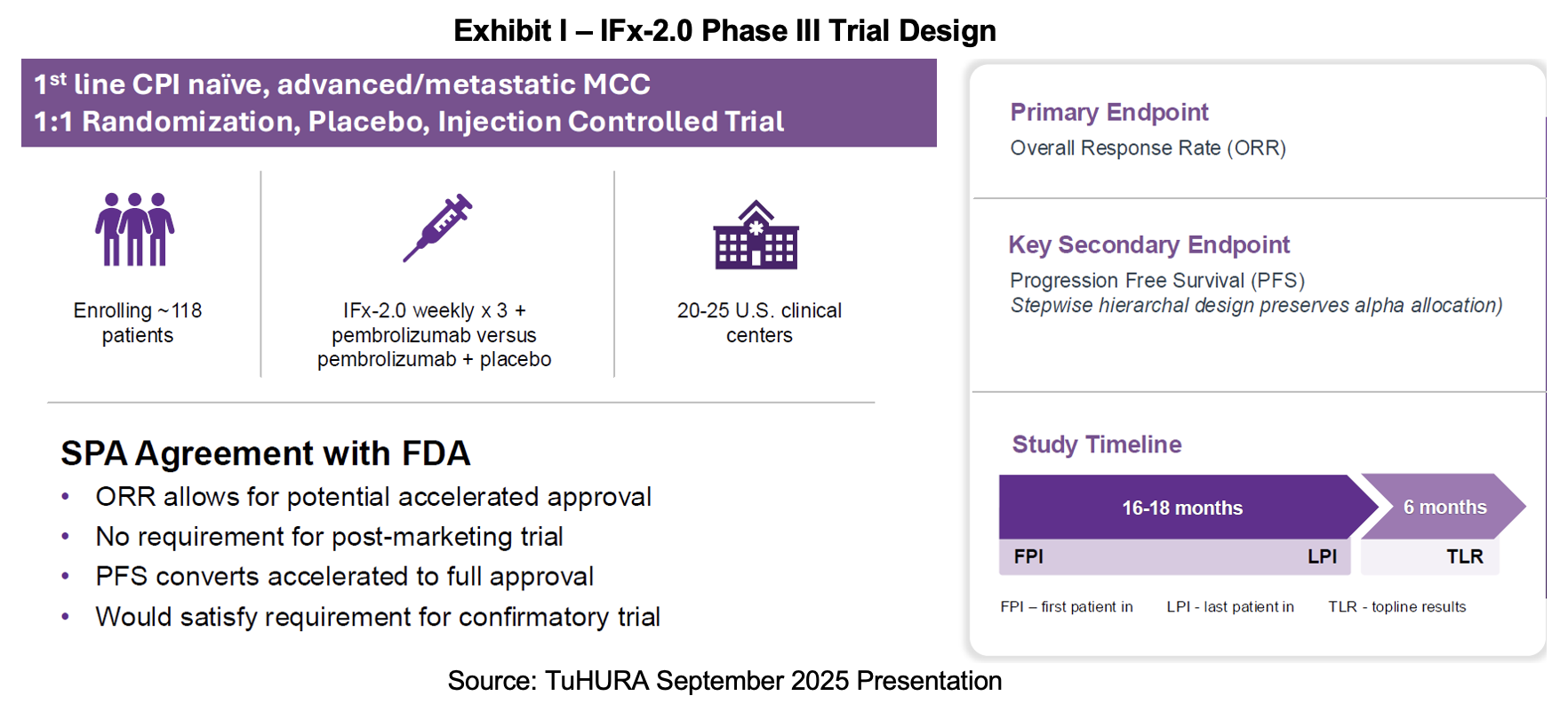
IFx-2.0 will prepare for a biologics license application (BLA) using the FDA’s accelerated approval program under a special protocol assessment (SPA). The trial was designed with the input of the FDA’s Oncology Center of Excellence (OCE). Accelerated approval allows the sponsor to use surrogate endpoints that predict clinical benefit. In most cases, an accelerated approval will require post-market confirmatory trials to verify the clinical benefit. However, in this case, the FDA has indicated that secondary endpoints that demonstrate clinical benefit may be used. If successfully achieved, the trial may satisfy the requirements for full approval.
MDSC Inhibitor Program
TuHURA is preparing its MDSC Inhibitor program for the clinic. It is an early preclinical, immune-modulating conjugate platform built around antagonizing the delta opioid receptor (DOR) on immunosuppressive myeloid cells. In contrast to conventional antibody drug conjugate (ADC) programs that employ a cytotoxic payload, the DOR ligand / inhibitor functions as the MDSC-targeting arm, while a checkpoint antibody, expected to be anti-VISTA/TBS-2025, serves as the immune-effector component. The company has not yet disclosed an IND, named the clinical candidate, or compiled an animal efficacy package. In the second half of 2026, TuHURA anticipates conducting in vivo proof-of-concept work in AML and presenting at scientific meetings.
Upcoming Milestones
SUBSCRIBE TO ZACKS SMALL CAP RESEARCH to receive our articles and reports emailed directly to you. Please visit our website for additional information on Zacks SCR.
DISCLOSURE: Zacks SCR has received compensation from the issuer directly, from an investment manager, or from an investor relations consulting firm, engaged by the issuer, for providing research coverage for a period of no less than one year. Research articles, as seen here, are part of the service Zacks SCR provides and Zacks SCR receives payments totaling a maximum fee of up to $50,000 annually for these services provided to or regarding the issuer. Full Disclaimer HERE.
________________________
[1] Our review uses originally reported data for comparisons.