By David Bautz, PhD
NASDAQ: LABT
READ THE FULL LABT RESEARCH REPORT
Business Update
First Patient Dosed in Phase 2a Trial of Nu-3 in Infected Diabetic Foot Ulcers
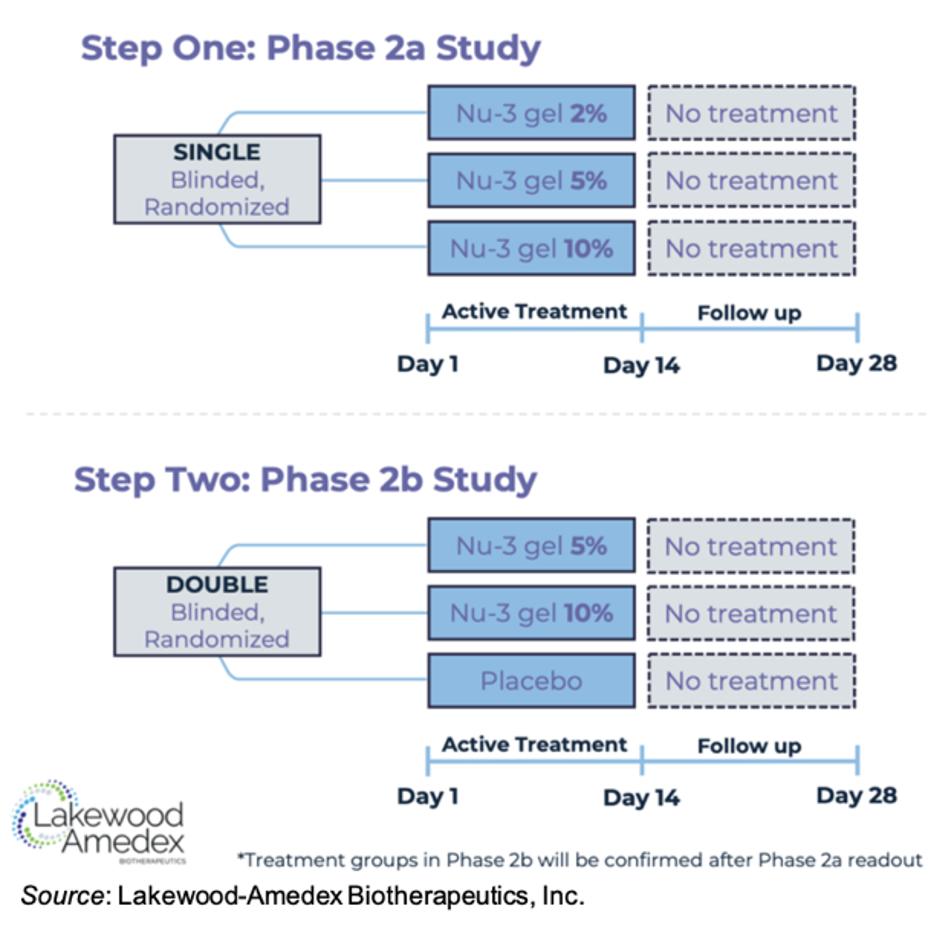
On September 24, 2026, Lakewood-Amedex Biotherapeutics (NASDAQ: LABT) announced the first patient dosed in the Phase 2a clinical trial of Nu-3 for the treatment of infected diabetic foot ulcers (iDFU). The trial will evaluate three different doses of Nu-3 gel (2%, 5%, and 10%) in non-hospitalized, diabetic patients with signs of a localized, mild foot infection (NCT07565506). Patients will be treated once daily for 14 days. The primary outcomes of the study will be safety and efficacy, as measured by a reduction in CFUs ≥ 2 logs per pathogen identified at Day 7 and Day 14 compared to Day 0. We anticipate topline results in the first quarter of 2027. An overview of the study, along with the planned Phase 2b trial, is given below.
The company recently announced positive findings from an in vitro Minimum Inhibitory Concentration (MIC) study of recent clinical isolates for Nu-3. The isolates were obtained from 14 clinical sites across the U.S. from patients suffering from DFUs. Lakewood evaluated the bactericidal activity of Nu-3 against multiple resistant pathogens, including resistant and susceptible Staphylococcus aureus (MRSA and MSSA, respectively) and Enterococcus faecalis (VRE and VSE, respectively). The results showed the MIC values were 2-8 times lower than the planned doses for the clinical trials.
In support of the upcoming Phase 2a study, Lakewood recently announced positive preclinical safety data supporting selection of the Phase 2a doses. Nu-3 was well tolerated at dose levels substantially above those planned for clinical evaluation, with very low systemic exposure and no evidence of impaired wound healing. The results, together with in vitro and animal efficacy data, support evaluation of the 2%, 5%, and 10% gel concentrations in the upcoming Phase 2a study. These safety findings are important to the company as they further reduce a key preclinical hurdle ahead of clinical testing.
Lakewood also recently highlighted additional in vitro data supporting Nu-3’s potential to address antimicrobial resistance. Nu-3 did not induce resistance in a serial passage experiment and demonstrated activity against bacteria carrying a range of resistance mechanisms, including antibiotic target modification, drug metabolizing enzymes, and efflux mechanisms. While these findings remain preclinical, they are consistent with the proposed physical mechanism of action of the Bisphosphocin platform and reinforce the potential differentiation of Nu-3 in the iDFU setting.
Diabetic Foot Ulcers
DFUs affect approximately 19 million individuals worldwide, with approximately 1.6 million in the U.S. (Armstrong et al., 2023). It’s estimated that approximately 19-34% of patients with diabetes will develop a foot ulcer during their lifetime, and the incidence rate for recurrence is 40% within one year and 65% within five years (Armstrong et al., 2017). Two of the leading risk factors for developing foot ulcers are peripheral neuropathy (sensory, motor, and autonomic) and peripheral vascular disease. These conditions can combine to cause alterations to a patient’s foot and decrease their awareness to injuries, thus resulting in ulcer formation.
Standard treatment for DFUs includes debridement, off-loading, managing any infection, moisture control, and adequate glycemic control. Chronic foot ulcers that are resistant to treatment are the precursors to amputation in 80% of cases. Approximately 50-60% of ulcers become infected (iDFU) and require broad spectrum antibiotics, with 20% of moderate to severe infections leading to lower extremity amputations. A recent meta-analysis showed the overall prevalence of MRSA in DFU was 17% (Zhou et al., 2024). Another study showed that approximately 60-80% of iDFUs involve the formation of biofilms, thus contributing to the ineffectiveness of oral antibiotic therapy (Pouget et al., 2020). Tragically, diabetics who develop a foot ulcer have a 5-year mortality rate of approximately 30%, which then exceeds 70% for those with an amputation (Armstrong et al., 2023). Hence, the necessity to quickly treat iDFUs is of the utmost importance for a patient’s health.
Conclusion
The initiation of the Phase 2a trial of Nu-3 in iDFUs is an important milestone for Lakewood and we look forward to topline results in the first quarter of 2027. This trial will be the first clinical test of Nu-3, thus, we will be interested to see whether the encouraging preclinical efficacy and safety profile of Nu-3 can translate into clinical success. With no changes to our model, our valuation remains at $12 per share.
SUBSCRIBE TO ZACKS SMALL CAP RESEARCH to receive our articles and reports emailed directly to you. Please visit our website for additional information on Zacks SCR.
DISCLOSURE: Zacks SCR has received compensation from the issuer directly, from an investment manager, or from an investor relations consulting firm, engaged by the issuer, for providing research coverage for a period of no less than one year. Research articles, as seen here, are part of the service Zacks SCR provides and Zacks SCR receives payments totaling a maximum fee of up to $50,000 annually for these services provided to or regarding the issuer. Full Disclaimer HERE.