By David Bautz, PhD
NASDAQ: LABT
READ THE FULL LABT RESEARCH REPORT
Business Update
Nu-3 Phase 2a Trial Continues; Topline Data in 1Q27
Lakewood-Amedex Biotherapeutics (NASDAQ: LABT) is currently conducting a Phase 2a clinical trial of Nu-3 for the treatment of mildly infected diabetic foot ulcers (DFUs). The first patient was dosed in September 2026 and we anticipate topline results in the first quarter of 2027.
The Phase 2a study is designed as a dose-comparison trial to evaluate Nu-3 dosing and administration in patients with mildly infected DFUs. The objective is to establish an initial clinical proof of concept and generate information that will guide subsequent clinical development. It is evaluating three different doses of Nu-3 gel (2%, 5%, and 10%) in non-hospitalized, diabetic patients with signs of a localized, mild foot infection (NCT07565506). Patients will be treated once daily for 14 days. The primary outcomes of the study will be safety and efficacy, as measured by a reduction in CFUs ≥ 2 logs per pathogen identified at Day 7 and Day 14 compared to Day 0. An overview of the study, along with the planned Phase 2b trial, is given below.
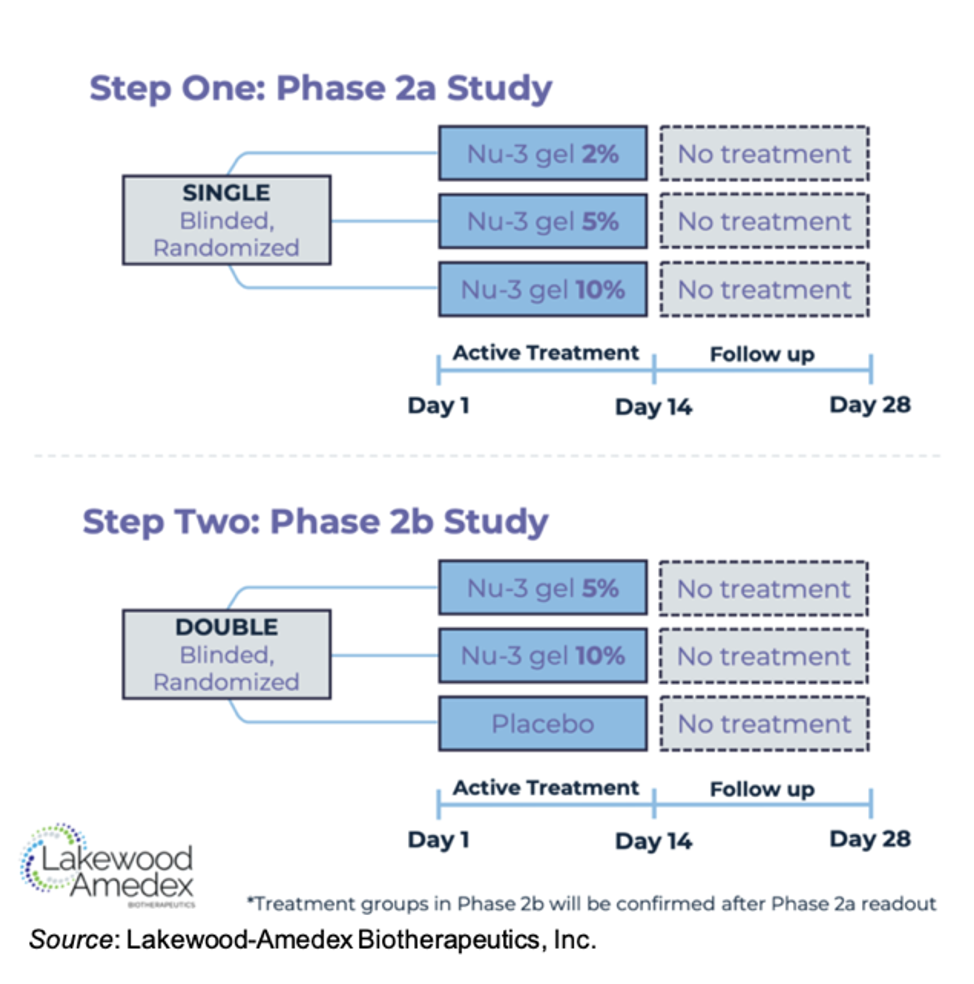
The topline results of the Phase 2a trial are the most important near-term catalyst for Lakewood-Amedex, as it will provide the first opportunity to evaluate the therapeutic potential of Nu-3 in the target patient population. DFUs are particularly challenging to manage when infection develops, as patients frequently have impaired circulation, compromised wound healing, and an increased risk of hospitalization and lower-extremity amputation. Treatment typically involves wound debridement, off-loading, wound care, and systemic antibiotics when necessary. However, antibiotic resistance and the formation of bacterial biofilms can complicate infection management, particularly in chronic wounds that fail to respond adequately to conventional treatment.
The upcoming Phase 2a results will be important not only for evaluating the clinical potential of Nu-3 but also for determining whether the favorable antimicrobial characteristics observed in preclinical studies translate into meaningful clinical activity. We will be particularly interested in the relationship between dose and antimicrobial response, the ability of Nu-3 to reduce bacterial burden, safety and tolerability, and whether the results support advancement into the larger, placebo controlled Phase 2b study.
Presentation at IDWeek 2026
In October 2026, Lakewood-Amedex announced the presentation of new research highlighting the antimicrobial properties of Nu-3 at IDWeek 2026. The poster, titled “Nu-3 – A Novel, Broad Spectrum Antimicrobial Compound with High In-Vitro Activity Against Resistant Pathogens for the Treatment of Infected Diabetic Foot Ulcers”, presented findings demonstrating broad-spectrum antimicrobial activity, rapid bactericidal effects, and a favorable resistance profile against clinically relevant pathogens.
Interestingly, Nu-3 demonstrated rapid bacterial eradication against tested Gram-positive, Gram-negative, and multidrug-resistant organisms, with bacterial killing occurring within ten minutes in certain experiments. The compound also demonstrated activity against biofilm-forming organisms, an important characteristic given the role that biofilms can play in persistent infections and treatment resistance in chronic wounds. An estimated 15% to 25% of infected DFUs involve resistant organisms, primarily methicillin-resistant S. aureus (MRSA), thus highlighting the potential relevance of Nu-3’s activity against resistant pathogens.
The presentation also included serial-passage experiments evaluating the potential for bacteria to develop resistance following repeated exposure to Nu-3. Over the course of the experiments, the minimum inhibitory concentration (MIC) for Nu-3 increased only slightly against Staphylococcus aureus and Escherichia coli. In comparison, ciprofloxacin demonstrated a substantially greater increase in MIC, ranging from approximately 600-fold to 2,000-fold. These findings suggest that Nu-3 may have a relatively low propensity for resistance development compared with conventional antibiotics.
Positive Preclinical Data in Urinary Tract and Pulmonary Infections
In October 2026, Lakewood-Amedex announced positive preclinical findings supporting the potential application of its Bisphosphocin compounds in urinary tract and pulmonary infections. The results expand the potential development opportunities for the platform beyond DFUs and provide additional evidence supporting the company’s strategy of developing locally administered antimicrobial therapies for infections involving resistant bacteria and biofilms.
In a rodent model of urinary tract infection, intravesical administration of Nu-8, another compound in the Bisphosphocin class, resulted in up to 97% inhibition of E. coli growth following administration of a 10% solution. The vehicle control group demonstrated no meaningful inhibition of bacterial growth. In addition to the in vivo findings, Bisphosphocin compounds have demonstrated in vitro activity against several resistant bacteria commonly associated with urinary tract infections (UTIs), including E. coli, Klebsiella pneumoniae, and Pseudomonas aeruginosa. The compounds have also demonstrated activity against biofilm-forming organisms, which are particularly relevant in complicated UTIs and catheter-associated UTIs (CAUTIs).
The company also reported positive findings in pulmonary infection models. Bisphosphocin compounds administered using an aerosol formulation demonstrated in vivo activity in animal models of pulmonary infections caused by Acinetobacter species, P. aeruginosa, and Aspergillus fumigatus. Additionally, in vitro testing demonstrated activity against a range of resistant bacteria commonly associated with pulmonary infections, including Haemophilus influenzae, K. pneumoniae, and P. aeruginosa.
These results are encouraging evidence of the broader potential of the Bisphosphocin platform. The ability to formulate compounds for intravesical or aerosol administration could allow Lakewood-Amedex to pursue multiple localized infection indications using the same underlying antimicrobial technology. Both complicated UTIs and pulmonary infections represent areas of substantial unmet medical need, particularly among patients with infections caused by resistant organisms or biofilm-forming bacteria.
Financial Update
On November 16, 2026, Lakewood-Amedex filed form 10-Q with financial results for the third quarter of 2026. As expected, the company did not report any revenues during the third quarter of 2026. R&D expenses in the third quarter of 2026 were approximately $733,000 compared with $753,000 in the third quarter of 2025. The decrease was primarily due to decreased personnel-related expenses partially offset by an increase in clinical and pre-clinical expenses. G&A expenses in the third quarter of 2026 were approximately $776,000 compared to $1.1 million for the third quarter of 2025. The decrease was primarily due to lower personnel-related expenses partially offset by an increase in corporate expenses.
Lakewood-Amedex exited the third quarter of 2026 with approximately $2.8 million in cash and cash equivalents. Subsequent to the end of the quarter, the company announced that it had completed the redemption of all remaining outstanding shares of its Series C Convertible Preferred Stock. The company redeemed 127,097 shares held by Shakawe Capital LLC for $1,270,970, representing the $10.00 face value per preferred share. The redemption eliminated the remaining conversion rights associated with the Series C financing, and the company now has no preferred stock outstanding and no outstanding debt.
As of November 13, 2026, the company had approximately 9.0 million shares outstanding and, when factoring in stock options, a fully diluted share count of 9.1 million shares.
Conclusion
We look forward to the topline data from the Phase 2a trial, which we anticipate in the first quarter of 2027. The October IDWeek presentation and additional preclinical findings in urinary tract and pulmonary infections provide further support for the scientific rationale and potential breadth of the Bisphosphocin platform. Lastly, the Series C redemption has simplified the capital structure, however the stock has been under enormous pressure over the past few months, and as a result we have increased the number of future shares to be issued for financings in our model. As a result, our valuation now stands at $5 per share.
SUBSCRIBE TO ZACKS SMALL CAP RESEARCH to receive our articles and reports emailed directly to you. Please visit our website for additional information on Zacks SCR.
DISCLOSURE: Zacks SCR has received compensation from the issuer directly, from an investment manager, or from an investor relations consulting firm, engaged by the issuer, for providing research coverage for a period of no less than one year. Research articles, as seen here, are part of the service Zacks SCR provides and Zacks SCR receives payments totaling a maximum fee of up to $50,000 annually for these services provided to or regarding the issuer. Full Disclaimer HERE.