By John Vandermosten, CFA
NASDAQ: LEXX
READ THE FULL LEXX RESEARCH NOTE
Lexaria Bioscience Corp. (NASDAQ: LEXX) announced absorption data from its 2026 Animal Study #2 (GLP-1-A26-2). The canine study examined amycretin and retatrutide bioavailability using oral delivery compared to reference formats. 18 different study arms were evaluated, measuring tablets and capsules as well as DehydraTECH (DHT) 2.0 and 3.0 formulations. The study demonstrated greater area under the curve (AUC) of blood plasma concentration. This was the first mention of DHT 3.0, which includes improvements and advancements within DHT’s oil phase processing steps and employs sodium caprate as a permeation enhancer. It also includes other enhancements that Lexaria has not disclosed. Management highlighted the 5-fold improvements in absorption for the Alternative (ALT) 2 DHT 3.0 tablet formulations for amycretin compared to reference DHT 2.0 tablets. We additionally note the best performing 0.26% absolute bioavailability for retatrutide capsules, which outperformed the DHT 2.0 formulation. Tablets were the better delivery form for amycretin, but capsules won out for retatrutide. The reference tablets use Sodium N-[8-(2-hydroxybenzoyl) amino] caprylate (SNAC)[1] technology. There is limited data for amycretin or retatrutide relative bioavailability for oral forms of these drugs from Novo Nordisk or Eli Lilly.
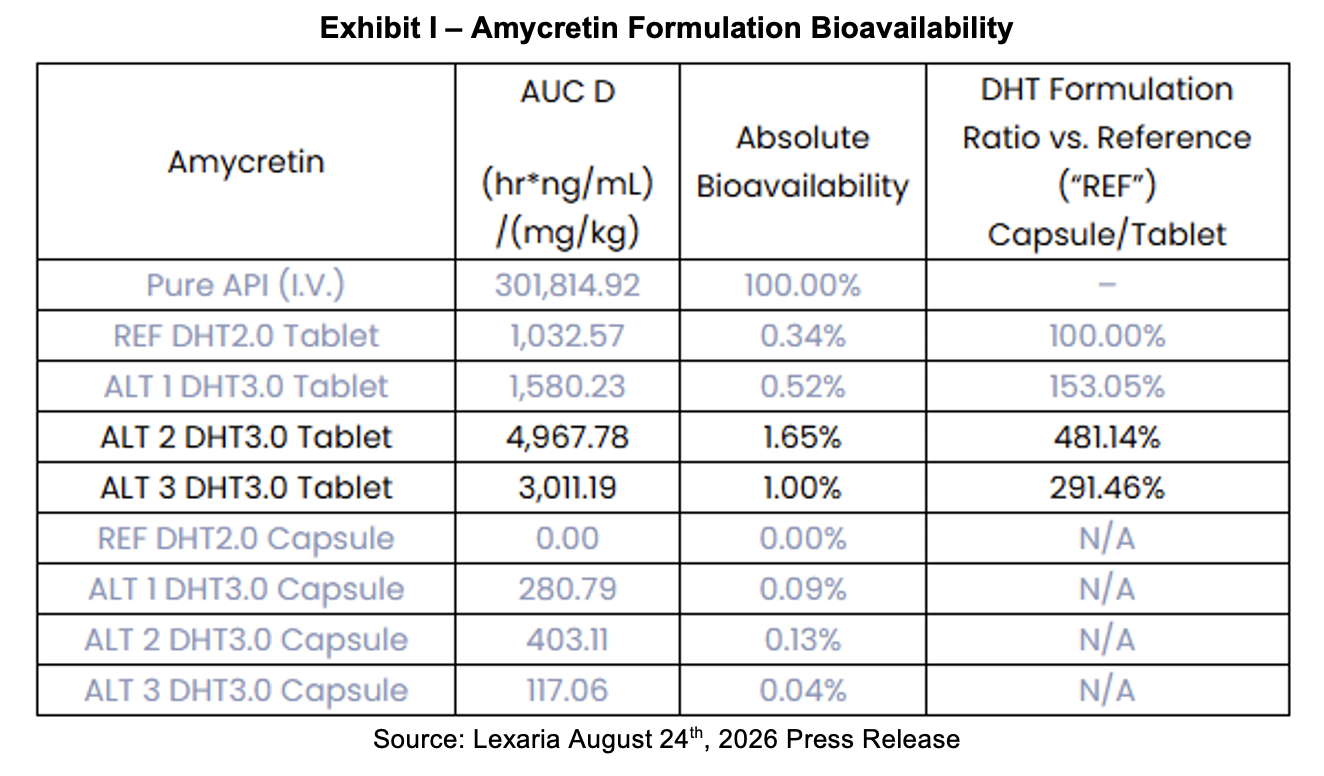
Other formulations that were used in the GLP-1-A26-2 study include potentially complementary commercially available gastrointestinal absorption enhancer compounds such as salcaprozate sodium (SNAC) and sodium caprate. In both the amycretin and retatrutide arms, the DHT 3.0 tablet version outperformed the DHT 2.0 formulations of the respective drug. In the prior exhibit, Lexaria emphasized the ALT 2 and 3 DHT 3.0 tablets, which produced almost 5-fold and 3-fold improvements compared with the reference formulation.
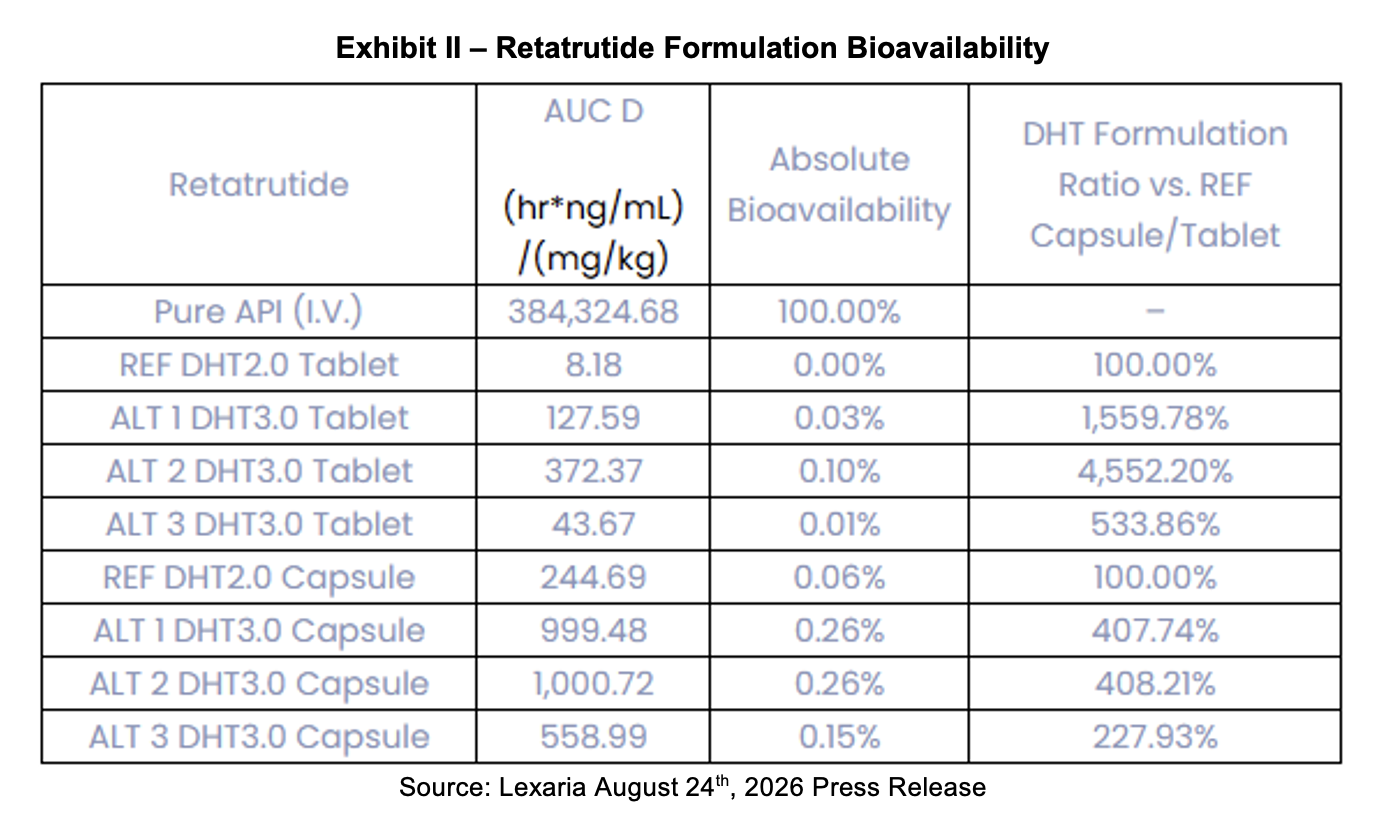
Lexaria investigated the relative bioavailability of oral retatrutide compared with the reference DHT 2.0 tablet, with results shown in the previous exhibit. In its press release, management highlighted the almost 46-fold improvement in bioavailability for the ALT 2 DHT 3.0 tablet relative to the DHT 2.0 SNAC-formulated reference product. However, on an absolute basis, the DHT 3.0 capsule performed better, generating over 4 times the absolute bioavailability as the reference DHT 2.0 capsule in the retatrutide example.
Lexaria’s goal with the new formulations is to support existing and future business development initiatives for GLP-1 and multi-hormone receptor agonists for use in weight loss, diabetes, and potentially other indications. The company has two active MTAs in this area and is seeking others.
Tax Rebate
Lexaria conducted its GLP-1-H24-4 study in Australia, which began in late 2024. On September 1st, 2026, the company announced that it had received a tax rebate of AUD$3.67 million from the Australian government related to these study expenditures. This is equivalent to $2.6 million in US currency. The payment follows Lexaria’s completion of the GLP-1-H24-4 study, a Phase Ib, 12-week chronic human study evaluating the use of DHT-formulations of GLP-1 agonist and cannabidiol (CBD) medicines for weight loss. The funds will support the company’s FY:27 research and development program.
Material Transfer Agreement (MTA) with PegBio
Lexaria announced an MTA with PegBio (HKEX: 2565) in mid-August. It is a commercial and clinical stage biopharmaceutical company based in China that is developing a portfolio of therapies for chronic metabolic diseases, with a primary focus on endocrine and liver disorders. The company’s pipeline includes two GLP-1 agonists, an opioid receptor antagonist, as well as GLP-1/GIP and GLP-1/GIP/glucagon receptor agonists for a broad spectrum of diseases. It specializes in PEGylation technology to create long-acting therapeutics that reduce dosing frequency. PegBio was the subject of an initial public offering (IPO) in May 2025 when it was added to the Hong Kong Stock Exchange. It is trading at a market cap of HKD$2.1 billion, which is about $274 million.
This marks the second MTA for Lexaria. Both arrangements are evaluating assets in the metabolic space, but are not related. PegBio will supply Lexaria with a proprietary GLP-1 molecule, which will then be processed with DHT technology and evaluated for pharmacokinetic performance in animal studies. Lexaria’s introduction to PegBio came from its consultant Liberi Group. When the studies are complete, an update will be provided.
SUBSCRIBE TO ZACKS SMALL CAP RESEARCH to receive our articles and reports emailed directly to you. Please visit our website for additional information on Zacks SCR.
DISCLOSURE: Zacks SCR has received compensation from the issuer directly, from an investment manager, or from an investor relations consulting firm, engaged by the issuer, for providing research coverage for a period of no less than one year. Research articles, as seen here, are part of the service Zacks SCR provides and Zacks SCR receives payments totaling a maximum fee of up to $50,000 annually for these services provided to or regarding the issuer. Full Disclaimer HERE.
________________________
[1] SNAC is a technological innovation that allows the protein-based medication semaglutide to be taken orally rather than by injection. Proteins and peptides (like semaglutide) are typically broken down in the digestive system before they can be absorbed, which is why most similar medications must be injected. SNAC works by creating a localized increase in pH around the drug molecule, protecting semaglutide from enzymatic degradation in the stomach, enhancing the permeability of the gastric mucosa and facilitating absorption of semaglutide through the stomach lining into the bloodstream. This technology was developed by Emisphere Technologies (later acquired by Novo Nordisk) and represents a significant advancement in oral delivery of peptide medications.