By John Vandermosten, CFA
NASDAQ: LEXX
READ THE FULL LEXX RESEARCH NOTE
The Continued March Forward
Over the last two months, Lexaria Bioscience Corp. (NASDAQ: LEXX) has increased its cash balance with a tax refund and warrant exercise, highlighted the shift towards oral GLP-1 formulations, updated stakeholders on both animal and human trials, received additional patent grants and announced a new agreement with an unidentified pharmaceutical company. In this report we summarize the results from the animal study, report progress in the human studies and review Lexaria’s business development activities including a newly announced agreement with a pharmaceutical company.
Receipt of Cash Flows
On September 9th, 2026, Lexaria announced that it had closed the exercise of $5.9 million of warrants. The financial instruments were repriced and new warrants were offered in a private placement. 454,000 warrants were assigned a strike price of $12.92 per share and exercised to generate the $5.9 million in gross proceeds. As an inducement, investors who exercised repriced warrants were additionally issued new warrants (Series A) to purchase another 454,000 shares with a five-year life and new warrants (Series B) to purchase another 454,000 shares with an 18-month life. The exercise price for the Series A and Series B warrants is $12.67.
On September 17th, Lexaria updated its financial position to reflect the receipt of over $2.6 million (AUD$3.667 million) in net proceeds from a tax refund related to trials conducted in Australia. The Land Down Under offers an attractive tax refund equal to 43.5% of eligible research and development expenses incurred. The payment follows Lexaria’s completion of the GLP-1-H24-4 study, a Phase Ib, 12-week chronic human study evaluating the use of DHT-formulations of GLP-1 agonist and cannabidiol (CBD) medicines for weight loss. The funds will support the company’s FY:27 research and development program.
Together with the warrant proceeds, the two items added $7.9 million in net new capital. Management believes the funds will extend Lexaria’s cash runway through 2027. The company does not plan to raise any capital for the remainder of 2026.
Animal Study Results (GLP-1-A26-1)
In an October 15th press release, Lexaria provided comparative data for its DehydraTECH (DHT)-formulated candidates relative to older versions using the same active pharmaceutical ingredient (API). The animal studies compared newly-formulated versions of DHT-cannabidiol (CBD) and DHT-semaglutide (SEMA) to evaluate whether they improved absorption into blood plasma and/or the brain. The study assessed systemic drug exposure and distribution into brain tissue. The brain is especially important as many drug molecules have difficulty crossing or will not cross the blood-brain barrier (BBB).
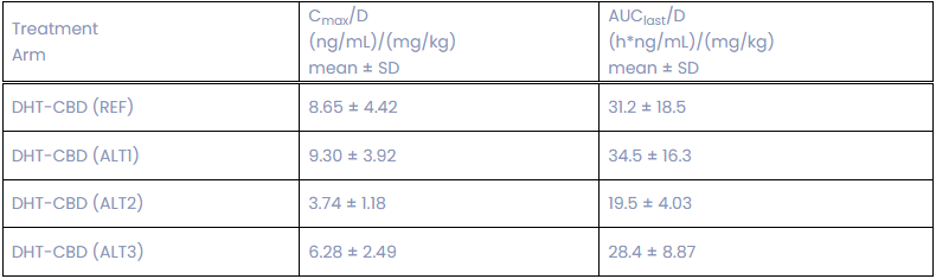
The DHT-CBD study arm included a reference (REF) arm measured against new alternative (ALT) formulations. The REF arm employs one of Lexaria’s best, pharmaceutical-grade, historical formulations. Of the three ALT formulations, ALT1 produced the greatest maximum concentration (CMAX/D) of 9.30 ± 3.92 (ng/mL)/(mg/kg), approximately 0.65 units higher than the REF. The area under the curve until the last measurable concentration (AUClast/D) was 34.5 ± 16.3 (h*ng/mL)/(mg/kg). This was approximately 3.3 units higher than the REF results. Based on the standard deviation, none of the results were statistically significant.
Exhibit I – DHT-CBD Blood Plasma Concentration/AUC Results
Source: Lexaria October 15th, 2026 Press Release
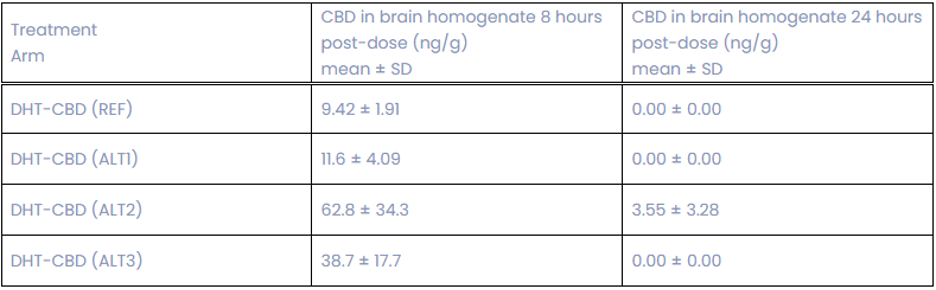
The study also examined the concentration of DHT-CBD in the brain tissue following administration of oral DHT-formulated candidates. The brain tissue results showed a greater magnitude of API concentration than the REF result for all of the ALT formulations in brain homogenate at 8 hours post dose. The ALT2 formulation generated a result 6.7x greater than the reference product. CBD clears from the brain tissue quickly and by 24 hours the measurable CBD in brain homogenate was zero in the REF, ALT1 and ALT3 samples. In the ALT2 sample, investigators measured an average of 3.55 ng/g of CBD, about 5.7% of the concentration found at 8 hours in the same sample.
Exhibit II – DHT-CBD Brain Tissue Concentration Results
Source: Lexaria October 15th, 2026 Press Release
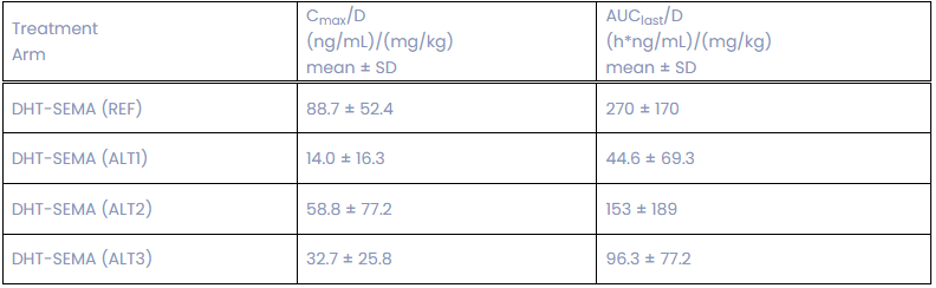
Lexaria also shared the results from the DHT-SEMA arm. In this cohort, none of the ALT formulations generated better concentration results for either the CMAX or AUC measurements compared with the REF arm. Investigators ran the same brain tissue study for SEMA as they did with the CBD group; however, DHT-SEMA concentrations were all below the limit of quantitation. Brain tissue results for DHT-SEMA were not included in the release.
Exhibit III – DHT-SEMA Blood Plasma Results
Source: Lexaria October 15th, 2026 Press Release
The ALT1, ALT2 and ALT3 formulations differed between the CBD and SEMA study arms. Lexaria tested certain prospective formulation enhancement strategies in each case that were tailored to the different active pharmaceutical ingredients of CBD versus SEMA. The goal of this work was to identify promising performance enhancements of DehydraTECH to use in future DHT compositions. The useful takeaway from the GLP-1-A26-1 study was the performance of the DHT-CBD ALT2 formulation in the brain, which produced 6.7x (or 567% greater) the concentration versus the reference formulation.
Study Design
GLP-1-A26-1 employed Sprague-Dawley rats in 11 different study arms using both DHT and non-DHT CBD and SEMA compositions. Blood samples were taken at multiple timepoints at and between the eight- and 24-hour marks post-dosing to quantify the pharmacokinetic performance of each composition in both the blood plasma and the brain.
Human Study GLP-1-H26-7
In an October 21st, 2026 press release, Lexaria announced that its GLP-1-H26-7 human study evaluating DHT-SEMA against Novo Nordisk’s Wegovy tablets had achieved full enrollment. The study was first announced in March 2026. This was followed by the engagement of the contract research organization divulged in an April 1 release and the start of dosing in June as disclosed in a June 25th dispatch.
The investigation intends to evaluate two oral DHT-SEMA compositions against Wegovy tablets. It is designed to have a five-week, parallel group structure, examining three separate arms. The study will assess safety, tolerability and pharmacokinetic properties of salcaprozate sodium (SNAC)-inclusive DHT-SEMA tablet and capsule formulations to commercially available Wegovy tablets. The study will be conducted under fasted pre-dose conditions. The research is exploring several new DHT enhancements that have not been previously evaluated. The five-week dosing duration of the study is expected to be sufficient to achieve steady-state concentrations. Formulation and study-design changes include:
- The use of an oral DHT-SEMA tablet (as opposed to a capsule) that is formulated to temporarily adhere to the stomach lining and release API in a focal manner that helps optimize absorption.
- Both the DHT-SEMA tablet and the capsule test articles will be formulated with SNAC.
The final study arm was fully enrolled and began dosing in early October. It is expected to be complete by mid-November. Data from the study will be analyzed in the laboratory and results reported upon completion.
Agreement Signed with Unidentified Pharmaceutical Company
On November 4th, 2026, Lexaria announced that it had entered into an agreement with a new collaborator. The counterparty was not identified, but is classified as a pharmaceutical company (PharmCo). The two will investigate Lexaria’s DHT technology with one or more proprietary PharmCo molecules. This agreement is separate from the two other relationships that Lexaria has with another unidentified pharmaceutical company and with PegBio. While this arrangement and the PegBio material transfer agreement (MTA) have no stated timeline, the MTA with the first unidentified pharmaceutical company is expected to expire at the end of 2026. We anticipate an update from Lexaria, clarifying whether or not the parties will pursue a closer relationship.
The introduction to PharmCo and PegBio was facilitated through Liberi Group, a consultancy that supports business development in the global life sciences industry. Lexaria first began working with Liberi in October 2025.
Milestones
- CEO Annual Letter – January 2026
- Lexaria annual meeting – January 27th, 2026
- Final results announced for Human Pilot Study #5 – February 2026
- Attendance at BIO International Convention – June 2026
- US Patent 12,691,163 awarded: Compositions and Methods for Treating Diabetes – July 2026
- Material transfer agreement announced with PegBio – August 2026
- Animal study #2 data release (GLP-1-A26-2) – late August 2026
- Receipt of Australian Tax Rebate – September 2026
- Participation at the HC Wainwright Investment Conference – September 2026
- Animal study #1 data release (GLP-1-A26-1) – October 2026
- US Patent 12,758,566 awarded: Compositions and Methods for Treating Diabetes – October 2026
- Canadian patent 3,199,547 awarded: Compositions and Methods for Treating Hypertension – October 2026
- European patent 4522159 awarded: Compositions and Methods for Treating Epilepsy – October 2026
- New agreement executed with pharmaceutical company – November 2026
- Extension of GLP-1 agonist MTA with pharmaceutical company – until December 31st, 2026
- Human pilot study #7 data release (GLP-1-H26-7) – 2027
Summary
Lexaria has moved through the fall period flaunting several feathers in its cap. It has reported results from its animal study, progressed with its human study, added to its cash balance through warrant exercise and receipt of tax rebates while keeping an eye on business development. Now with three arrangements in place, with the latest signed earlier this month, the company is reaching a critical milestone with its first MTA by year end. Lexaria has shown improved bioavailability for its DehydraTECH formulations in many areas including GLP-1 agonists and continues to improve its formulations as shown in the animal data reported in October. The company also announced several additions to its patent portfolio in the US, Canada and Europe which we enumerate in our milestones. With the human trial expected to complete dosing in November and data expected next year, we are eager to see the safety, tolerability and pharmacokinetic data when released.
SUBSCRIBE TO ZACKS SMALL CAP RESEARCH to receive our articles and reports emailed directly to you. Please visit our website for additional information on Zacks SCR.
DISCLOSURE: Zacks SCR has received compensation from the issuer directly, from an investment manager, or from an investor relations consulting firm, engaged by the issuer, for providing research coverage for a period of no less than one year. Research articles, as seen here, are part of the service Zacks SCR provides and Zacks SCR receives payments totaling a maximum fee of up to $50,000 annually for these services provided to or regarding the issuer. Full Disclaimer HERE.