By John Vandermosten, CFA
NASDAQ: LGND
READ THE FULL LGND RESEARCH NOTE
Ligand Pharmaceuticals, Inc. (NASDAQ: LGND) reported second quarter 2026 results boasting total revenue and income of $63.7 million, a 34% year over year increase. Adjusted core earnings per share (EPS) of $2.37 were also impressive, rising 48%. By line item, royalties rose 32%, and contract revenue increased by 161%. Captisol was the odd man out, with a revenue decline of 4% due to timing of customer orders. Since Ligand’s May financial update, the company has executed a $700 million convertible debt financing and closed its acquisition of XOMA Royalty Corporation. The financing deal brought quarter end cash and equivalents to almost $1.4 billion; however, the acquisition of XOMA was completed two weeks after the end of the quarter, leaving Ligand with a still impressive $700 million in cash and equivalents to continue its acquisition efforts.
Royalty revenue growth was driven by the usual suspects: Filspari, Ohtuvayre and Qarziba. After an anemic first quarter, contract revenue jumped by almost $5 million to $7.7 million. Captisol lagged, which management attributed to timing of customer orders. Adjusted net income per share was $2.37, increasing 48% over prior year levels. Revenue guidance and all of its components for 2026 remained the same as provided during the May update at $270 to $310 million. Ligand raised the low end of its 2026 adjusted EPS guidance to $9.00 from $8.50, resulting in a new range of $9.00–$9.50. The change is attributed to the cash interest generated from the zero-coupon convertible proceeds.
Ligand completed several other investments since its last financial update. This includes the second tranche of royalty financing with Orchestra BioMed of $15 million, a $3.3 million investment in Zerion Pharma supporting its Dispersome technology, and participation in an $85 million private placement along with Commodore Capital into Agenus and its BOT/BAL program.
2Q:26 Financial and Operational Results
Ligand reported second quarter financial and operational results disclosed in a press release and Form 10-Q filing with the SEC on August 6th and 7th, respectively. A conference call was held with an accompanying presentation to discuss results with investors following the release. For the quarter ending June 30th, 2026, Ligand recognized revenues of $63.7 million. GAAP EPS for 2Q:26 totaled $2.22, and adjusted core EPS was $2.37, with the primary difference related to addback of share-based compensation expense, R&D funding expenses, and realized gain from short-term investments, partially offset by a gain from the change in fair value of investments. For 2Q:26 versus the same prior year period:
- Revenues of $63.7 million rose 34% from $47.6 million, driven by strong growth in royalties. Intangible royalties grew 24% to $37.4 million and financial royalties grew 69% to $10.7 million. Ligand cites Filspari, Ohtuvayre and Zelsuvmi as primary drivers for revenue growth; however, the value of Zelsuvmi-related revenues is not disclosed. Captisol revenues fell 4% to $8.0 million. Despite the decline, management maintains visibility into sales over the next year and maintains its 2026 guidance of $35 to $40 million. Contract revenue and other income rose 161% to $7.7 million;
- Cost of revenue, which is related to Captisol cost of goods sold, totaled $3.2 million, rising 11% over prior year levels. Captisol gross margin fell to 59.7% from 64.9% due to change in customer mix;
- Amortization of intangibles was $8.1 million vs. $8.3 million;
- Research and development expense rose 123% to $14.7 million versus $6.6 million. The increase was attributable to the research and development funding arrangement with Orchestra BioMed, which is required to be classified as R&D expense. This was partially offset by the absence of research and development expenses associated with Pelthos, which were present in the prior year period;
- General & Administrative expenses were $29.1 million, up 44% from $20.2 million, with the change pertaining to transaction costs associated with the XOMA Acquisition, along with higher employee-related costs, including increased headcount and share-based compensation related to Ligand’s continued investment in its origination and portfolio management functions;
- There were no fair value adjustments to partner program derivatives compared to a $1.3 million expense;
- Total non-operating income was $55.7 million vs. $2.8 million. Material items include a $35.7 million gain related to change in fair value of equity method investments and $11.8 million related to gain from short-term investments. This category also includes net interest income, which totaled $5.6 million;
- Income tax expense of $15.8 million represents a tax rate of 24.6%;
- Net earnings were $48.5 million ($2.22 per share) versus $4.8 million ($0.24 per share). Adjustments to 2Q:26 GAAP earnings added $0.15 per share to generate core earnings of $2.37 per share.[1] Material adjustments include the removal of the $1.67 gain on change in fair value of investments and the $0.55 gain from short-term investments, which were more than offset by addbacks for share-based compensation, R&D funding expenses, realized gain from short-term investments and amortization among other miscellaneous items.
As of June 30th, 2026, cash, equivalents and short-term investments totaled $1,358 million. This amount compares to the $734 million balance held at the end of 2025. Free cash generated year to date totaled $72.5 million while cash from financing was $532 million related to the $700 million convertible issuance offset by debt issuance costs, stock repurchase, net hedging costs, and the net impact from employee stock awards. The company maintains access to a revolving line of credit[2] and an at-the-market (ATM) facility with Leerink Partners that can expand access to capital as needed. Following the end of the quarter, Ligand closed the XOMA acquisition. Management noted that cash following the close was approximately $700 million.
0.0% Convertible Notes Due 2031
In June 2026, Ligand announced an offering of $550 million of convertible notes due 2031. Initially, the notes were expected to carry a coupon; however, after the bankers probed the market’s appetite, Ligand was able to place $700 million of convertible notes at zero interest. The capital raise closed on June 25th, 2026. Net proceeds were $679 million after deducting fees and expenses. The conversion price for the notes is $334.27. Ligand may call the notes after September 2029 if the shares trade 130% above the conversion price for 20 of 30 consecutive trading days. The notes mature in September 2031.
Ligand executed convertible hedge transactions[3] that offset dilution if the company’s stock moves above its conversion price of $334.27. The hedge purchased call options with a strike of $334.27 and issued warrants at an exercise price of $524.34 per share. The amount was sufficient to cover the entire 2.094 million shares that would be issued if the convertible note were in the money at expiration. The net cost of the hedge was $81.7 million. This structure avoids dilution from share price increases until Ligand stock exceeds $524.34 as the value of the calls increases along with the stock.
The financing, together with cash on hand and cash generation, enabled Ligand to fund the approximately $739 million XOMA acquisition with resulting cash levels around $700 million post transaction completion.
XOMA Acquisition
In an April 27th press release, Ligand announced that it would acquire XOMA Royalty Corporation (NASDAQ: XOMA) for $39 per share in an all-cash transaction. XOMA shareholders will also receive a Contingent Value Right (CVR) entitling the holders to 75% of any net proceeds that may result from pending Tremfya litigation with Janssen. The merger required cash redemption of XOMA’s preferred stock, repayment of loans, along with cash settlements of in-the-money options and certain warrants. The total value of the purchase was $739 million. It was funded through cash on Ligand’s balance sheet and proceeds from the recent convertible note issuance. Management issued a press release, Form 8-K, and slide deck accompanied by a conference call on the morning of April 27th, 2026, which included relevant details of the transaction.
The deal closed on July 14th, 2026 and is expected to be immediately accretive to Ligand’s earnings. As a result of the acquisition, 2026 revenue estimates increased by $25 million, and earnings per share (EPS) increased by $0.50 per share. Incremental operating profit from XOMA in 2026 is expected to be $20 million, offset by a $6 million hit to other income related to reduced capital deployment and acquisition-related capital costs. The entire revenue increase quantified in guidance will accrue to the Royalties segment, and there may be milestone revenues recognized in the back half of 2026. In the 2Q:26 slide deck, Ligand identified $2.3 billion of potential milestone opportunities. In 2027, earnings per share are expected to be incrementally higher by $1.50.
The acquisition brings more than 120 additional assets to Ligand’s portfolio. This includes seven commercial programs, 14 Phase III or registrational programs, and more than 100 earlier-stage assets. During the second quarter conference call, management noted that there had been several positive developments for assets they had originally valued at zero for the purposes of determining the XOMA purchase price. The opportunities emerged in the early and mid-stage pipeline. Other assets they have reviewed since the close demonstrate optionality, and the Ligand team believes that, with a few million dollars of investment, some of XOMA’s earlier-stage assets could be validated and advanced to the clinic. Lauren Hay, Ligand’s VP of Portfolio Strategy & Investments, highlighted 14 late-stage clinical programs, in addition to the seven commercial-stage programs previously shared.
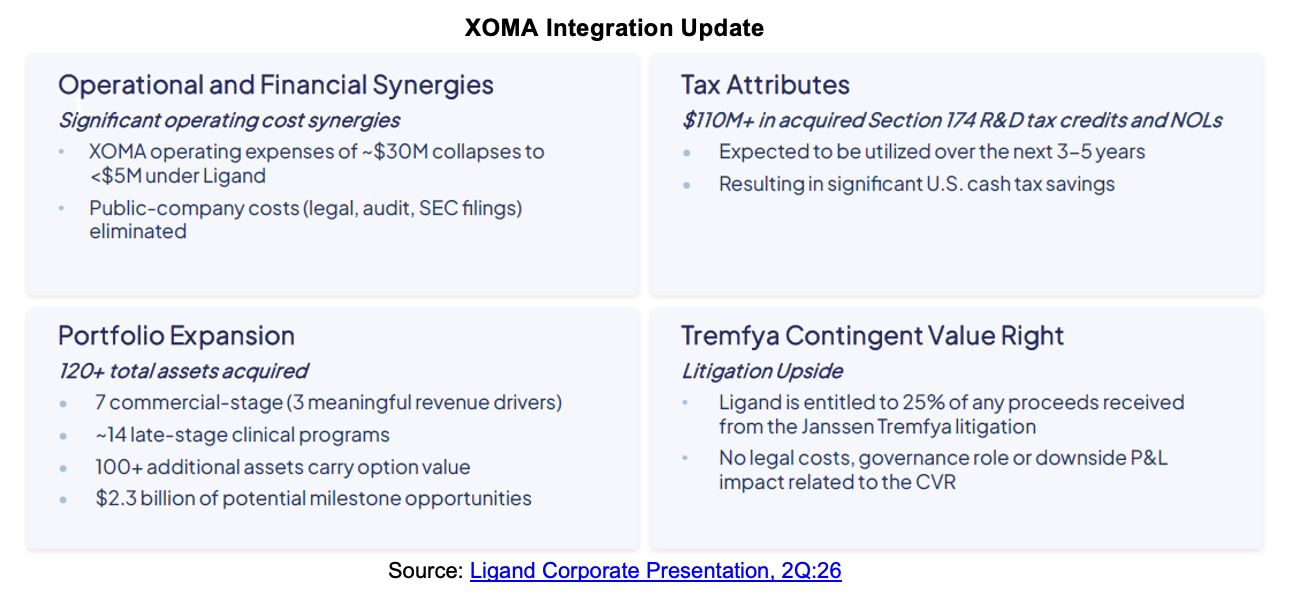
Beyond XOMA’s revenue contribution, Ligand anticipates that it will be able to reduce costs. It has developed an investment team and infrastructure that can accommodate additional assets. Management expects that most standalone operating costs associated with XOMA can be eliminated. This is expected to contribute to the anticipated $0.50 in incremental earnings expected in 2026 and the $1.50 of incremental earnings in 2027.
XOMA also offers tax benefits to the combination. In its 2025 10-K filing, XOMA reported almost $200 million of federal and $23.5 million of state net operating loss (NOL) carryforwards. The use of these tax assets may be severely limited due to anticipated expirations in the 2030s and limitations on use due to change in control. There are also federal research and development (R&D) tax credits of $2.0 million and state (California) R&D credits of about $20 million. Ligand identified $110 million of tax benefits that it expects can be used over the next two to five years.
Following the convertible note capital raise, Ligand completed the acquisition of XOMA Royalty on July 14th, 2026. Simultaneously, the company entered into an Amended Credit Agreement with Citibank, which continues to provide a $125 million revolving credit facility maturing in September 2028.
Zerion Pharma
On June 22nd, Ligand invested $3.3 million in Zerion Pharma, consisting of $2.3 million for royalty rights and $1.0 million to purchase ordinary shares of Zerion. Zerion is a private company based in Copenhagen, Denmark. In connection with the Zerion Transaction, a convertible bridge loan previously issued to Zerion in April 2026 converted into ordinary shares of Zerion, resulting in the issuance of an additional $0.3 million of ordinary shares of Zerion to Ligand. Under the royalty agreement, Ligand is entitled to receive royalties equal to 11% of annual revenue up to $15.0 million and 1% of annual revenue above $15.0 million, subject to a minimum annual royalty payment of $0.3 million beginning in 2027.
Zerion is developing its Dispersome platform, which aids with drug solubility. The technology stabilizes drugs in their amorphous form by creating a drug dispersion within a protein-based matrix, which produces exceptional drug loading and enhanced dissolution. It relies on a novel class of protein-based excipients that allow poorly soluble small-molecule drugs to be formulated as stable amorphous solid dispersions with high drug loading. We have not yet had an opportunity to ask management about it; however, based on our review of Zerion, it appears that this technology could complement Ligand’s own Captisol platform.
Tzield
On April 22, 2026, Sanofi announced that the FDA approved its supplemental biologic license application (BLA) for Tzield. The approval expanded pediatric labeling for Tzield to delay onset of Stage 3 Type 1 Diabetes in patients eight years and older to as young as one year of age. The approval was granted under a priority review process and is supported by one-year data from the PETITE-T1D Phase 4 study, evaluating safety and pharmacokinetics in young children.
Filspari
Travere’s Filspari was approved in 2023 to slow kidney function decline in adults with primary immunoglobulin A nephropathy (IgAN) who are at risk for disease progression. It later submitted its supplemental New Drug Application (sNDA) for Focal Segmental Glomerulosclerosis (FSGS) in March 2025. The application was initially given a Target Action Date of January 13th, 2026. However, just prior to this milestone, the FDA extended the review period.
In the weeks prior to the anticipated approval, the FDA made a series of information requests to clarify the benefit of Filspari in FSGS. While the responses were submitted prior to the agency’s decision, there was not sufficient time for the agency to properly review the data. As a result, the FDA delayed the Target Action Date by three months, classifying the additional data submission as a Major Amendment.
On April 13th, 2026, Travere announced that the FDA had granted full approval for Filspari in adults and children aged 8 years and older with FSGS who do not have nephrotic syndrome. We do not explicitly forecast FSGS revenues in our model, but Ligand does include a component for FSGS revenues in their Pharm Team segment. In its Analyst Day presentation last December, Ligand estimates that the contribution from Filspari for FSGS will be an estimated $40-$45 million in 2030.
Travere is developing Filspari for other indications, including for post-transplant patients with recurrent IgAN. This is being done in the Phase IV SPARX study, which is expected to complete enrollment in the second quarter of 2026. Since the May update, Chugai announced that it filed a new drug application in Japan for sparsentan for the treatment of IgA Nephropathy. Chugai has a licensing and partner relationship with Travere through Chugai's acquisition of Renalys Pharma, securing regional rights to the kidney disease drug sparsentan.
Ohtuvayre
In January, Nuance Pharm announced that the National Medical Products Administration (NMPA) of China has officially accepted for review the NDA for Ohtuvayre (ensifentrine) for the maintenance treatment of chronic obstructive pulmonary disease (COPD). In 2021, Nuance Pharma entered into an agreement with Verona Pharma for the exclusive rights to develop and commercialize Ohtuvayre in Greater China (mainland China, Hong Kong, Macau and Taiwan). According to the NMPA website, the review timeline for drug marketing authorization applications is 200 days.
First quarter 2026 saw a sequential decline in Ohtuvayre revenues. Sales were adversely impacted by Medicare deductible resets and a CMS reimbursement change. Second quarter revenues achieved an all-time high, breaking with the first quarter hiccup. Ohtuvayre has gained attention in the COPD market, and competitors are noticing. In early July, AstraZeneca paid Sino Biopharmaceutical a $200 million upfront for ex-China rights to a late-phase challenger to Merck’s COPD drug. The deal, which includes up to $1.9 billion in milestones, covers Sino’s PDE3/4 inhibitor, TQC3721. The Chinese biopharma is working through its Chia Tai Tianqing Pharmaceutical subsidiary to advance a nebulized formulation of the drug candidate into Phase III development in China.
Agenus’ Botensilimab and Balstilimab (BOT/BAL)
In January, Agenus closed on its planned strategic collaboration with Zydus Lifesciences to commercialize botensilimab plus balstilimab (BOT/BAL) in India and Sri Lanka. The deal included upfront monies, an equity investment in Agenus, future milestones and royalties that will support the development of manufacturing capacity in the United States. In July, Agenus announced a private placement which included funds from Ligand, of $85 million in gross proceeds that will fund the ROBBIN trial of neoadjuvant BOT/BAL in microsatellite-stable (MSS) colon cancer. The deal included warrants that could raise an additional $255 million if they are in the money.
SUBSCRIBE TO ZACKS SMALL CAP RESEARCH to receive our articles and reports emailed directly to you. Please visit our website for additional information on Zacks SCR.
DISCLOSURE: Zacks SCR has received compensation from the issuer directly, from an investment manager, or from an investor relations consulting firm, engaged by the issuer, for providing research coverage for a period of no less than one year. Research articles, as seen here, are part of the service Zacks SCR provides and Zacks SCR receives payments totaling a maximum fee of up to $50,000 annually for these services provided to or regarding the issuer. Full Disclaimer HERE.
________________________
[1] Details of the GAAP to core earnings reconciliation are in Ligand’s earnings press release.
[2] Ligand has access to a $125 million credit facility with Citibank, of which $124.4 million is available as of June 30th, 2026. In the 2Q:26 10-Q, the amended and restated credit agreement is included. It preserves a $125 million secured revolving facility through September 12, 2028, but recasts the documentation around the XOMA acquisition, Ligand’s larger convertible-note capital structure, and expanded subsidiary/collateral framework.
[3] The option strategy employed is a Bull Call Spread defined here.