By Steven Ralston, CFA
TSXV: MLP | OTCQB: MLPNF
READ THE FULL MLPNF RESEARCH REPORT
EXECUTIVE SUMMARY
Context & Geopolitical Necessity
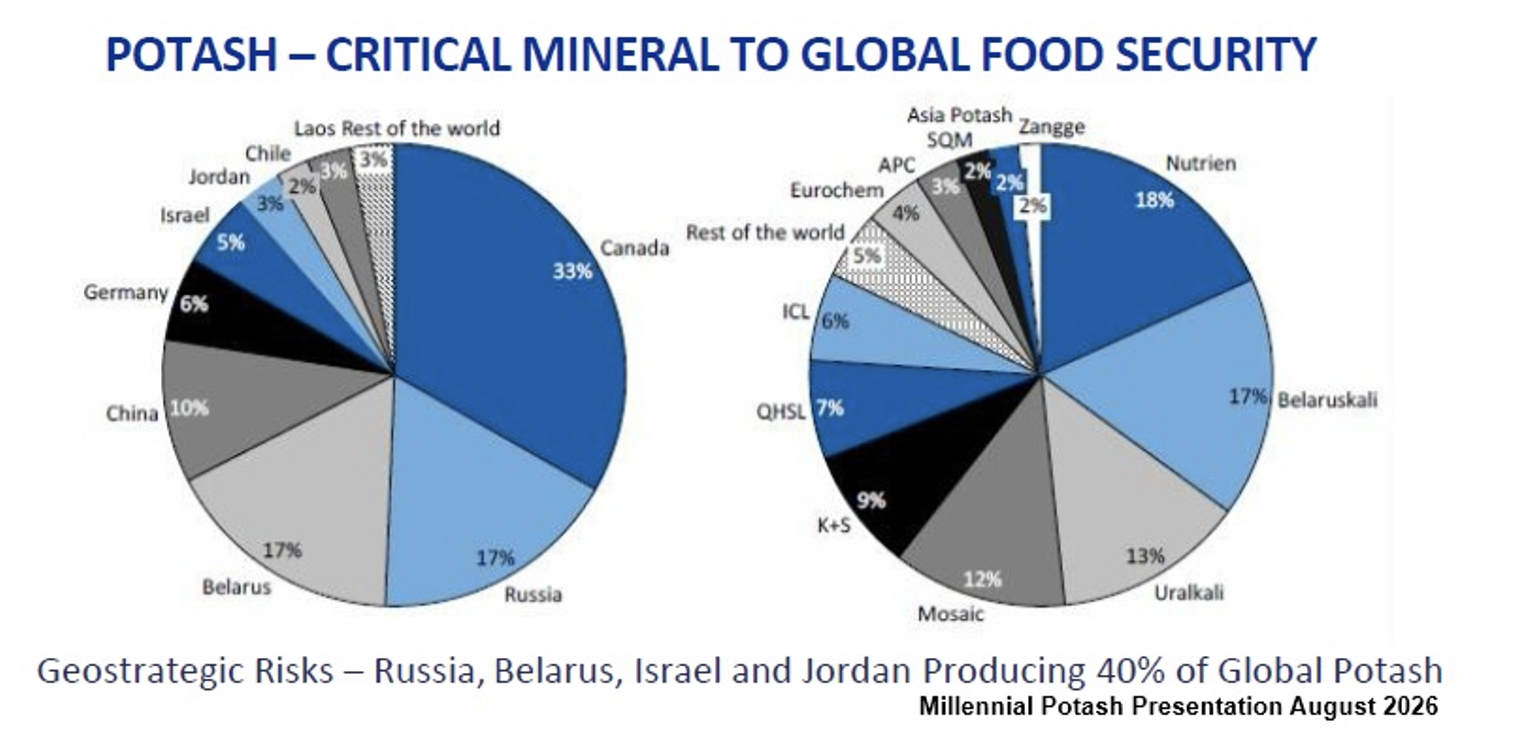
The global agricultural economy faces supply chain vulnerabilities due to the concentration of potash production. In 2025, three countries (Canada, Russia, and Belarus) controlled 70.5% of the world's potash supply. As a result, the United States is dependent on foreign producers to meet 92% of domestic agricultural potash requirements. Recognizing the threat to food security and national economic stability, the U.S. Department of the Interior officially added potash to the Final List of Critical Minerals on November 6, 2025.
The Banio Potash Project
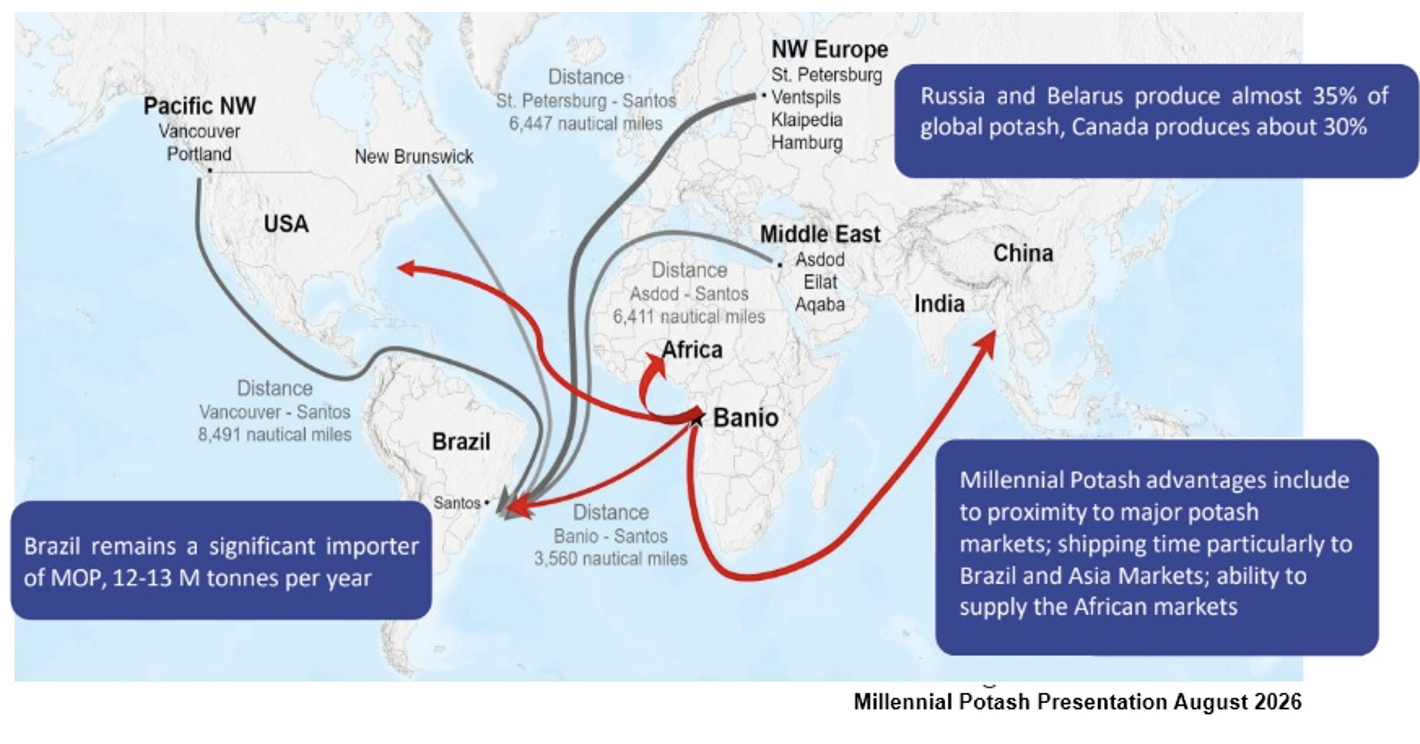
Millennial Potash Corp. (TSXV: MLP, OTCQB: MLPNF) is actively advancing the Banio Potash Project, which will help mitigate macro supply chain risks. Situated within the onshore extension of the Congo Coastal Basin in southern Gabon, the project holds an estimated resource base of 6.0 billion tonnes of potash mineralization (including Measured, Indicated, and Inferred resources). The company’s low-cost solution mining methodology, paired with a strategic location 50 km south of the port city of Mayumba, provides a structural and logistical advantage for low-cost maritime shipping routes, which can directly serve destination markets in the United States, Brazil, and across Africa.
Host-Nation Alignment & Infrastructure De-Risking
The development of the Banio Potash Project is fully aligned with host-country geopolitical and economic diversification mandates. Since late 2023, Gabonese President Brice Oligui Nguema has pledged high-level administration support to fast-track regional infrastructure expansions. Infrastructure upgrades directly advance the project’s viability and include the construction of a local Mayumba Power Station, national electricity grid expansions, and the development of a strategic deep-water port at Mangali.
U.S. Development Capital & Near-Term Milestones
The strategic importance of alternative potash avenues is backed by US$3.0 million in non-dilutive development funding from the U.S. International Development Finance Corporation (DFC). This milestone-based capital is actively financing the completion of a Definitive Feasibility Study (DFS).
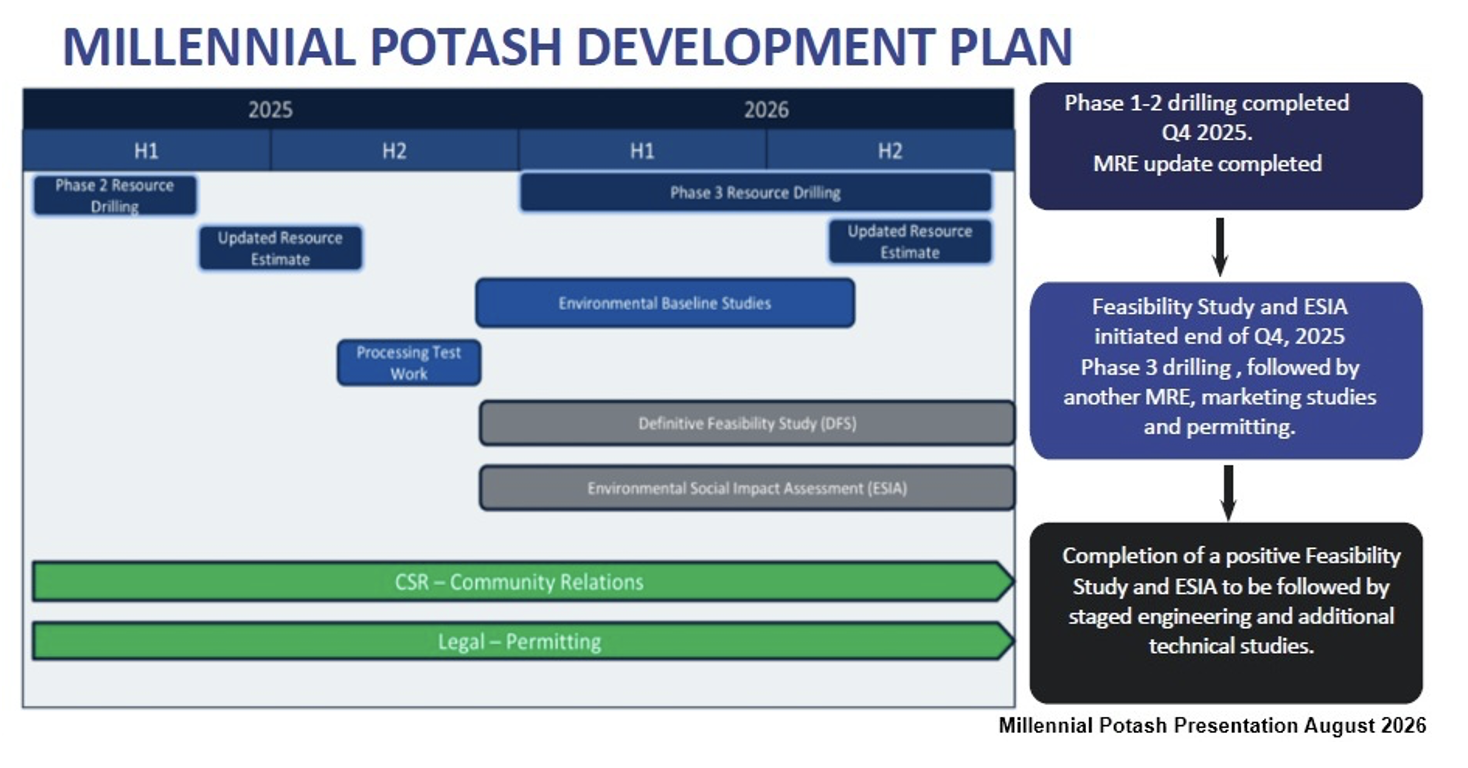
Millennial Potash is progressing toward several major catalysts targeted for late 2026:
- 4Q 2026: Target completion of a 4-hole drilling program (Holes BA-005 through BA-008) to expand southern and western resource boundaries.
- End of 2026: Finalization of an updated Mineral Resource Estimate (MRE) and the completion of the Environmental and Social Impact Assessment (ESIA).
- End of 2026: Delivery of a Definitive Feasibility Study (DFS).
POTASH SUPPLY VULNERABILITY & GEOPOLITICAL ADVANCEMENTS
U.S. Dependence on Potash
The strategic vulnerability of the United States regarding the supply chains of critical minerals has come to the forefront in current geopolitical discourse, primarily driven by an overwhelming domestic dependence on these minerals, particularly potash. As a foundational nutrient required to sustain global crop yields and safeguard domestic food security, potash serves as an indispensable commodity of the agricultural economy. According to the USGS, the United States relied on foreign producers to meet 92% of domestic potash requirements in 2025[1], as 70.5% of the world's supply was being sourced from three countries: Canada, Russia, and Belarus.[2] In recognition of the systemic dangers related to the concentration of suppliers of potash to the nation's food supply, the U.S. Department of the Interior added potash to the Final List of Critical Minerals on November 6, 2025, following an extensive evaluation by the U.S. Geological Survey. Recognizing potash’s vital role in agriculture and food security, the designation elevates potash from a standard agricultural input to a mineral that is essential to the national security and economic stability of the United States.
Host-Country Engagement
The advancement of Millennial Potash’s flagship Banio Potash Project requires not only the technical exploration and engineering expertise, but also navigating a path through encouraging the development of supporting civic infrastructure and fostering civic infrastructure, community goodwill and host-nation diplomacy. Cultivating multi-tiered political support from the Gabonese government is fundamental to de-risking a mining project. High-level political support has been demonstrated through a series of high-profile site inspections by Gabonese and Western dignitaries.
On November 30, 2023, during the COP28 Climate Change Conference in Dubai, a key meeting took place between His Excellency Brice Oligui Nguema (President of Gabon) and Farhad Abasov (Chairman of Millennial Potash), along with senior Gabonese officials, Economy Minister Mays Mouissi and Environment Minister Maurice Ntossui Allogo. The Gabonese President expressed full support for the Banio Potash Project and emphasized the importance of direct foreign investment in Gabon. In addition, the ministers noted that the Gabonese government would collaborate with Millennial to develop the necessary infrastructure for the project, including new port facilities in Mayumba.
In early September 2024, His Excellency Brice Oligui Nguema conducted a formal site visit to the towns of Mayumba and Ndindi, which are situated within the Banio Project. During the visit, he was presented with potash-rich drill core samples, and he explicitly committed the government to fast-tracking essential regional infrastructure upgrades that would enable the advancement of the project, namely the ongoing construction of a localized power station, national grid expansions, the upgrade of the Mayumba-Ndindi transit road, and the development of a strategic deep-water port at Mangali north of Mayumba.
His Excellency Brice Oligui Nguema was elected President of the Gabonese Republic on April 12, 2025 on a platform of stabilizing the nation, fostering economic growth, encouraging investment in infrastructure and enhancing social programs. He was officially sworn into office on May 3, 2025. The U.S. has recognized Gabon's commitment to a democratic transition. On October 1, 2024, U.S. Secretary of State Antony Blinken hosted President Nguema at the State Department, and two days later, the U.S. Chamber of Commerce hosted His Excellency for a high-level business roundtable, culminating in the formal signing of six Memorandums of Understanding (MOUs) between American corporations and the Gabonese government.
On September 3, 2025, the Vice President of Gabon, Mr. Séraphin Moundouga, reviewed the completed drillhole BA-004 and a drone LiDAR survey. He praised the Banio Project's technical transparency and commented that the project has the potential to diversify Gabon’s natural resource economy.
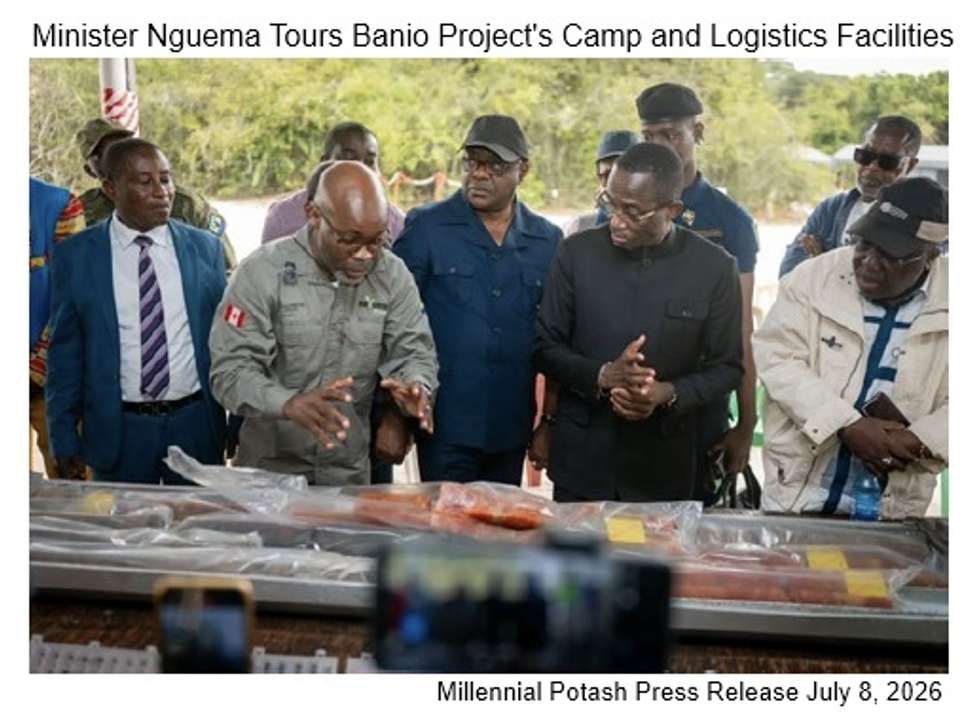
Between July 5 and 6, 2026, the Gabonese Minister of Mines and Geological Resources, Mr. Sosthene Nguema Nguema, along with the Governor of Nyanga Province, Mr. Jean Robert Mabobet, led a technical field visit to the Banio camp and the active BA-006 drill site. Minister Nguema publicly expressed his satisfaction with the integration of young Gabonese workers’ training alongside international specialists.
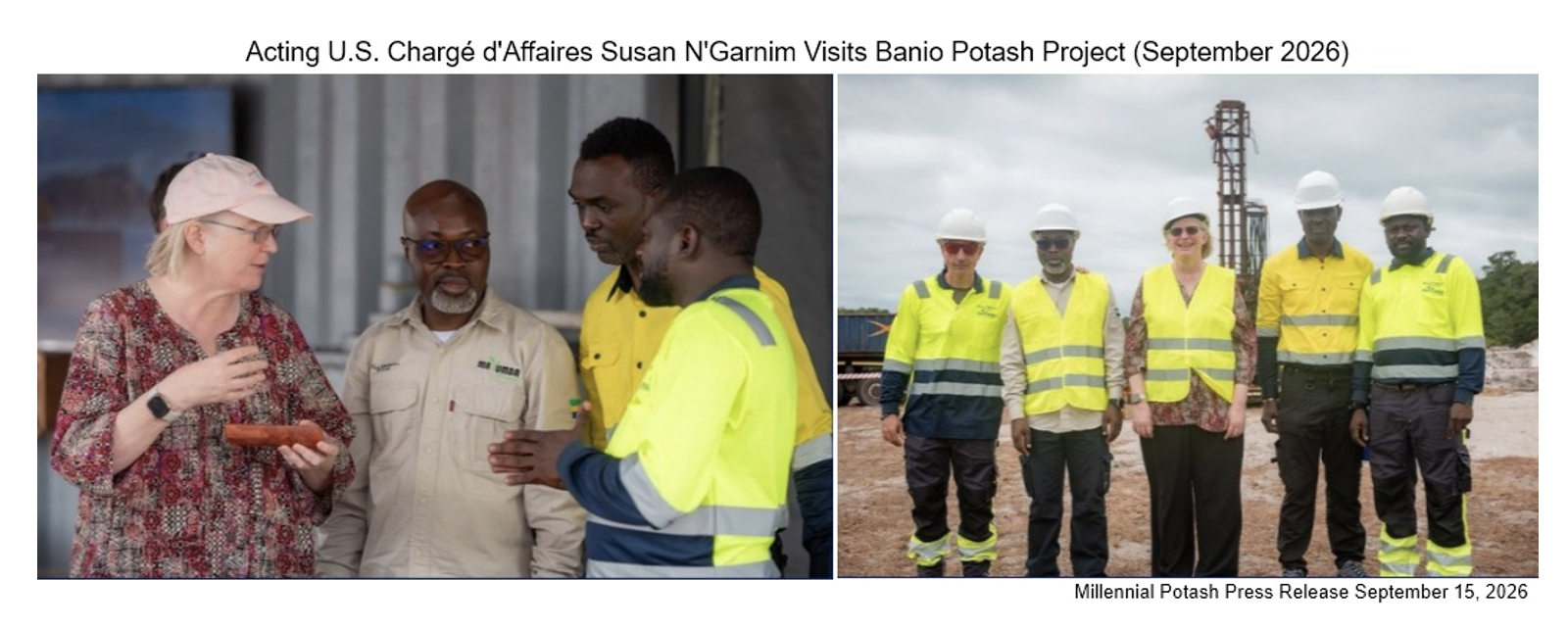
The geopolitical financial backing was prominently demonstrated during a subsequent, high-level diplomatic field visit on September 10, 2026, when the U.S. Embassy Acting Chargé d'Affairesfor Gabon, Ms. Susan N'Garnim, led a senior delegation of U.S. diplomats to the Banio Project. After touring the operational zones, inspecting core samples from the BA-006 hole and reviewing active operations at the BA-008 drill site, the diplomatic delegation stated that the project's infrastructure and execution exceeded expectations. The visit provided a physical demonstration of the active, multi-year partnership connecting the U.S. Embassy in Gabon, the DFC in Washington, DC, and Millennial Potash's management and technical teams.
Positioned directly on the Atlantic coast, the Banio Project would reduce logistical risks that are related to landlocked operations and would establish a cost-efficient shipping route to agricultural hubs across the African continent, Brazil, and the United States.
By merging the economic diversification goals of the Gabonese government with the national security mandates of the United States, the Banio Project has garnered a unique combination of high-level support, positioning the Banio Potash Project as a stabilizing counterweight to help ameliorate the potential adverse effects of a concentrated global potash supply chain.
U.S. Development Capital to Advance Alternative Sources of Potash Supply
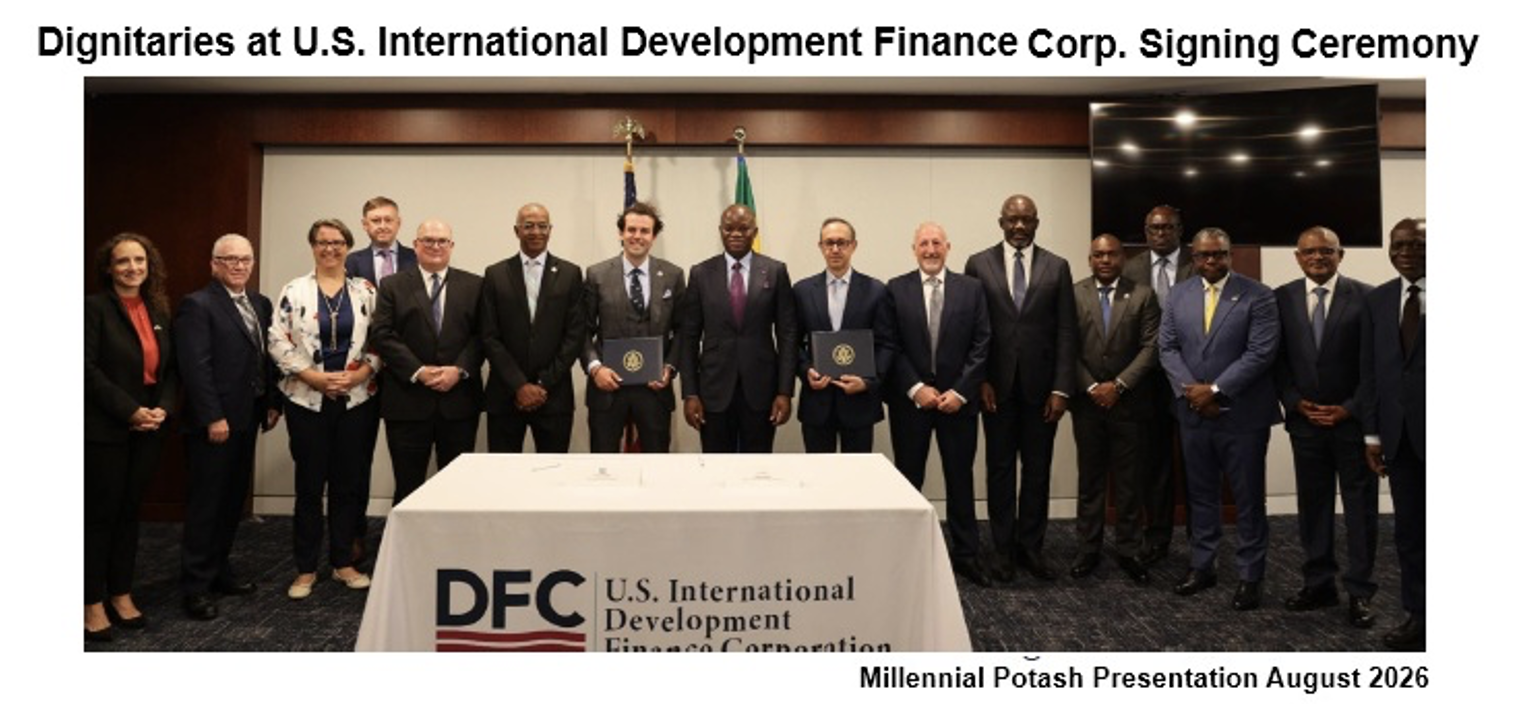
The high-level, local support of Gabonese officials has been accompanied by strategic backing from the United States government. In early July 2025, the U.S. International Development Finance Corporation (DFC) committed US$3.0 million in development funding for Millennial’s Banio Potash Project under a specialized Project Development Program. The capital is structured to de-risk the project by directly funding a Definitive Feasibility Study (DFS). The signing ceremony was held in Washington, D.C., with President Brice OliguiNguema, Conor Coleman (DFC Head of Investments and Chief of Staff), Millennial’s CEO, Jason Wilkinson, and Millennial’s Chairman, Farhad Abasov, in attendance.
Rather than delivering a single lump sum, the DFC releases these development funds systematically over the course of the study, tying tranches to the successful completion of specific, audited milestone activities that will form integral parts of the final feasibility report. The milestone-based structure is designed to build a bankable technical foundation that will meet the strict underwriting criteria required for a potential future, large-scale U.S. debt project financing. The funding is non-dilutive and carries no interest. Repayment is due when the project reaches a Final Investment Decision (FID) for construction or financing.
BANIO POTASH PROJECT – EXPLORATION (2026)
PHASE 2 DRILLING PROGRAM (2026)
On August 26, 2026, Millennial Potash announced the completion of drillhole BA-006 to a total depth of 674m as part of the continuation of the Phase 2 drilling program. Collared approximately 4 km west of drillhole BA-001, BA-006 is strategically positioned in a newly acquired permit area closer to the Atlantic coast and the company's planned route to the deep-water port site at Mangali, which is located just north of Mayumba. The drillhole expanded the Banio Project's known potash footprint to the southwest by intersecting an evaporite-bearing Salt Sequence that remains open at depth, beginning from a depth of roughly 332m from the surface to the terminus of the hole at 674m. Preliminary logging revealed prominent horizontal bedding planes consisting of interbedded halite and carnallite, yielding an estimated cumulative thickness of approximately 80m of potash mineralization across six distinct evaporite cycles (Cycles V to X).
Notably, the discovery of Cycles IX and X marks the first time these specific packages have been encountered at the project, indicating an increase in potash thickness toward the west. The hole was terminated due to the depth limitations of the drill rig, leaving the mineralization open at depth. The geological data gathered from BA-006 is being prepared for core sampling at the Saskatchewan Research Council.
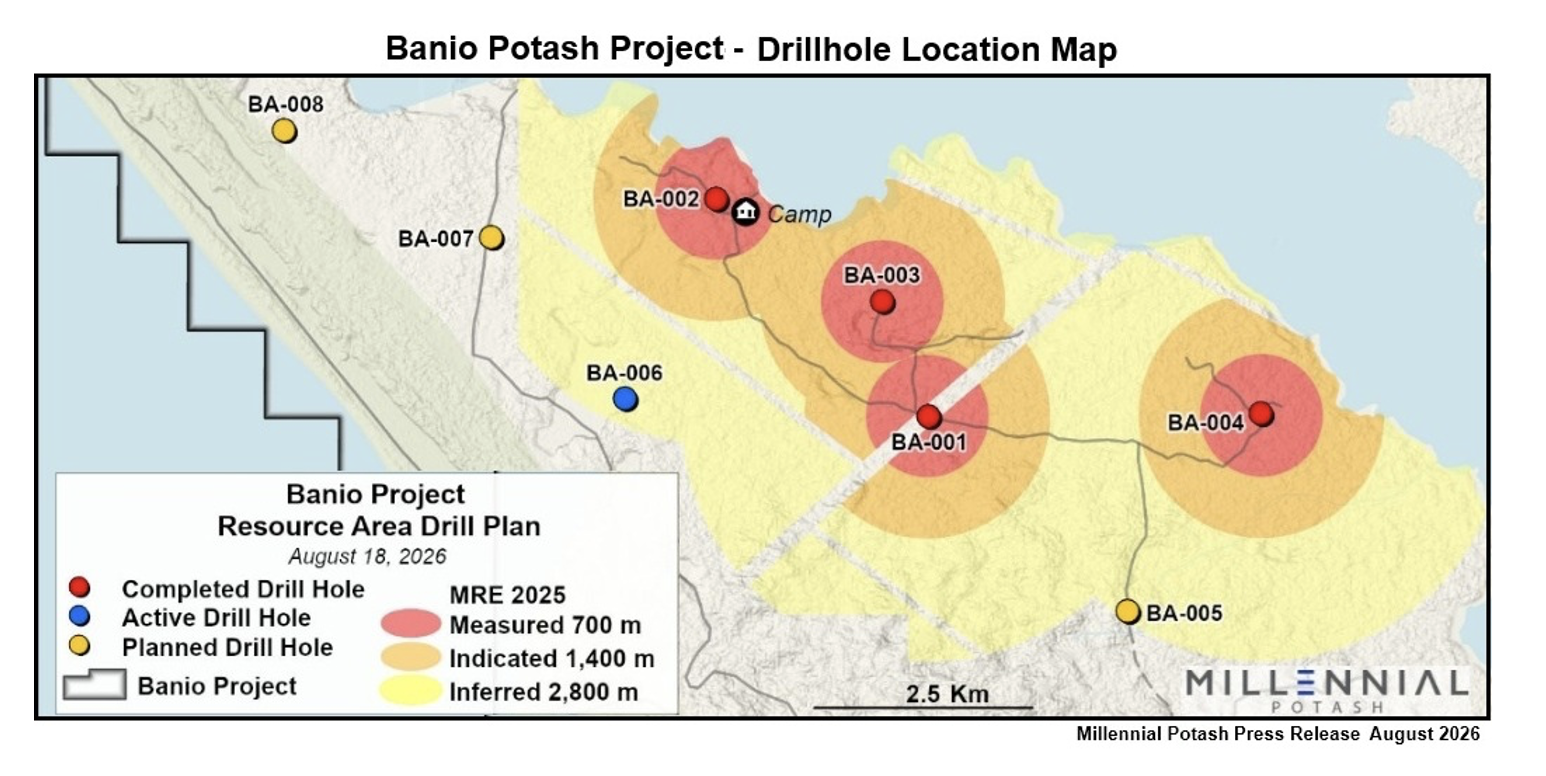
The drilling program continues with BA-007 and BA-008 underway. As of mid-September 2026, field crews were advancing the drill casing at drillhole BA-008 to prepare the borehole for cementation, which was observed firsthand by the visiting U.S. Embassy diplomatic delegation.
There is also activity at drillhole BA-007. Both holes are targeting the deeper sections of the evaporite basin to confirm the southern and western extensions of the massive potash cycles.
The entire four-hole program (BA-005, BA-006, BA-007 and BA-008) remains on track for completion in 4Q 2026 in order to be integrated into an updated Mineral Resource Estimate, and ultimately into the upcoming Definitive Feasibility Study.
VALUATION
As a junior potash mining company, Millennial Potash should not be valued using traditional revenue, earnings or cash flow metrics, which are better suited for mining companies that have reached a Final Investment Decision (FID) and secured project construction financing. Management’s primary strategic objective is to maximize shareholder value through the development of the company’s Banio Potash Project in Gabon through continued exploration by expanding estimated mineral resources at its flagship Banio Potash Project and advancing the asset toward a shovel-ready state.
In the solution mining space, junior potash companies developing potash projects using solution mining typically trade at an EV/tonne multiple between $0.20/t and $1.00/t. Focusing on the EV/M&I Contained KCl tonne ratio, the multiple expands to the $1.00/tonne and $3.00/tonne range, in recognition of the project’s higher geological certainty and structural de-risking.
Assuming management continues to successfully advance the Banio Potash Project to a valuation of an EV/M&I Contained KCl tonne of 1.25, the indicated price target for MLPNF is US $3.88 and CAD $5.46 for TSXV: MLP. The targets do not include the expected upgrade in M&I resources from the current ongoing drilling program.
SUBSCRIBE TO ZACKS SMALL CAP RESEARCH to receive our articles and reports emailed directly to you. Please visit our website for additional information on Zacks SCR.
DISCLOSURE: Zacks SCR has received compensation from the issuer directly, from an investment manager, or from an investor relations consulting firm, engaged by the issuer, for providing research coverage for a period of no less than one year. Research articles, as seen here, are part of the service Zacks SCR provides and Zacks SCR receives payments totaling a maximum fee of up to $50,000 annually for these services provided to or regarding the issuer. Full Disclaimer HERE.
________________________
[1] 2026 USGS Potash Commodity Summary: https://pubs.usgs.gov/periodicals/mcs2026/mcs2026-potash.pdf
[2] Government of Canada: https://natural-resources.canada.ca/minerals-mining/mining-data-statistics-analysis/minerals-metals-facts/potash-facts