By Steven Ralston, CFA
OTCQB: MLPNF | TSXV: MLP
READ THE FULL MLPNF RESEARCH REPORT
EXECUTIVE SUMMARY
Millennial Potash Corp. (TSXV: MLP, OTCQB: MLPNF) is advancing the Banio Potash Project, a low-cost solution mining potash project located along the Atlantic coast in southern Gabon. Situated within the onshore extension of the evaporite-rich Congo Coastal Basin, the project combines a massive potash mineralization deposit with a logistical competitive advantage. Located approximately 50 km south of the port city of Mayumba, the Banio Project is uniquely situated to implement a low-cost solution mining operation with direct access to sea shipping routes to global export destinations, particularly Brazil, the eastern U.S., and Africa.
Key Company, Management, and Project Attributes
Updated Mineral Resource Estimate (MRE): After a successful Phase 2 drilling program in 2025, Millennial Potash filed an updated 43-101-compliant Mineral Resource Estimate (MRE) totaling 6.01 billion tonnes of potassium-bearing mineralization, an over 175% increase from the maiden MRE filed in early 2024. The resource is classified into 2.45 billion tonnes of Measured & Indicated mineralization and 3.56 billion tonnes of Inferred resources, grading at an average of 15.61% KCl.
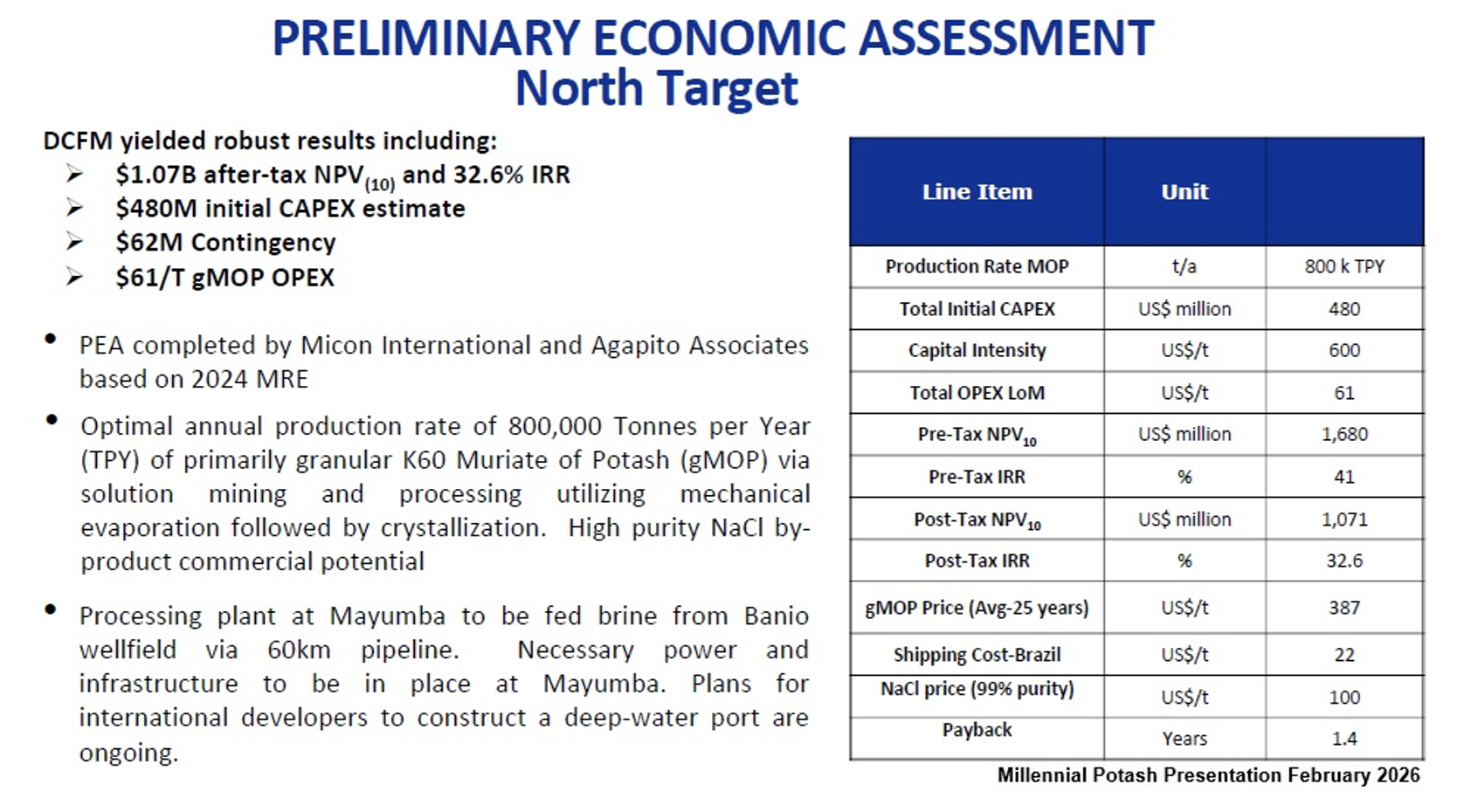
Preliminary Economic Assessment (PEA): Completed in mid-2024, the PEA’s optimistic scenario outlines a benchmark production level of 800 kt/a, an after-tax Net Present Value (NPV10) of USD $1.071 billion, an exceptional after-tax IRR of 32.6% and a rapid 1.4-year payback period.
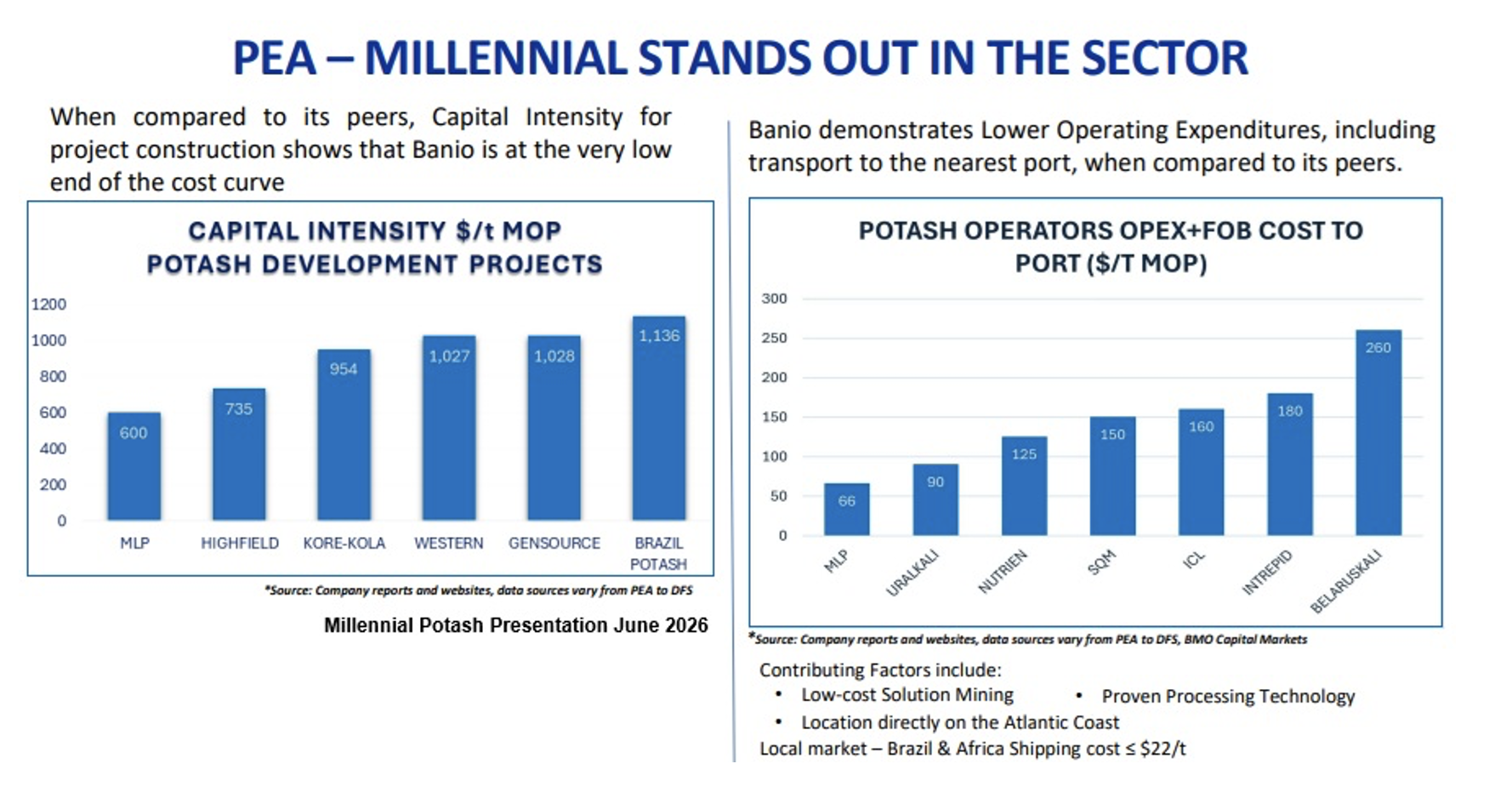
Estimated operating costs of USD $61 per tonne would position the Banio Potash Project as one of the lowest-cost potash operations globally. The initial capex is estimated at USD $480 million, which is markedly low for a potash asset of this scale.
Strategic Exploration Permit Ownership: Millennial Potash operates under an exclusive option agreement to acquire 100% of Equatorial Potash Pty Ltd, the ultimate parent of the Gabonese operational company, Mayumba Potasse SARL, which owns the exclusive exploration rights for potash and related salts through Mayumba Permit G5-595. Millennial Potash has completed successive advancement milestones and financial commitments to earn an 80% interest in the initial 1,238 km2 Banio Potash Project. Furthermore, the addition of the 261.39 km2 Haute Banio exploration permit in February 2026 expanded the total project area by 21% to 1,499.39 km2, allowing for lateral exploration upside, which will be tested in a Phase 3 drilling program later in 2026.
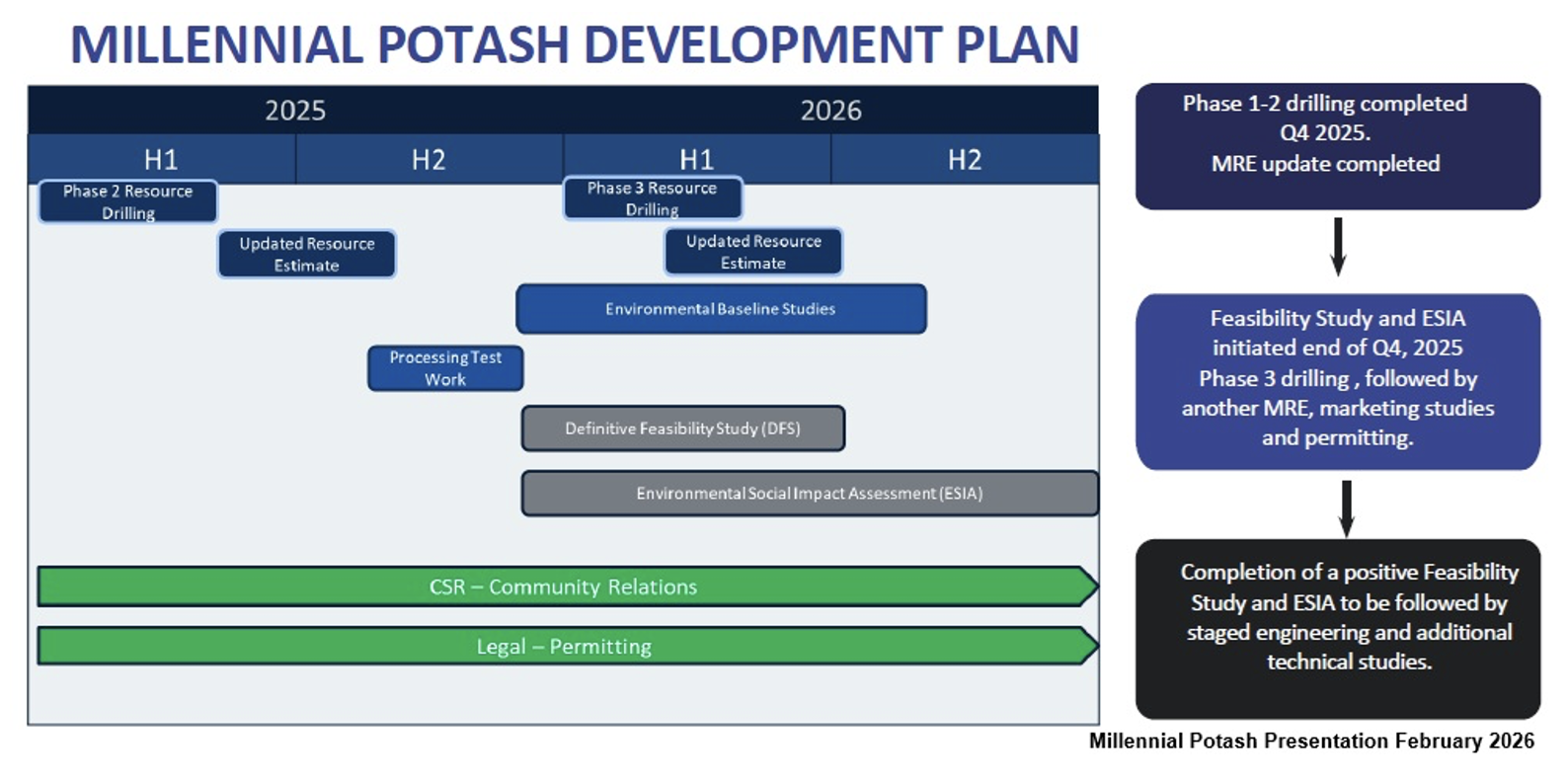
Management Has Significantly De-Risked the Project Since 2024 Through the Attainment of Multiple Milestones: With a short period of slightly over two years, management has filed a maiden MRE, completed a PEA, and filed an updated MRE with a maiden Measured Resource. Current workstreams are advancing an environmental and social impact assessment (ESIA) and working on a bankable Definitive Feasibility Study (DFS), the latter providing the milestone necessary for ownership of a 100% interest in the Mayumba Permit G5-595.
Management’s Proven Track Record
Management has considerable, successful prior resource advancement experience with a track record of exploring and advancing junior resource companies. The report highlights four specific historical examples: Energy Metals (uranium), Millennial Lithium (lithium), Potash One (potash), and Allana Potash (potash).
BANIO POTASH PROJECT: OUTLINE OF KEY ADVANCEMENT MILESTONES
Leadership & Corporate Milestones
- 2020: Farhad Abasov appointed Chairman of the Board and Director of Black Mountain Gold USA Corp. (TSXV: BMG)
- January 25, 2023: Black Mountain Gold USA Corp. renamed Millennial Potash Corp. and begins trading under the ticker MLP on the TSXV
- February 6, 2023: Mr. Abasov reappointed Chairman of the Board and Director of Millennial Potash Corp.
Ownership Milestones (Banio Potash Project & Haute Banio Exploration Permit)
- October 31, 2022: Black Mountain Gold USA Corp. enters into a definitive agreement that provides an option to acquire up to a 100% interest in the Banio Potash Project (Mayumba Permit No. G5-595).
- January 24, 2023: Millennial Potash earned 25% interest upon TSXV approval of definitive agreement.
- 20, 2024: Millennial Potash earned 51% interest in Banio Project by filing maiden MRE.
- July 9, 2024: Millennial Potash earned 70% interest in the Banio Project by filing a PEA.
- April 15, 2026: Millennial Potash earned 80% interest following USD $500,000 milestone payment.
- February 4, 2026, 261.39 km2 Haute Banio exploration permit granted to Millennial Potash (adjacent to 1,238 km2 Mayumba exploration permit).
Technical Reports & Environmental Progress
- February 20, 2024: Millennial Potash filed maiden MRE for North Target of the Banio Project.
- April 23, 2024: Millennial Potash completed PEA on the Banio Project (filed June 6, 2024).
- December 29, 2025: Millennial Potash filed updated MRE for North Target of Banio Project.
Ongoing Technical Report & Environmental Study
- December 9, 2025: Millennial Potash initiates work on Environmental & Social Impact Assessment (ESIA) at Banio Potash Project.
- January 13, 2026: Millennial Potash initiates work on Definitive Feasibility Study (DFS) for Banio Potash Project.
Ongoing Work on Infrastructure & Logistics
- April 2, 2025: Completion of Phase 1 at the Mangali Port (construction of 130m quay, 3m draft) through a public-private partnership.
- Millennial Potash is supporting the advancement of the Mayumba Power Station, a thermal gas- turbine power plant, which is initially planned to deliver 8.5 MW of capacity (and expandable to 50 MW).
PRELIMINARY ECONOMIC ASSESSMENT (PEA) ON NORTH TARGET
On April 23, 2024, Millennial Potash announced the completion of a Preliminary Economic Assessment (PEA) for the North Target at the Banio Potash Project. The study evaluated three production scenarios, ranging from Option 1 (400 kt/a capacity, lowest initial capex and lowest rate of extraction leading to a 112-year LOM) to Option 3 (production level 800 kt/a, highest upfront capex, maximizing capital efficiency through economies of scale and the highest rate of extraction leading to an estimated 56-year LOM and a rapid 1.4-year payback period). Management is focusing on Option 3 but only using the first 25 years of the project, which offers an after-tax Net Present Value (NPV10) of US$1.071 billion with an exceptional after-tax IRR of 32.6%.
Estimated operating costs of US$61 per tonne would position the Banio Potash Project as one of the lowest-cost potash operations globally. The initial capex is estimated at US$480 million, which is markedly low for a potash asset of this scale.
The estimated benchmark annual production rate is 800,000 tonnes, primarily of granular K60 Muriate of Potash (gMOP) extracted by solution mining and processed utilizing mechanical evaporation, which is sensitive to natural gas prices.
The operational plan entails piping brine from the wellfield at Banio through a 60km pipeline to a processing plant at Mayumba. The Project’s success is dependent on external developments of local power grid infrastructure to operate the solution mining operation and the processing plant, along with the construction of a deep-water port at Mayumba.
BANIO POTASH PROJECT - UPDATED MRE (2025)
The findings from BA-001-EXT and BA-004, along with the integration of data from BA-002-EXT in 2023, contributed to an updated Mineral Resource Estimate, which significantly upgraded the Banio Project’s total tonnage estimation. The updated MRE was released on November 17, 2025.
- Expanded Vertical Depth: Testing the historic BA-001 and BA-002 holes at depth proved that the potash mineralization continued below the assumed shallow baseline depth. By piercing into deeper stratigraphy, multiple stacked carnallitite seams were discovered, dramatically increasing the resource’s vertical thickness.
- Basin Continuity: The step-out BA-004 drill hole proved that the potash horizons were decidedly continuous across the basin. The verification of thelateral continuity allowed geologists to confidently connect the data points among the drill logs and reclassify wide swaths of the deposit into the resource estimation, as well as upgrading the category of some resources in the maiden MRE released two years earlier.
- Category Upgrades: The drilling data verified good geological correlation of the evaporite cycles and carnallitite seams among the drill holes BA-001 to BA-004. The professional geologist who prepared the 43-101-compliant Updated Mineral Resource Estimate for the North Target of the Banio Potash Project was able to shift a massive portion of the resource from the Inferred Resource to the Indicated Resource category, and also, for the first time, a Measured Resource was established.
- Tonnage Multipliers: Even though harder data restrictions were utilized in the calculating software, the thick seams from BA-001-EXT (112.5m in cumulative thickness) and BA-004 (101.45m in cumulative thickness) contributed massive incremental volume to the models. The thick footprint significantly expanded the estimated Inferred Resource.
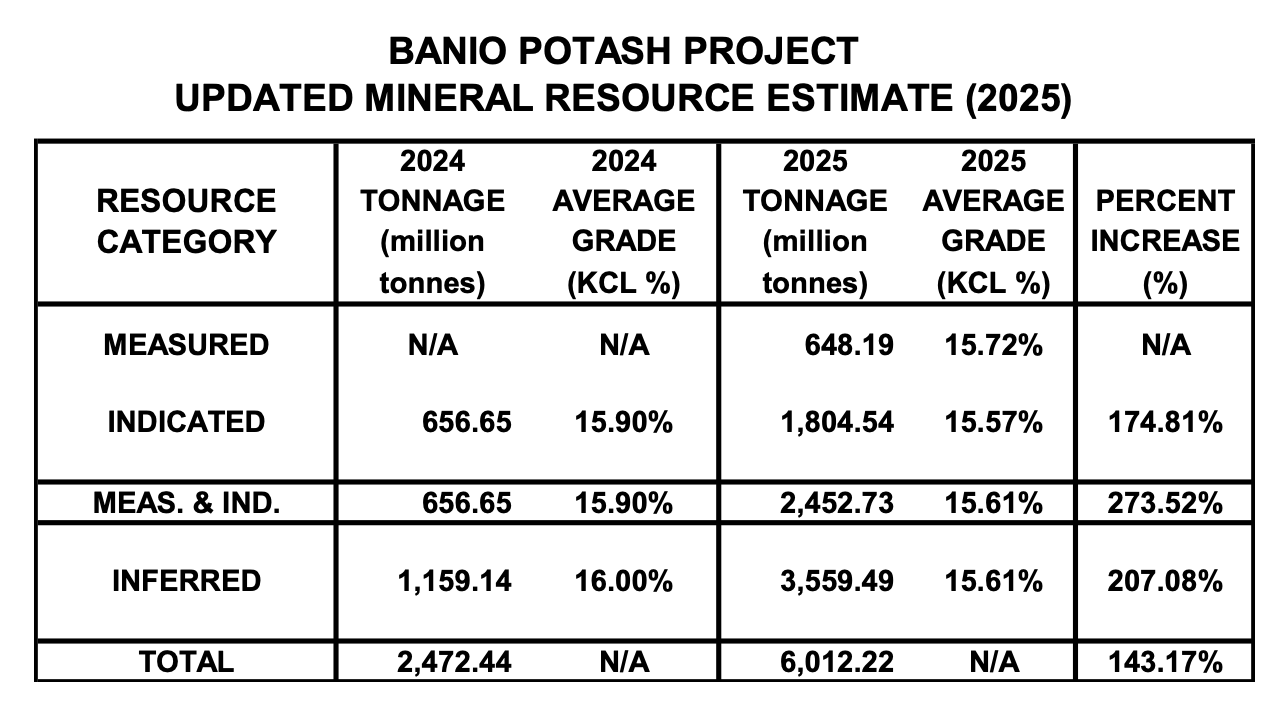
- The estimated Measured & Indicated Resource increased 273.5% from 656.65 million tonnes (average grade 15.9% KCl) to 2,452.7 million tonnes (average grade 15.61% KCl). The maiden Measured Resource of 648.2 million tonnes (average grade 15.72% KCl) significantly fueled the triple-digit increase.
- The estimated Indicated Resource increased 175% from 656.65 million tonnes (average grade 15.9% KCl) to 1,804.54 million tonnes (average grade 15.57% KCl), primarily driven by the verified correlation of evaporite cycles and carnallitite seams.
- The estimated Inferred Resource increased 207% from 1.159 billion tonnes (average grade 15.8% KCl) to 3.559 billion tonnes (average grade 15.61% KCl).
PLANNED PHASE 3 DRILLING PROGRAM
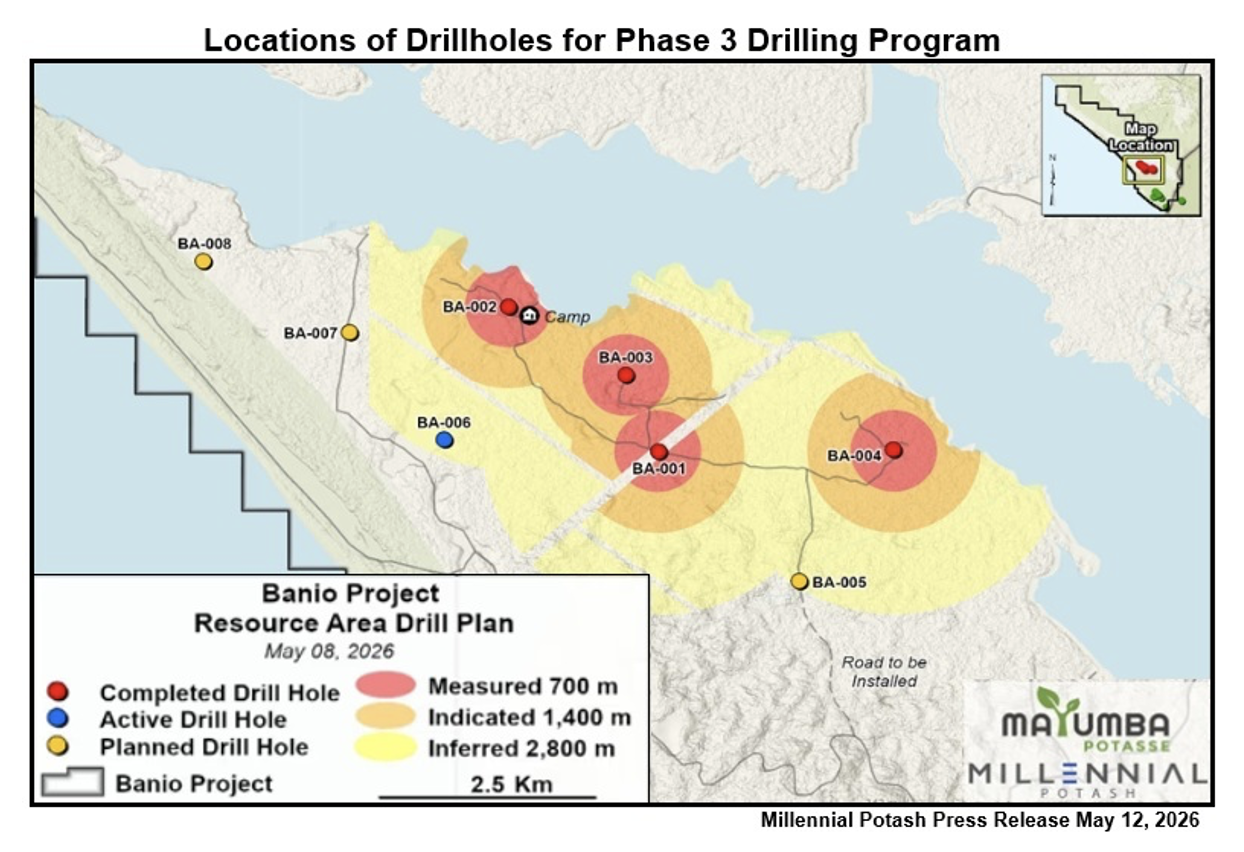
Since the Phase 2 drilling program proved that some potash sequences were far thicker and more continuous than prior models assumed, the design of the Phase 3 drilling program will target the four unmapped southern (BA-005) and western (BA-006, BA-007, BA-008) projected extensions of the deposit, where the thick 100m+ sequences are projected to continue. BA-007 and BA-008 will be situated on the recently acquired Haute Banio exploration permit. The drillholes are expected to be approximately 1,000m in depth in order to have the potential of intersecting all 10 potash cycles, including the potential of intersecting, targeting localized overthickening, even though the recommendation in the updated MRE was for 700m holes. The ultimate objective of the Phase 3 drilling program is to expand the resource base through assay data that increases the volumetric extent. The program is planned to be completed by the end of the fourth quarter of 2026.
MANAGEMENT & PRIOR RESOURCE ADVANCEMENT EXPERIENCE
Millennial Potash’s leadership team is experienced with a proven track record of exploring and advancing junior resource companies.
Farhad Abasov, Chairman of Millennial Potash Corp., has successfully advanced/developed several junior resource companies in the potash, lithium, and uranium industries. Over the last 22 years, Mr. Abasov was an integral member of the management teams that advanced and de-risked projects at Energy Metals Corp. (uranium), Potash One, Allana Potash Corp., and Millennial Lithium Corp. through exploration, PEA, and feasibility milestones such that these junior resource companies became strategic acquisition targets. All four (4) were subsequently acquired.
Other members of Millennial Potash’s leadership team also participated in the development of some of these acquired junior resource companies. Jason Wilkinson, CEO, was a Managing Director for Allana Potash Corp and COO for South Harz Potash. Peter MacLean, Director, was Senior Vice President of Technical Services for Millennial Lithium Corp and VP Exploration for Allana Potash. Rich Lacroix, Director, served as a Director for Allana Potash Corp and Millennial Lithium. Max Missiouk, CFO, was CFO of Millennial Lithium Corp. And Paul Matysek, Senior Strategic Advisor, was CEO of Energy Metals and CEO of Potash One.
Energy Metals Corporation (TSXV: EMC) was a Vancouver-based junior resource company focused on uranium exploration and development of properties located in the western U.S., with the flagship property being the La Palangana in Texas. Farhad Abasov joined the company in 2004 as Senior Vice President of Strategy. At that time, Energy Metals was a micro-cap junior explorer with a stock price under CAD$0.50 and a market value under CAD$10 million. Under his watch, the company aggressively acquired uranium properties (in Oregon, New Mexico, Wyoming, and Texas) and added a licensed uranium processing facility in Texas. After a period of rapid asset growth between 2005 and 2007, Energy Metals was acquired for US$1.6 billion by Uranium One in August 2007.
Based in Saskatchewan, Potash One (TSX: KCL) was an exploration and development company that focused on advancing a single massive underground potash deposit located in southern Saskatchewan known as the Legacy Potash Project. Farhad Abasov co-founded the venture in 2007, initially as an unlisted private concept. The initial shares were valued at less than CAD$0.50 with an early-stage startup value of less than CAD$5 million. During his time at Potash One, the flagship Legacy Project by executing extensive exploratory drilling and seismic testing. In March 2008, Potash One acquired three potash exploration and development permits from Giant Potash Corporation, and in April 2009, Potash One acquired Potash North Resource Corporation, which added two subsurface mineral exploration permits. A PFS study was filed on July 23, 2009, and in February 2010, an Environmental Impact Statement was submitted. Management advanced Legacy as a solution mining project. In November 2010, the Project achieved a key regulatory milestone when the Saskatchewan provincial government granted the environmental permit. The de-risking process prompted German fertilizer giant K+S Aktiengesellschaft to launch a friendly takeover bid of CAD$4.50 per share or CAD$434 million, which closed in March 2011. Ultimately, the Legacy Potash Project became the Bethune Potash Mine, which was the first greenfield potash mine in Saskatchewan to be brought into production in over 40 years.
Toronto-listed Allana Potash Corp. (TSX: AAA, OTCQX: ALLRF, DE: APW) was a junior mining company that focused on expanding and de-risking its flagship asset, the Danakhil Potash Project (aka the Dallol Project) in Ethiopia. In early 2008, Mr. Abasov was appointed President and CEO of Allana, which at the time was valued at CAD$0.20 per share with an approximate market valuation of CAD$10.1 million. Under Mr. Abasov’s leadership, the Danakhil was expanded from 154 km2 to 312 km2 through the acquisition of Nova-Ethio Potash Corp. Extensive exploratory drilling programs established a massive, shallow resource base of sylvinite, kainitite and carnallitite. The Danakhil Potash Project advanced from an early-stage exploration project to one with a completed Feasibility Study (FS), which was delivered on March 19, 2013. The target output of the FS was estimated to be 1 million tonnes of Muriate of Potash (MOP) per year over a 25-year LOM (Life of Mine). Later in 2013, the Ethiopian Ministry of Mines formally granted Allana a large-scale, 20-year mining concession for the project. A Preliminary Economic Assessment (PEA) was completed early 2015. The multi-year de-risking process led to Israel Chemicals Ltd. (NYSE: ICL) acquiring an initial 16% stake in Allana in 2014 and, later in June 2015, closing a friendly buyout offer of CAD$137 million for the remaining 83.78%, which would value the whole company at CAD$163.5 million.
Millennial Lithium Corp. (TSXV: ML, OTCQB: MLNLF, A3N2:GR: Frankfurt) developed a portfolio of lithium brine mining concessions located in the Lithium Triangle and associated with salars in Argentina, specifically four (4) lithium brine projects, with the flagship project being Pastos Grandes. The company utilized a mining shell company, Redhill Resources, and on June 24, 2016, renamed it Millennial Lithium Corp. Farhad Abasov was appointed CEO and Director on May 8, 2017, along with Richard Lacroix as Director and Peter MacLean as Senior Vice President. At the time, the stock traded at CAD$0.77 with a market cap of roughly CAD$32 million. Under Mr. Abasov’s leadership, the flagship Pastos Grandes Project was fast-tracked through a development cycle by conducting brine sampling and pump tests in 2017, both exploratory and definition drilling programs between 2018 and 2019, finalizing a bankable Feasibility Study on July 29, 2019 (NPV: $1.03 billion, IRR 24.2%, LOM 40 years), expanding the portfolio of licensed lands associated with the Pastos Grandes Project by 14,200 hectares in 2020-2021 timeframe and begin to operate a pilot processing plant in April 2021, which produced battery-grade lithium carbonate with 99.96% purity. The rapid de-risking of the company’s lithium projects triggered a high-profile bidding war in July 2021 among Chinese lithium producer Ganfeng Lithium, Contemporary Amperex Technology Co. Ltd. aka CATL (the world's largest EV battery manufacturer) and Canada-based Lithium Americas (TSE: LAC.TO, NYSE: LAC), which resulted in Millennial Lithium being acquired for CAD$4.70 per share by Lithium Americas, which equated to $490 million when the transaction closed on January 25, 2022. Subsequently, Lithium Americas spun out those Argentinian lithium assets under Lithium Argentina (TSX: LAR, NYSE: LAAC) in October 2023.
Commonalities Among Farhad Abasov’s Forays In Advancing Junior Resource Companies
A consistent project advancement strategy with key steps is manifest across Farhad Abasov’s corporate undertakings. Mr. Abasov specializes in transforming micro-cap, early-stage junior resource companies into highly valuable, de-risked strategic targets. After targeting a mineral with increasing demand on a secular basis and with a projected insufficient supply to meet the expected demand, management selects an early-stage junior mining company and fast-tracks the advancement of its flagship project through exploratory and later definition drilling programs, the preparation of a Mineral Resource Estimate (MRE), and initial technical test work concerning the feasibility of extracting the ore. These project advancements lead to the economic evaluation stage, during which a Preliminary Economic Assessment (PEA) and later a bankable Feasibility Study (FS) are produced.
Additionally, management usually increases the size of the project by acquiring adjacent properties in order to expand the mineral resource base and improve the scale of the project.
On occasions, one of the advancements is the achievement of aregulatory hurdle, such as being granted a crucial environmental permit or a vital mining concession from governmental authorities, which further de-risks the project.
In the past, management’s comprehensive de-risking process validated the commercial viability of mineral deposits, which attracted major industry players and culminated in friendly takeovers, buyout offers and a high-profile bidding war.
As a strategic sidebar, the management of Millennial Potash appears to favor projects that are amenable to solution mining methods, which require significantly lower initial capital expenditures, produce at lower operating costs, and attain production on shorter timelines compared to conventional underground operations. The application of differing fluid-extraction techniques was dependent on the specific mineral targeted, the geology of the deposit, and the mechanical stability of the host rock.
At Potash One's Legacy Project, now the Bethune Potash Mine, a classic solution mining technique was employed, which involves injecting brine (a heated salt-water mixture) into the evaporite host rock in order to dissolve the potassium chloride and then pumping the pregnant leach solution to the surface. At Millennial Lithium’s Pastos Grandes Project, the solution mining method recommended in the Feasibility Study just involves utilizing submersible pump to deliver the naturally occurring, lithium-rich, subsurface brine from salars to the surface, where solar evaporation is employed to extract the minerals in open-air ponds. At Energy Metals’ La Palangana Property in Texas, In-Situ Recovery (ISR) was ultimately utilized, a uranium solution mining technique in which groundwater mixed with an oxygenated lixiviant (usually hydrogen peroxide and sodium bicarbonate) is injected underground to dissolve the uranium in place. Then, the pregnant solution is pumped to the surface for processing. For Allana Potash’s Danakhil Potash Project, the DFS recommended solution mining as the preferred extraction technique, which would specifically target the sylvinite (KCl) layer with an adaptation of a standard solution mining technique. After initial preparation, a solvent would be injected through a single drill hole into the top of each identified sylvinite cavern in order to dissolve the potash. The pregnant leach solution would then be pumped from the bottom cavern back up to the surface, where solar evaporation ponds would be used to naturally dry out and collect the potash crystals for subsequent processing.
The progression of the advancements for the Banio Potash Project has the same strategic attributes as prior successful ventures.
Target Minerals with Growing Demand and Insufficient Projected Supply
Interestingly, all the minerals previously targeted by Mr. Abasov are on the current official U.S. Critical Minerals List published by the Department of the Interior and the U.S. Geological Survey (USGS), namely uranium (Energy Metals), lithium (Millennial Lithium), and potash (Potash One and Allana Potash). The Banio Potash Project is Mr. Abasov’s third foray in the potash industry.
Fast-Track Resource Growth
Mr. Abasov has specialized in taking early-stage projects and rapidly growing their resource bases through aggressive drilling programs. Initially, Mr. Abasov was appointed Chairman and Director of Black Mountain Gold USA Corp (the predecessor to Millennial Potash). After being reappointed Chairman of the Board in February 2023 following the company’s name change to Millennial Potash, a Maiden MRE was completed in February 2024, followed by an updated MRE in December 2025, which, due to drilling programs, expanded the resource base at the Banio Project to 6.0 billion tonnes, including a Measured Resource of 648 million tonnes.
Expand the Scale of the Project through Property Acquisitions
Traditionally, adjacent properties have been acquired in order to expand the size of the project and improve its economic scale. Recently, in February 2026, the footprint of the Banio Potash Project expanded by 20% by being granted the Haute Banio exploration permit, which is adjacent to the company’s core Mayumba exploration permit. In addition, the Haute Banio permit provides access to the Atlantic coast for infrastructure development and will allow for testing the westward extension of the thick potash mineralization from Mayumba permit area.
De-Risking the Project by Clearing Regulatory and Permitting Hurdles
Being granted government environmental permits and/or mining concessions is an outright demonstration of a de-risking step in the advancement of mining projects. Furthermore, the issuance of the Haute Banio exploration permit also demonstrates the support from the Gabonese government for the Banio Project, along with an official site visit by the Vice President of the Gabonese Republic and his delegation to the Banio Project in September 2025. Work on an Environmental and Social Impact Assessment (ESIA) began in late 2025 and is expected to be completed by the end of 2026. Management’s timeline for an application of a formal Mining License is planned for early 2027.
Potential for a Strategic Exit
Traditionally, when Mr. Abasov has advanced a project through a Definitive Feasibility Study (DFS), the company has become a prime target for a friendly takeover or buyout. Currently, engineering work is geared toward selecting plant locations, deciding on power options, and determining on processing methods, along with technical lab tests on rock cores to help in the optimal design for the underground mining caverns. The company is on track to complete a bankable Definitive Feasibility Study (DFS) on the Banio Project by the end of 2026.
The U.S. International Development Finance Corporation (DFC) has committed US$3 million in project development funding to Millennial Potash Corp, which is being used directly to advance the Banio Project's DFS. The funding is non-dilutive and carries no interest. Repayment is due when the project reaches a final construction or financing investment decision.
VALUATION
As a junior potash mining company, Millennial Potash should not be valued using traditional revenue, earnings or cash flow metrics, which are better suited for mining companies that have reached a Final Investment Decision (FID) and secured project construction financing. Management’s primary strategic objective is to maximize shareholder value through the development of the company’s Banio Potash Project in Gabon through continued exploration by expanding estimated mineral resources at its flagship Banio Potash Project and advancing the asset toward a shovel-ready state.
In the solution mining space, junior potash companies developing potash projects using solution mining typically trade at an EV/tonne multiple between $0.20/t and $1.00/t. Focusing on the EV/M&I Contained KCl tonne ratio, the multiple expands to the $1.00/tonne and $3.00/tonne range, in recognition of the project’s higher geological certainty and structural de-risking.
Assuming management continues to successfully advance the Banio Potash Project to a valuation of an EV/M&I Contained KCl tonne of 1.10, the indicated price target for MLPNF is US $3.85 and CAD $5.50 for TSXV: MLP.
This article is disseminated on behalf of Millennial Potash Corp., with which Zacks SCR has a paid research agreement.
SUBSCRIBE TO ZACKS SMALL CAP RESEARCH to receive our articles and reports emailed directly to you each morning. Please visit our website for additional information on Zacks SCR.
DISCLOSURE: Zacks SCR has received compensation from the issuer directly, from an investment manager, or from an investor relations consulting firm, engaged by the issuer, for providing research coverage for a period of no less than one year. Research articles, as seen here, are part of the service Zacks SCR provides and Zacks SCR receives payments totaling a maximum fee of up to $50,000 annually for these services provided to or regarding the issuer. Full Disclaimer HERE.