By David Bautz, PhD
NASDAQ: MTVA
READ THE FULL MTVA RESEARCH REPORT
Business Update
Encouraging Phase 1 Part 3B Results for DA-1726; Shifting to MetALD and ALD
On November 5, 2026, MetaVia, Inc. (NASDAQ: MTVA) announced positive interim results from the Phase 1 Part 3B trial of DA-1726, the company’s oxyntomodulin analog that is a dual GLP-1/glucagon receptor agonist, which showed encouraging reductions in liver fat, body weight, and HbA1c following 16 weeks of treatment. While the 13.5% placebo-adjusted reduction in body weight is a competitive early efficacy signal in relation to other incretin-based therapies, the most important finding from the study was a statistically significant 68% placebo-adjusted reduction in liver fat. Based on these results, the company has decided to prioritize development of DA-1726 in metabolic dysfunction and alcohol-associated liver disease (MetALD) and alcohol-associated liver disease (ALD). MetaVia is in the planning stages for a 48-week Phase 2 study in up to 150 individuals with MetALD and ALD that is intended to initiate in the second half of 2027, which is a meaningful shift in the program’s development strategy from its previous emphasis on obesity.
Phase 1 Part 3B Interim Results
The Phase 1 Part 3B trial was a 16 week, randomized, placebo controlled study evaluating once-weekly subcutaneous DA-1726 in otherwise healthy adults with obesity and without diabetes. Participants were titrated from 16 mg for four weeks to 32 mg for four weeks to the target dose of 64 mg for eight weeks. The interim analysis included 15 DA-1726-treated participants and four placebo participants, with an MRI substudy involving 12 active-treatment participants and four placebo participants.
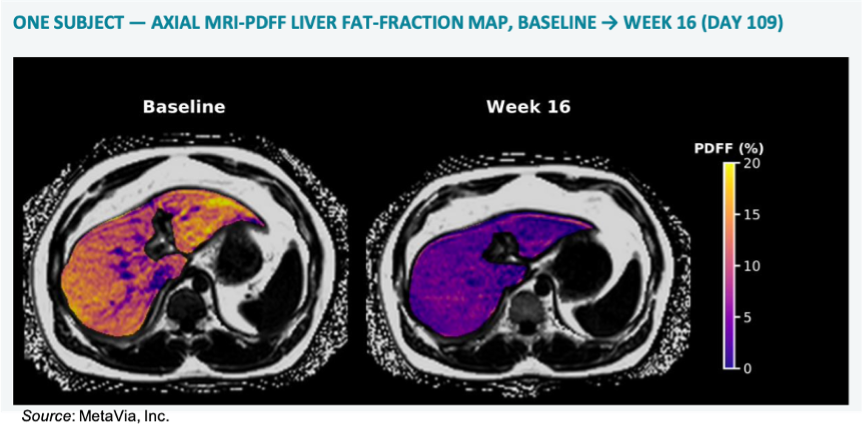
An important finding from the study was the reduction in liver fat, which declined 68% on a placebo-adjusted basis as measured by MRI-proton density fat fraction (MRI-PDFF; P<0.001). The absolute treatment difference versus placebo was 6.4 percentage points (P=0.007). Importantly, 10 of 12 DA-1726-treated patients (83%) achieved at least a 30% relative reduction in liver fat, compared with none of the four placebo participants. All five participants with baseline liver steatosis (MRI-PDFF of ≥ 5%) achieved levels below 5% by Day 109. Among those five participants, mean liver fat declined from 8.3% to 3.0%, a 5.3-percentage-point reduction (P=0.005). In contrast, liver fat in the placebo group increased 40.4% from baseline. The following figure shows a representative MRI-PDFF liver fat-fraction map for a DA-1726-treated subject, with yellow-orange representing 15-20% fat and purple representing 0-5% liver fat. At baseline this patient’s liver was mostly orange on the scan while at Week 16 it is almost completely purple, thus showing that liver fat has decreased into the normal range.
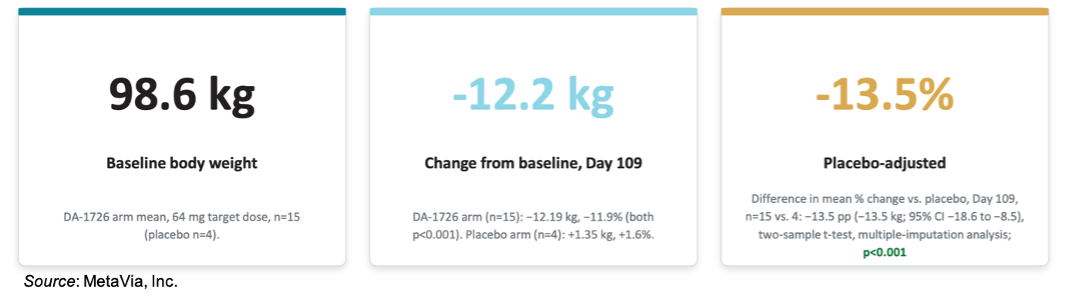
At Day 109, DA-1726 demonstrated a statistically significant 13.5% placebo-adjusted reduction in body weight (P<0.001). Participants receiving DA-1726 lost an average of 12.2 kg (26.9 lbs), which represents an 11.9% reduction from baseline body weight of 98.6 kg (217 lbs), compared with a 1.6% increase in the placebo group.
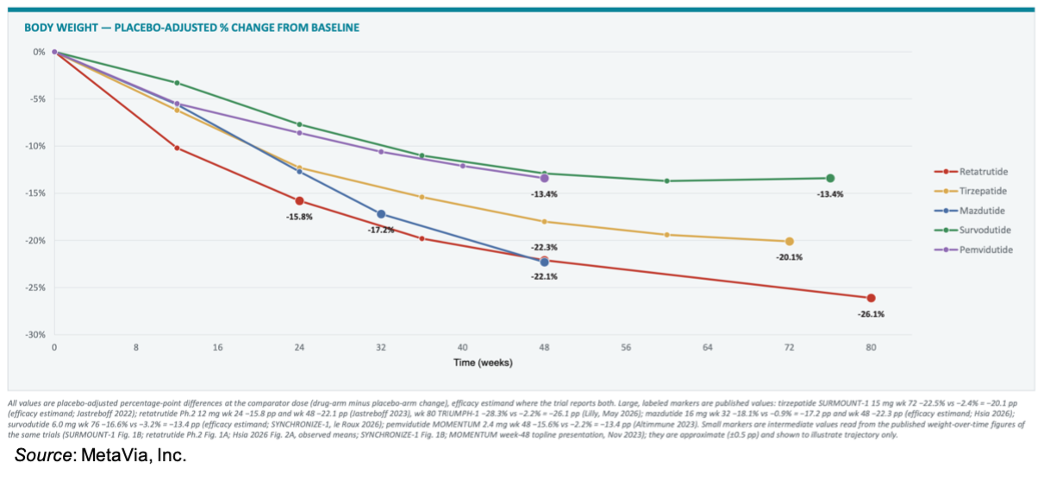
The weight loss result compares quite favorably with publicly reported early-stage data for several incretin-based obesity candidates. For example, retatrutide produced approximately 15.8% placebo-adjusted weight loss at 24 weeks in its Phase 2 obesity study (Jastreboff et al., 2023), while tirzepatide demonstrated approximately 12.8 kg of absolute weight loss at 20 weeks in SURMOUNT-1 across the pooled treatment groups (Jastreboff et al., 2022). Other dual GLP-1/glucagon agonists have also demonstrated meaningful weight reductions, including mazdutide, survodutide, and pemvidutide, as shown in the following figure. It should be noted that cross-trial comparisons are limited by a number of factors, including duration, titration schedules, and patient populations. In addition, the long-term results for retatrutide and tirzepatide show that substantial additional weight loss can occur with extended treatment. Thus, DA-1726’s results should be viewed as an encouraging early efficacy signal when compared to other incretin-based therapies.
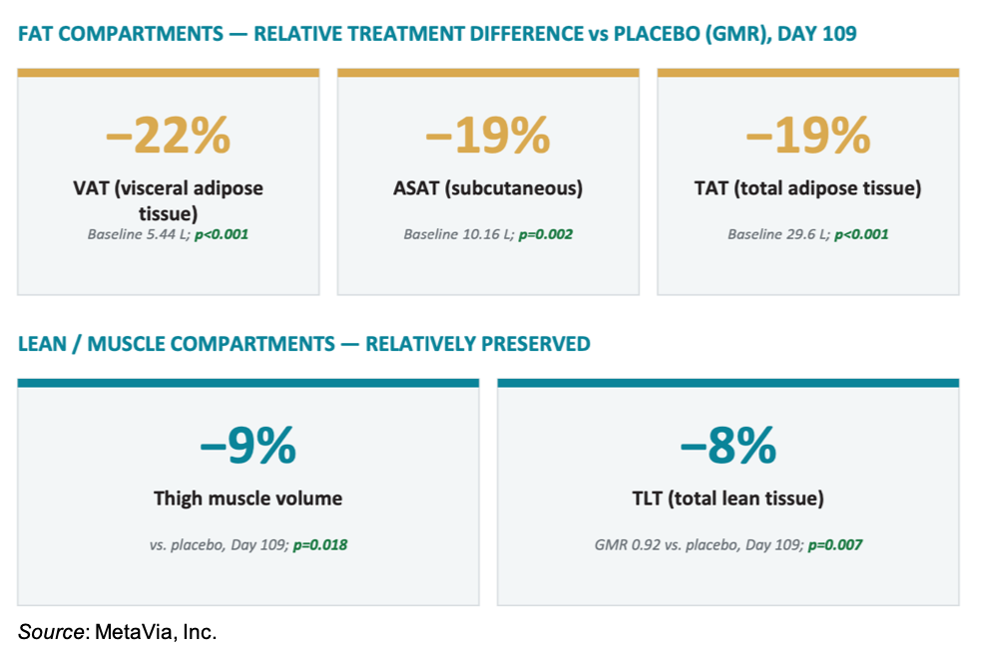
DA-1726 also showed improvements in glycemic control and body composition. Mean HbA1c declined from 5.79% to 5.33%, representing a 0.44 percentage-point reduction from baseline and a statistically significant 0.24 percentage-point improvement relative to placebo (P=0.006). Visceral adipose tissue declined 22% compared to placebo, while abdominal subcutaneous adipose tissue and total adipose tissue declined 19% each. Interestingly, lean tissue and muscle volume were relatively preserved, declining 8% and 9%, respectively, versus placebo. Lastly, waist circumference declined 9.1% on a placebo-adjusted basis.
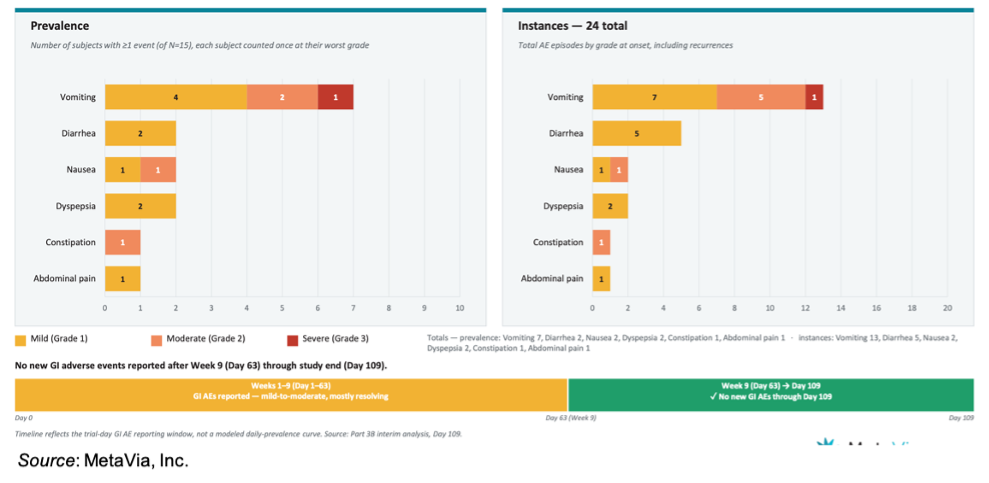
The safety profile was generally manageable, with gastrointestinal (GI) adverse events (AEs) being the most common. Nine of 15 DA-1726-treated patients reported GI AEs, including vomiting in seven participants (46.7%) and nausea in two (13.3%). One serious adverse event (SAE) involving severe vomiting was considered possibly treatment-related, however there was just one instance of it occurring and the patient recovered. There were no study discontinuations due to AEs. The following figure shows the prevalence and instances for GI AEs along with the fact that all GI AEs occurred during the titration portion of the study (through Day 63) while no new GI AEs were reported from Day 63 through the end of the study at Day 109.
Shift in Development Strategy to MetALD and ALD
Based on the findings from the Phase 1 Part 3B trial, MetaVia intends to prioritize development of DA-1726 in MetALD and ALD, rather than pursuing the increasingly competitive obesity market as its primary development. The company believes the combination of GLP-1 and glucagon receptor activation may be particularly relevant in these populations given the importance of metabolic dysfunction, adiposity, and hepatic fat accumulation in disease progression.
MetALD is a relatively new disease classification that was introduced as part of the 2023 multisociety revision of steatotic liver disease nomenclature (Rinella et al., 2023). It encompasses patients with hepatic steatosis and at least one cardiometabolic risk factor, such as obesity, type 2 diabetes, hypertension, or dyslipidemia, who also consume moderate amounts of alcohol. Specifically, the classification includes women consuming 140-350 grams of alcohol weekly (~2-3 glasses of wine a day) and men consuming 210-420 grams weekly (~ 3-4 glasses of wine a day). ALD encompasses patients with heavier alcohol consumption, exceeding 350 grams weekly (≥4 glasses of wine a day) in women and 420 grams weekly (≥5 glasses of wine a day) in men.
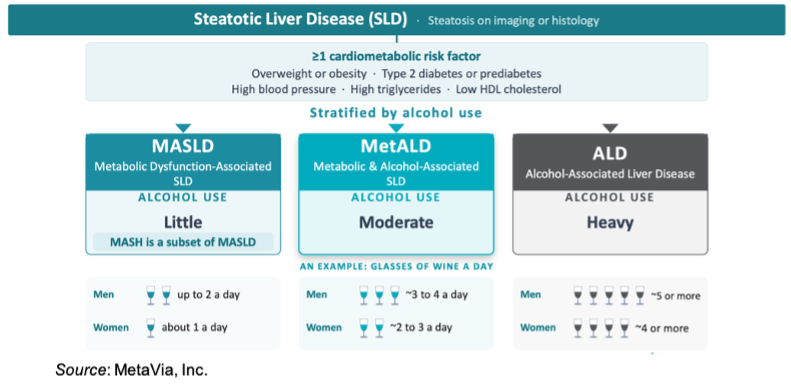
There is a wide range for the estimated prevalence of MetALD in the U.S. due to the fact that self-reported alcohol intake badly underestimates the true consumption. For example, the prevalence of MetALD was found to be approximately 5.7 million U.S. adults using a cross-sectional and longitudinal analysis of U.S. National Health and Nutrition Survey (NHANES) data from 1988 to 2023. After adjusting for alcohol underreporting the prevalence of MetALD was approximately 10.7 million adults (Younossi et al., 2026). The treatment eligible subset of this population, those with F2+ fibrosis, is approximately 15-20% of the prevalence population.
The opportunity in MetALD is particularly appealing given that there are limited treatment options. Currently, there are no FDA-approved therapies specifically indicated for MetALD or ALD, although several companies are pursuing adjacent or overlapping indications. For example, Altimmune is developing pemvidutide in the 48-week RESTORE Phase 2 study involving approximately 120 patients with ALD and a history of chronic heavy drinking (NCT07009860), with topline results expected in the second half of 2027. In addition, the National Institute on Alcohol Abuse and Alcoholism is conducting a 12 week Phase 2 study evaluating tirzepatide in patients with alcohol use disorder and MetALD (NCT07046819).
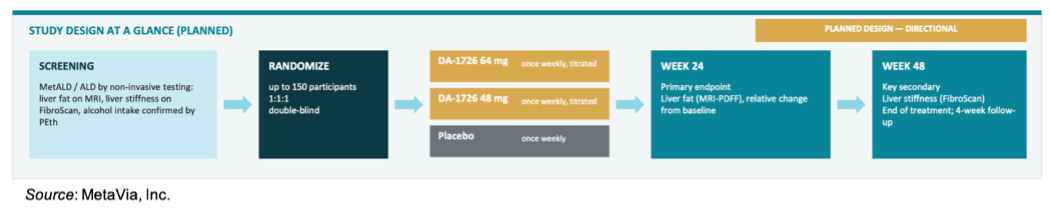
MetaVia is planning to initiate a 48 week, randomized, double blind, placebo controlled Phase 2 study in up to 150 patients with MetALD and ALD during the second half of 2027. The proposed study will evaluate two DA-1726 dose levels (64 mg and 48 mg) against placebo, with 1:1:1 randomization. The primary endpoint is expected to be the relative change in liver fat measured by MRI-PDFF at Week 24, with liver stiffness at Week 48 serving as a key secondary endpoint. Additional assessments are expected to include fibrosis biomarkers, liver enzymes, body weight, glycemic control and alcohol consumption. The proposed protocol also uses phosphatidylethanol (PEth), a blood-based biomarker of recent alcohol consumption, to provide an objective assessment of alcohol intake. The final study design is subject to feedback from the FDA.
Conclusion
The results from the Phase 1 Part 3B trial are a very encouraging development for DA-1726 and open up a potentially more differentiated development opportunity in MetALD and ALD than competing directly in the obesity market. While the 13.5% placebo-adjusted weight reduction is impressive for a 16 week study, the 68% reduction in liver far is arguably the more important finding that provides support for the company’s new focus on MetALD and ALD. The combination of improvement in hepatic fat, body weight, and glycemic control provides a reasonable biological rationale for evaluating DA-1726 in patients with overlapping metabolic and alcohol-related liver disease. The competitive landscape is also relatively underdeveloped, thus if MetaVia can advance DA-1726 into the planned Phase 2 study, the program could establish a differentiated position in an area with substantial unmet medical need. We believe the latest results strengthen the rationale for continued development of DA-1726, while the upcoming Phase 1 Part 3A topline data (expected in the first quarter of 2027) should provide a more comprehensive assessment of its efficacy and tolerability.
We have incorporated MetALD and ALD into our financial model with the following assumptions: 10.7 million MetALD patients in the U.S. with 15% of those being F2+ and being eligible for treatment, a Phase 2 study to launch in 2027, a Phase 3 study to launch in 2029, a BLA filing in 2032, approval in 2033, peak sales of ~$1.6 billion seven years after launch, a 12% discount rate, and a 30% probability of approval. We have also kept the obesity indication in the model based on the topline weight loss number but lowered the probability of approval in obesity to 10%. This results in a valuation of $25 per share.
SUBSCRIBE TO ZACKS SMALL CAP RESEARCH to receive our articles and reports emailed directly to you. Please visit our website for additional information on Zacks SCR.
DISCLOSURE: Zacks SCR has received compensation from the issuer directly, from an investment manager, or from an investor relations consulting firm, engaged by the issuer, for providing research coverage for a period of no less than one year. Research articles, as seen here, are part of the service Zacks SCR provides and Zacks SCR receives payments totaling a maximum fee of up to $50,000 annually for these services provided to or regarding the issuer. Full Disclaimer HERE.