By David Bautz, PhD
NASDAQ: MTVA
READ THE FULL MTVA RESEARCH REPORT
Business Update
Dose Titration Complete in Phase 1 Part 3 Study of DA-1726
MetaVia, Inc. (NASDAQ: MTVA) is currently conducting Part 3 of the Phase 1 study of DA-1726, the company’s oxyntomodulin analog agonist that targets glucagon-like peptide-1 receptors (GLP1R) and glucagon receptors (GCGR), for the treatment of obesity. The trial has a planned enrollment of 40 obese but otherwise healthy individuals across two parts, with 20 subjects per part randomized 4:1 (16 active; 4 placebo). Part 3A will evaluate a one-step titration regimen with 16 mg DA-1726 for four weeks followed by 48 mg DA-1726 for 12 weeks. Part 3B will evaluate a two-step titration regimen, with 16 mg DA-1726 for four weeks, 32 mg DA-1726 for four weeks, and 64 mg DA-1726 for eight weeks. On July 9, 2026, the company announced the completion of the dose titration portion of Part 3 of the Phase 1 study of DA-1726, with all actively enrolled patients having reached their highest target doses in both study cohorts.
The primary endpoints of the study include monitoring adverse events (AEs), serious adverse events (SAEs), treatment-emergent adverse events (TEAEs), and AEs leading to discontinuation. Secondary and exploratory endpoints include pharmacokinetic (PK) profiling and evaluation of metabolic, glycemic, lipid, and body composition measures, including weight, waist circumference, and body mass index (BMI). We anticipate topline results in the fourth quarter of 2026.
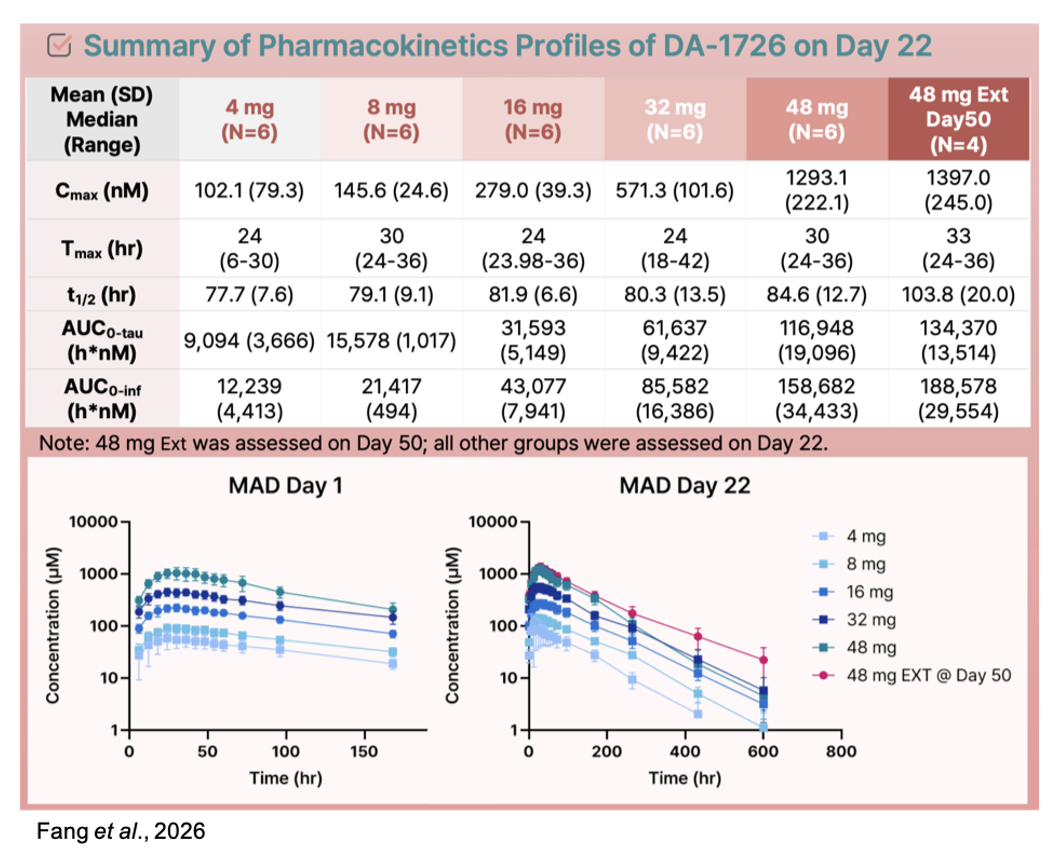
In June 2026, MetaVia presented new late-breaking data on DA-1726 at the American Diabetes Association (ADA) 2026 Scientific Sessions. A copy of the poster can be found here. The presentation included new pharmacokinetic (PK) results from the Phase 1 study of DA-1726 that showed linear and dose-proportional PK data that support once-weekly dosing.
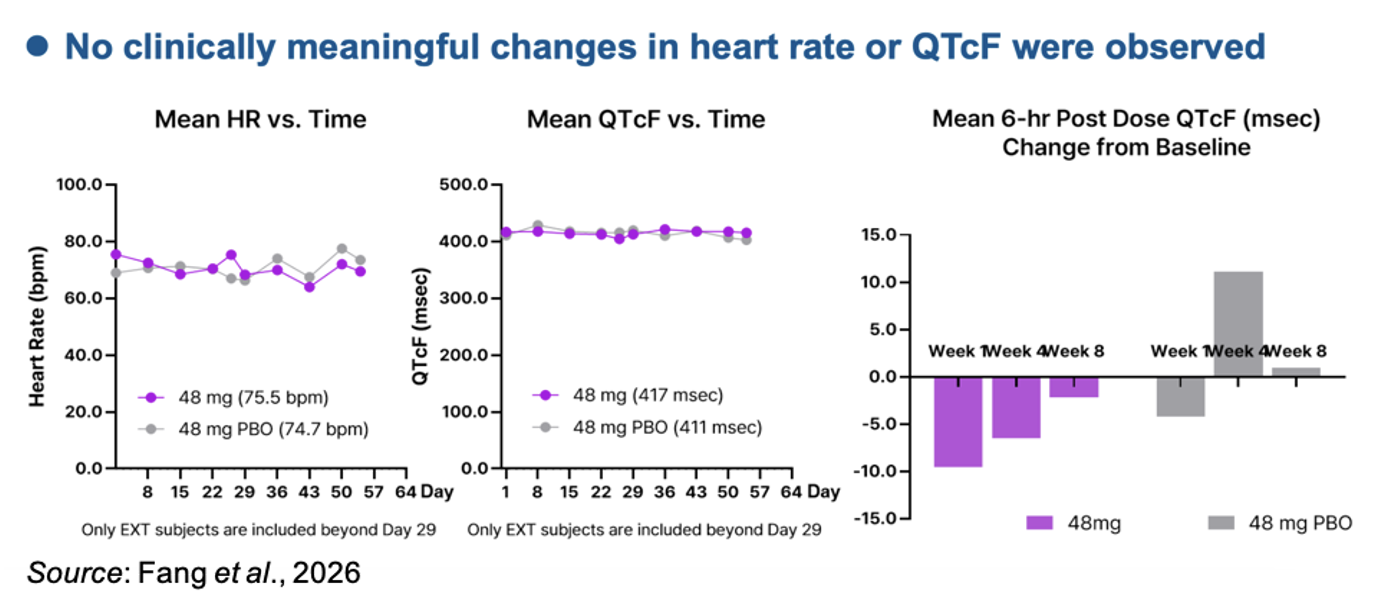
In May 2026, MetaVia presented new data from the Phase 1 trial of DA-1726 at the European Association for the Study of the Liver Congress 2026 (EASL 2026) that included results showing no clinically meaningful changes in heart rate or QTcF, which is the corrected QT interval (the time it takes for the heart’s lower chambers to electrically reset between beats) adjusted for heart rate using the Fridericia correction formula. A rising QTcF suggests there may be altered cardiac ion channel activity (a potential arrhythmia risk), which can occur with some pharmaceuticals. Normal absolute QTcF numbers are generally <450 msec for men and <470 msec for women. As the QTcF rises >500 msec, it can be cause for concern. In addition, drugs that target glucagon receptors can theoretically increase heart rate more so than pure GLP-1 agonists. The data for DA-1726 show that the QTcF values remain near ~410-420 msec and show no increase toward 500 msec. In fact, if anything, the QTcF numbers decrease slightly for those treated with DA-1726. In addition, the recorded heart rates remained roughly stable (65-75 bpm). Thus, we see no effect thus far of DA-1726 on cardiovascular parameters.
Financial Results
On August 6, 2026, MetaVia announced financial results for the second quarter of 2026. As expected, the company did not report any revenues in the second quarter of 2026. R&D expenses for the second quarter of 2026 were approximately $3.5 million compared to approximately $2.3 million for the second quarter of 2025. The increase was primarily due to higher direct R&D expenses related to DA-1726 product development. G&A expenses were approximately $1.9 million for the second quarter of 2026 compared to approximately $2.0 million in the second quarter of 2025. The decrease was primarily due to lower legal and professional fees.
As of June 30, 2026, MetaVia had approximately $12.6 million in cash and cash equivalents. We estimate the company has sufficient capital to fund operations through the end of 2026. As of August 3, 2026, MetaVia had approximately 6.6 million shares outstanding and, when factoring in stock options and warrants, a fully diluted share count of approximately 15.5 million.
Conclusion
Now that MetaVia has successfully titrated all patients in Part 3 of the Phase 1 trial to their highest target dose, the next big catalyst should be the topline data release in the fourth quarter of 2026. We will be particularly interested not just in the weight loss numbers, but in how the adverse event profile compares to other agents, particularly with the titration regiment. While we await the results, we have made no changes to our model, and our valuation remains at $30 per share.
SUBSCRIBE TO ZACKS SMALL CAP RESEARCH to receive our articles and reports emailed directly to you. Please visit our website for additional information on Zacks SCR.
DISCLOSURE: Zacks SCR has received compensation from the issuer directly, from an investment manager, or from an investor relations consulting firm, engaged by the issuer, for providing research coverage for a period of no less than one year. Research articles, as seen here, are part of the service Zacks SCR provides and Zacks SCR receives payments totaling a maximum fee of up to $50,000 annually for these services provided to or regarding the issuer. Full Disclaimer HERE.