By John Vandermosten, CFA
NYSE: NSRX
READ THE FULL NSRX RESEARCH REPORT
Nasus Pharma Ltd. (NYSE: NSRX) held a virtual Key Opinion Leader (KOL) event on June 10th, 2026, featuring two distinguished physicians representing the allergy space: Michael S. Blaiss, MD, and Joel Brooks, DO, MPH. They were joined by Nasus’ CEO, Dan Teleman, Chief Development Officer, Dr. Dalia Megiddo, and CFO Eyal Rubin. The presentation provided a review of Nasus, its lead candidate NS002, and the Phase II clinical trial results for the treatment of anaphylaxis. KOLs shared their opinions on unmet needs, approved therapies, and trends in the anaphylaxis space. A day prior to the webcast, Nasus reported results from its preclinical pharmacokinetic (PK) and safety study of intranasal ondansetron, intended to treat chemotherapy and post-operative nausea and vomiting. It was a good week for the company and a step forward for its pipeline assets.
Nasus Pharma NS002 Virtual KOL Event
On June 10th, Nasus held a KOL event to discuss NS002 for the treatment of anaphylaxis. The event featured two KOLs and Nasus management team members. Michael S. Blaiss, MD, from the Medical College of Georgia, Good Samaritan Health Center of Gwinnett, and Joel Brooks, DO, MPH, from Columbia University Vagelos College of Physicians and Surgeons, were the featured guests. CEO Dan Teleman, Chief Development Officer Dr. Dalia Megiddo, and CFO Eyal Rubin represented Nasus management. Mr. Teleman began with an introduction to Nasus Pharma and the KOL guests. Details on the background of NS002 can be found in our May 22nd initiation.
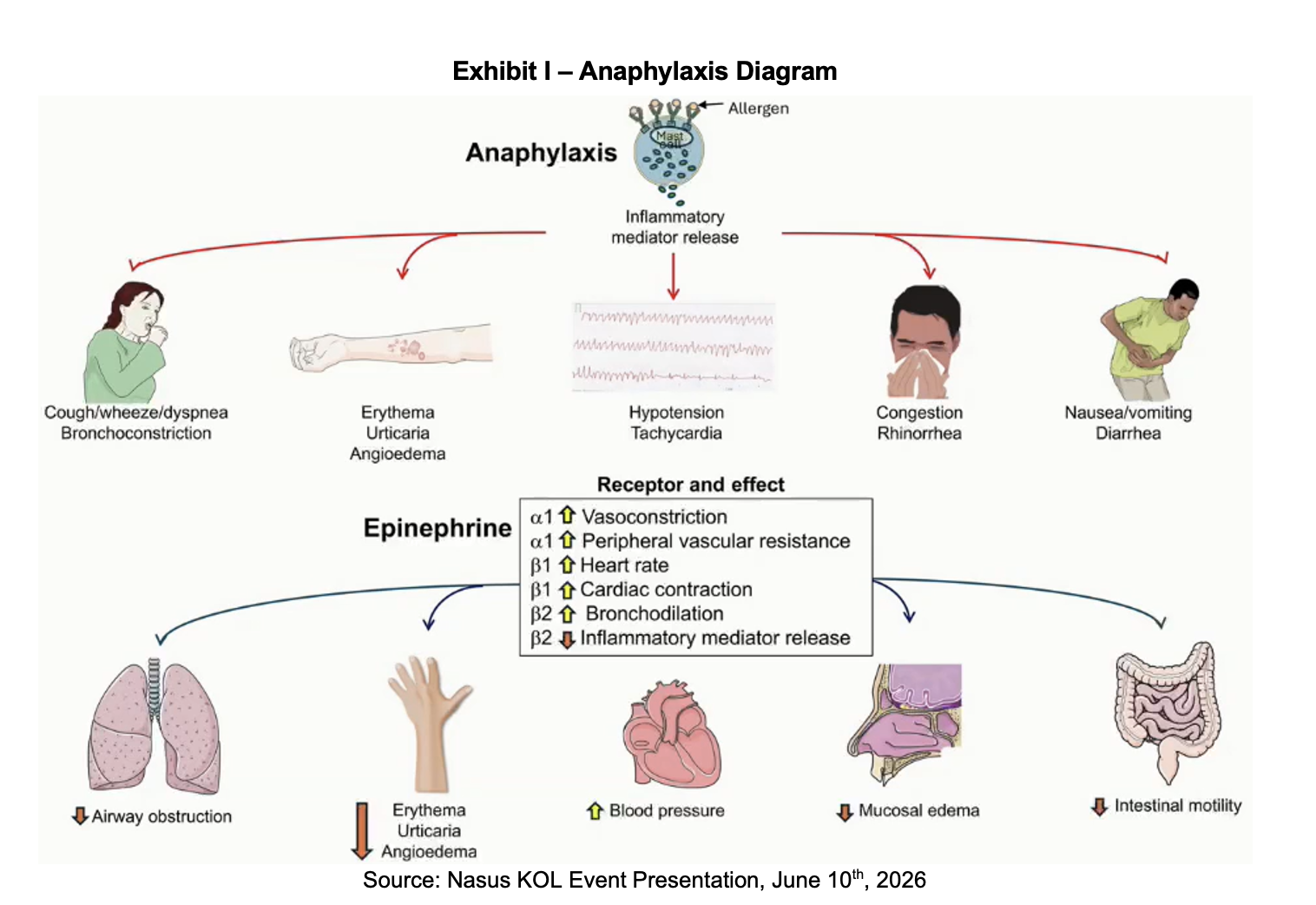
Nasus’ CEO handed the call off to Dr. Blaiss to provide background on anaphylaxis. The condition rapidly occurs as allergens bind to high-affinity Immunoglobulin E (IgE) receptors on mast cells, and cross-linking activates the mast cell and triggers degranulation. This is followed by the release of histamine and other inflammatory signals, which provoke an allergic reaction. If the reaction is widespread, it can be considered anaphylaxis. When this occurs, standard of care treatment is epinephrine.
Dr. Blaiss continued, noting that there is an estimated range of 1.6% to 5.1% of the population that has experienced an anaphylactic episode and that the prevalence has increased over the last one or two decades. Food allergies are the largest contributor to anaphylaxis, especially in children. Adults have a higher rate of anaphylaxis from medications. These allergens can lead to symptoms that progress within minutes, including urticaria (hives), bronchospasm, cardiovascular collapse, and death. Epinephrine is the only first-line treatment for the condition, as antihistamines and steroids are adjunctive only. The following exhibit illustrates anaphylaxis and epinephrine’s effect on it.
A significant hurdle to treating anaphylaxis presented by Dr. Blaiss is patients’ failure to use epinephrine despite having it. He cited fear of needles, leaving at home due to large size, concern about pain for self or child, device complexity, and difficulty administering under stressful or anaphylactic conditions as reasons why it is not used. In some cases, the product is administered, but important steps are missed. A specific example of this was that the injector should be held in place for five seconds following the administration of the medicine. Another important step frequently skipped is the administrator massaging the site for 10 seconds after injection to improve absorption. New approaches can simplify the limitations of injected epinephrine.
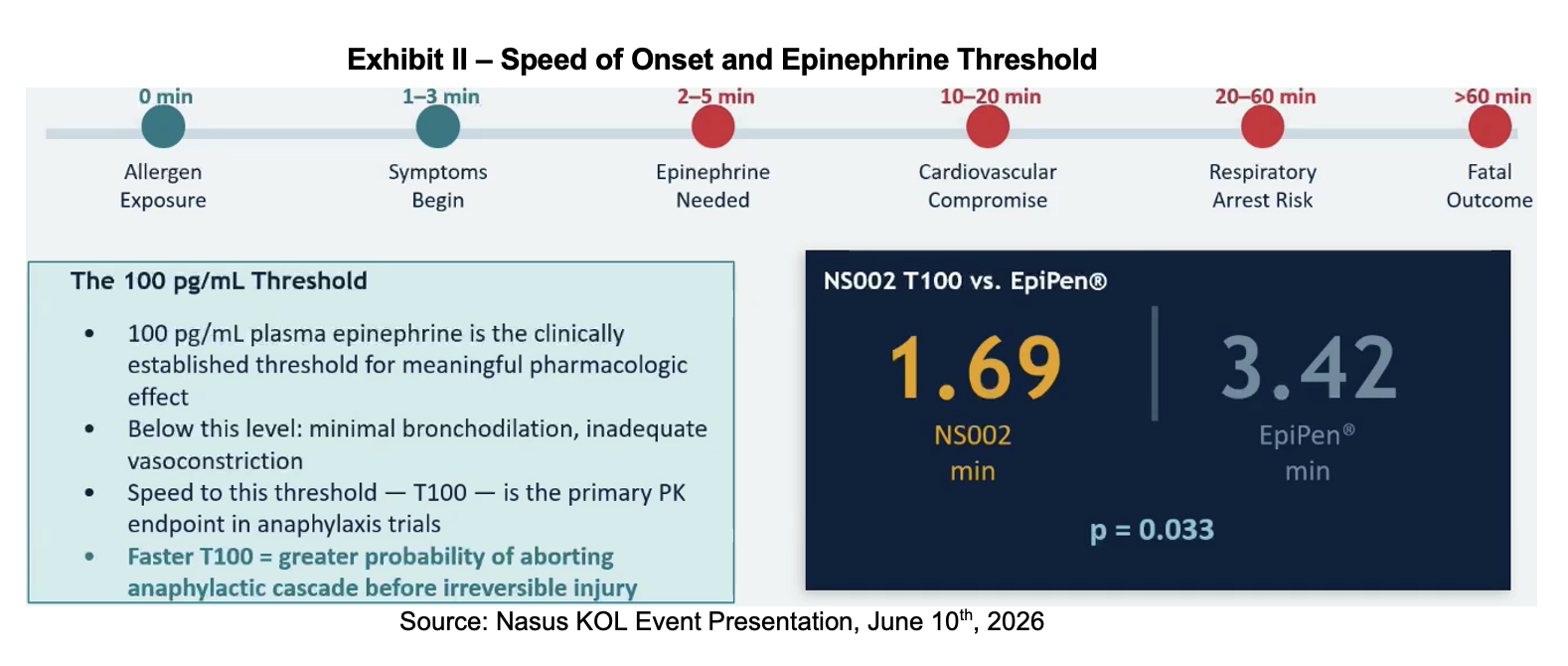
The following slide from Dr. Blaiss highlighted the timeline for anaphylaxis and the critical epinephrine threshold required to counteract the allergic response. He related this to the recent Phase II data for NS002 and how the faster time to threshold can provide life-saving benefits to patients experiencing anaphylaxis.
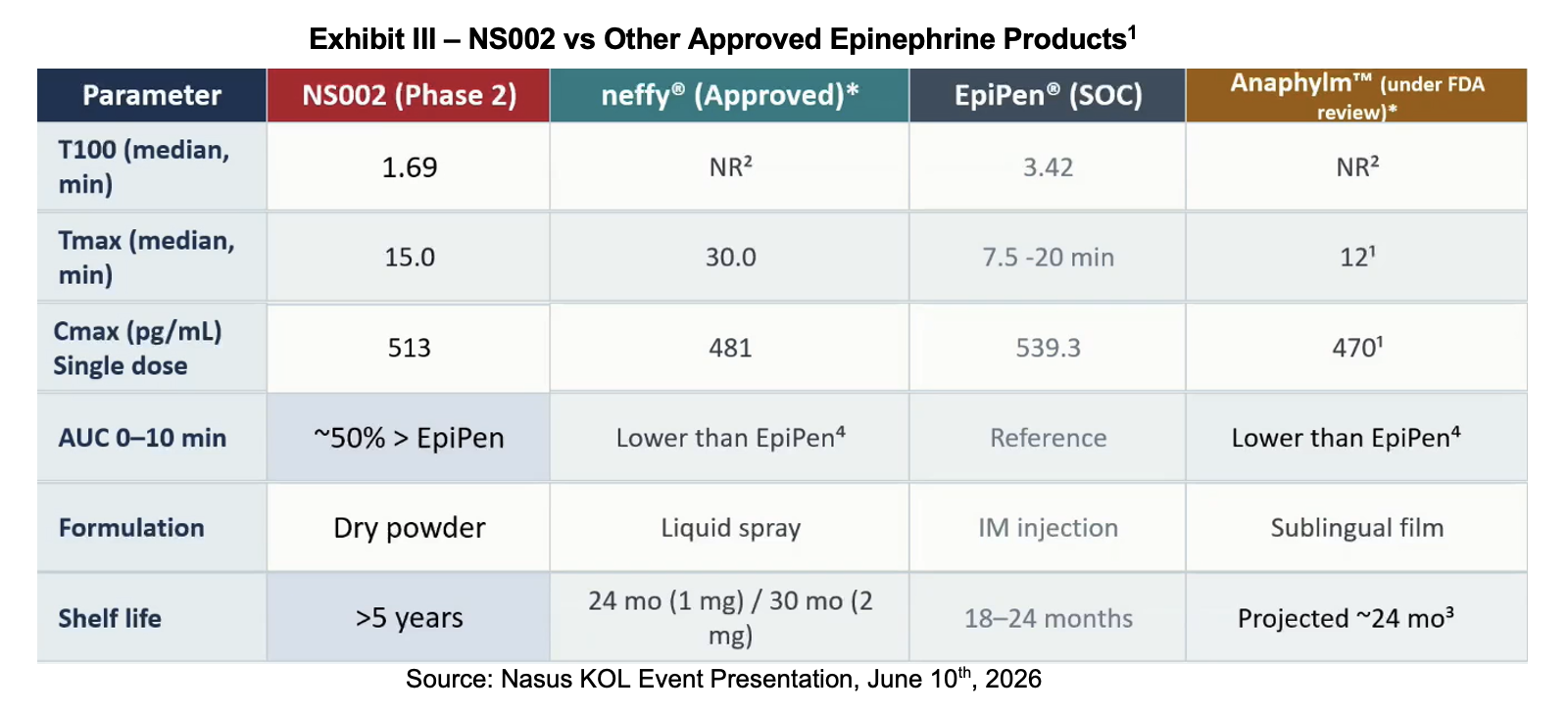
The next segment of Dr. Blaiss’ presentation reviewed the results from the NS002 Phase II study. We provided a summary of the results in our March 16th note. The presentation provided a helpful summary of performance metrics for the key epinephrine products in the space, which we include below.
Dr. Brooks accepted the baton from Dr. Blaiss and continued the webcast by describing the growing epidemic of allergy. According to his resources, 8% of US children have IgE-mediated food allergy, and 10.8% of adults report a food allergy. Peanut, milk, shellfish, and tree nuts are the primary categories in descending prevalence. These allergies produce a 42% emergency department (ED) visit rate and a 19% ED visit for food-allergic children per year.
These allergies create a burden for patients and their families related to unpredictable exposure threats that are far-ranging. Dr. Brooks highlighted anxiety, dietary restrictions, and social isolation as the most common. Availability of epinephrine can, in part, alleviate these burdens if it is easily accessible. Dr. Brooks identified several elements that, if improved, could help: 1) Improved carry rate; 2) Greater use of epinephrine when needed in place of OTC medications; and 3) Accelerated use of epinephrine. Timely administration of epinephrine may even allow the afflicted individual to return to their activities without an ED visit.
The next segment of the webcast examined data regarding treatment adherence. Most adults and adolescents were willing to immediately use intranasal epinephrine, with the strongest desire among the needle-phobic group. A greater proportion of adults were also willing to carry an intranasal epinephrine device vs. an autoinjector. Patient priorities emphasize faster symptom relief and higher delivery success rate. Caregivers were more concerned with route of administration.
Following the KOL presentations, the event opened up for analyst questions, which revolved around real-world usage of intranasal epinephrine. Participants wanted to know how the practitioners would prescribe, which patients they would prescribe to, the relative benefit of NS002 compared to approved products, and anecdotal examples of intranasal epinephrine use. Other questions revolved around performance and initial commercialization hurdles for neffy and the spectrum of allergy and anaphylaxis, specifically where epinephrine is appropriate.
Ondansetron NS003 Data Report
Nasus issued a June 9th press release summarizing the results from a preclinical PK and Safety Study of intranasal ondansetron. The asset is designated NS003 and is being developed for chemotherapy and post-operative nausea and vomiting. The preclinical study compared NS003 to an intravenous (IV) formulation of ondansetron in an animal study. The data demonstrated a PK profile for NS003 comparable to IV, with similar time to maximum concentration (Tmax) and area under the curve (AUC) results. In a separate toxicology study, NS003 demonstrated a favorable safety profile at four times the test dose, with no adverse effects observed. Nasus Pharma is now preparing to initiate a first-in-human PK study in the third quarter of 2026.
Ondansetron Mechanism of Action
Ondansetron is a selective 5-HT3 (serotonin type 3) receptor antagonist, widely known under the brand name Zofran. It's one of the most commonly prescribed antiemetics in both oncology and surgical settings. Ondansetron works by blocking 5-HT3 receptors, which are found both peripherally on vagal afferent nerve terminals in the gastrointestinal tract and centrally in the chemoreceptor trigger zone of the area postrema,[2] and in the nucleus tractus solitarius (NTS[3] in the brainstem. The emetic reflex driving nausea and vomiting after chemotherapy or surgery is heavily mediated by serotonin release from enterochromaffin cells in the gut wall. When cytotoxic chemotherapy damages these cells, or when surgical/anesthetic stimuli trigger their release, serotonin binds to 5-HT3 receptors on vagal afferents, sending signals up to the brainstem vomiting center. Ondansetron sits on those receptors and blocks serotonin from activating them, interrupting the reflex at both the peripheral gut level and the central trigger zone level. It has essentially no effect on dopamine receptors, which distinguishes it mechanistically from older antiemetics like metoclopramide or prochlorperazine.
Nasus management has identified approximately one million patients in the United States that undergo chemotherapy and 800,000 that receive radiotherapy every year. A proportion of these patients experience nausea and vomiting that would benefit from antiemetic treatment. Nasally administered ondansetron may provide a convenient, portable, and outpatient method for managing this condition.
Summary
Nasus held a KOL event to communicate with investors and to discuss the treatment landscape and unmet needs for anaphylaxis. Two KOL speakers were joined by senior members of Nasus management to present recent clinical trial data for NS002, discuss products available for anaphylaxis, and explore their drawbacks. The group reviewed EpiPen, neffy, and Anaphylm along with solutions offered by NS002. After an extensive discussion of the benefits of nasal administration, the call opened up for analyst questions. A day prior to the KOL event, Nasus shared results for NS003 demonstrating comparable performance for its asset vs. IV ondansetron. The company indicated its intent to begin a human clinical trial for NS003 later this year. More importantly, we expect to see NS002 start a pivotal study, which is planned to begin in 4Q:26 and generate topline data by early 2027.
SUBSCRIBE TO ZACKS SMALL CAP RESEARCH to receive our articles and reports emailed directly to you each morning. Please visit our website for additional information on Zacks SCR.
DISCLOSURE: Zacks SCR has received compensation from the issuer directly, from an investment manager, or from an investor relations consulting firm, engaged by the issuer, for providing research coverage for a period of no less than one year. Research articles, as seen here, are part of the service Zacks SCR provides and Zacks SCR receives payments totaling a maximum fee of up to $50,000 annually for these services provided to or regarding the issuer. Full Disclaimer HERE.
________________________
[1] In contrast to the parenthetical note in the Anaphylm heading, we note that it received a CRL and is being prepared for resubmission.
[2] The area postrema is the anatomical brain structure located in the medulla oblongata on the floor of the fourth ventricle.
[3] The NTS acts as the primary relay station for interoceptive information, continuously monitoring & regulating the body's internal environment.