By David Bautz, PhD
NASDAQ: ONCY
READ THE FULL ONCY RESEARCH REPORT
Business Update
Aligns with FDA on Pivotal Trial in Anal Cancer
In April 2026, Oncolytics Biotech Inc. (NASDAQ: ONCY) announced it had reached alignment with the U.S. Food and Drug Administration (FDA) on a pivotal study for pelareorep, the company’s lead development product that is a systemically delivered oncolytic virus designed to selectively replicate in cancer cells and enhance anti-tumor immunity, in unresectable metastatic squamous cell carcinoma of the anal canal (SCAC). The company is currently incorporating the FDA’s feedback into a final protocol, which is expected to be a single, randomized controlled clinical trial with the ability to seek both accelerated approval and full approval at different points in the trial.
SCAC is a relatively rare malignancy, with approximately 9,000–10,000 new cases diagnosed annually in the United States, but its incidence has been steadily increasing over the past several decades (Siegel et al., 2024). The disease is strongly associated with infection by high-risk human papillomavirus (HPV), particularly HPV-16, which drives oncogenesis through expression of viral oncoproteins that promote immune evasion and cellular transformation (Lin et al., 2018).
While early-stage SCAC can often be treated effectively with chemoradiation, outcomes for patients with unresectable or metastatic disease are significantly worse. First-line treatment has historically consisted of platinum-based chemotherapy (e.g., carboplatin plus paclitaxel), which can achieve response rates in the range of 60-80%, although a substantial proportion of patients ultimately experience disease progression (Gondal et al., 2023). More recently, the treatment landscape has begun to evolve with the incorporation of immune checkpoint inhibitors, including the approval of retifanlimab in combination with chemotherapy in the first-line setting. Despite this progress, outcomes following progression remain poor, and treatment patterns in the second-line and later setting are not well defined, with no universally adopted standard of care.
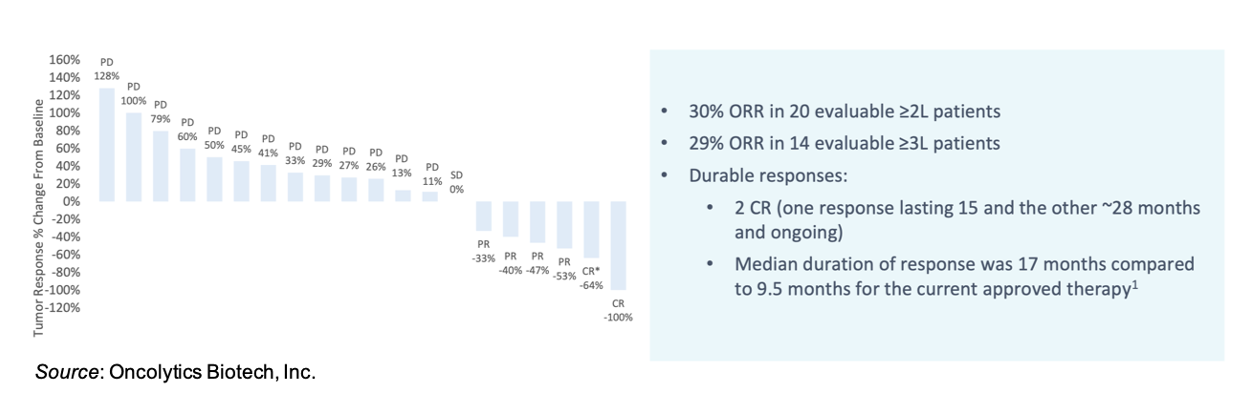
Pelareorep has been evaluated in SCAC in the GOBLET study, an ongoing multi-cohort clinical trial investigating pelareorep in combination with checkpoint inhibition and chemotherapy, as appropriate, across gastrointestinal malignancies (NCT07280377). In Cohort 4, pelareorep was combined with the PD-L1 inhibitor atezolizumab in patients with second-line or later SCAC, representing a heavily pretreated population with limited therapeutic options. Updated data from this cohort demonstrated evidence of clinical activity, including a 30% overall response rate and a median 17-month duration of response.
Notably, the pattern of response observed in GOBLET Cohort 4 is consistent with pelareorep’s proposed mechanism as an immune primer. Treatment was associated with tumor shrinkage across multiple patients, including both partial responses and prolonged stable disease, suggesting that the combination of pelareorep and checkpoint inhibition may overcome resistance mechanisms that limit the efficacy of PD-1/PD-L1 blockade alone. While cross-trial comparisons should be interpreted cautiously, the observed activity compares favorably to historical benchmarks for checkpoint inhibitor monotherapy in this setting, where response rates are generally low and disease control is limited.
Durable Responses Reported in Second-Line CRC
In May 2026, Oncolytics announced new durability data from the ongoing REO 022 trial that demonstrated a 19.5-month median duration of response in second-line KRAS-mutant, microsatellite stable (MSS) metastatic colorectal cancer (mCRC) patients. This is in addition to previously reported median overall survival (OS) data of 27.0 months. These results compare favorably to established benchmarks for FOLFIRI plus bevacizumab in the second-line setting. Across prospective trials and real-world studies, objective response rates for FOLFIRI-based regimens in previously treated mCRC are typically in the range of ~6–11%, with median PFS of approximately 5–7 months and median OS of approximately 11–13 months (Bennouna et al., 2013; Iwamoto et al., 2015). While cross-trial comparisons should be interpreted with caution, the magnitude of improvement observed with pelareorep, particularly in a molecularly defined, poor-prognosis KRAS-mutant population, suggests the potential for meaningful clinical benefit beyond cytotoxic therapy alone.
Oncolytics is currently enrolling a Phase 2 trial in second-line, RAS-mutated, microsatellite-stable mCRC patients (NCT07446322). The patients will be randomized into one of two groups: bevacizumab and FOLFIRI or pelareorep, bevacizumab, and FOLFIRI. The study is powered for statistical significance, with each arm expected to enroll 30 patients. The primary endpoint of the trial is objective response rate (ORR), with PFS, OS, safety, and biomarker analysis as other endpoints. The company is actively engaged with the FDA regarding a potential accelerated approval pathway based on response durability and time-to-event endpoints in this study.
Financial Update
On May 14, 2026, Oncolytics filed Form 10-Q with financial results for the first quarter of 2026. As expected, the company did not report any revenues in the first quarter of 2026. R&D expenses in the first quarter of 2026 were $4.6 million compared to $2.8 million in the first quarter of 2025. The increase was primarily due to increased personnel-related expenses and clinical trial costs. G&A expenses in the first quarter of 2026 were $4.7 million compared to $2.2 million in the first quarter of 2025. The increase was primarily due to increased public company-related expenses, personnel-related expenses, and intellectual property expenses.
As of March 31, 2026, Oncolytics had approximately $5.5 million in cash and cash equivalents. Subsequent to the end of the quarter, the company sold approximately 2.6 million common shares pursuant to an Open Market Sale Agreement signed in April 2026 with Jefferies LLC for net proceeds of approximately $2.3 million. As of May 12, 2026, Oncolytics had approximately 119.4 million common shares outstanding and, when factoring in stock options and warrants, a fully diluted share count of 146.6 million.
Conclusion
We look forward to additional details on the upcoming pivotal trial for pelareorep in anal cancer, for which we continue to anticipate it initiating in the second half of 2026. The updated response data for pelareorep in mCRC is very encouraging, and we look forward to updates from the company regarding the potential for accelerated approval in that indication. With no changes to our model, our valuation remains at $6 per share.
SUBSCRIBE TO ZACKS SMALL CAP RESEARCH to receive our articles and reports emailed directly to you each morning. Please visit our website for additional information on Zacks SCR.
DISCLOSURE: Zacks SCR has received compensation from the issuer directly, from an investment manager, or from an investor relations consulting firm, engaged by the issuer, for providing research coverage for a period of no less than one year. Research articles, as seen here, are part of the service Zacks SCR provides and Zacks SCR receives payments totaling a maximum fee of up to $50,000 annually for these services provided to or regarding the issuer. Full Disclaimer HERE.