By John Vandermosten, CFA
NYSE: PLX
READ THE FULL PLX RESEARCH REPORT
Second Quarter 2026 Financial and Operational Review
Protalix BioTherapeutics, Inc. (NYSE: PLX) surprised to the upside with a strong quarter of sales for Elfabrio, generating revenues of over $14 million for the product in 2Q:26. The result vaulted total revenues to almost $20 million, which helped tip earnings into positive territory. Elelyso revenues were also ahead of our estimates, rising 3%.
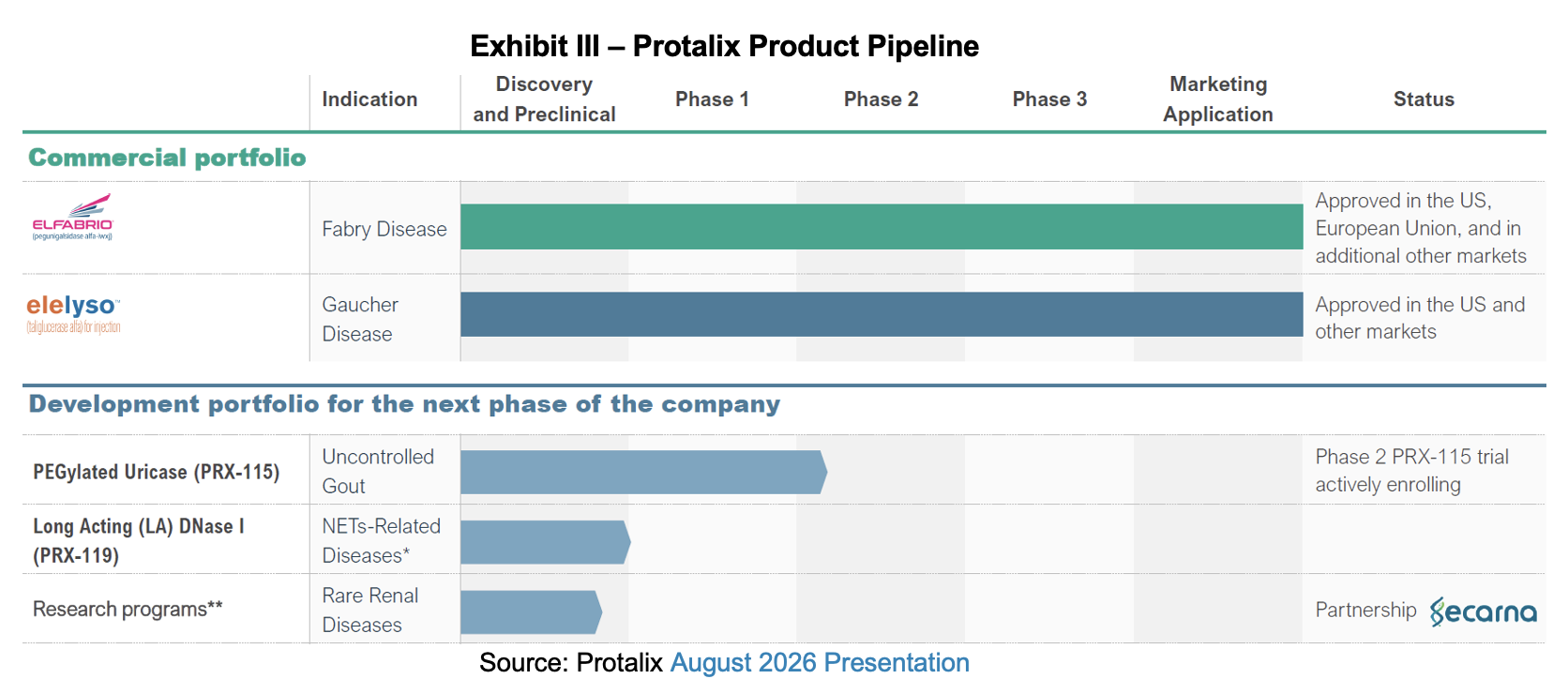
Other positive news since the first quarter update includes a five-year grant of patent term extension lengthening Elfabrio’s intellectual property protection to November 2035. Additionally, Elfabrio received orphan drug designation and marketing authorization in South Korea. PRX-115 posted positive news with the issuance of a new patent, along with management’s continued anticipation for a 2H:27 topline readout for the gout treatment. The RELEASE trial continues to enroll subjects at almost 30 sites located in the US, Georgia, and Israel. Topline results are expected in 2H:27.
In the preclinical arena, Protalix continues its relationship with Secarna along with other undisclosed early partners focusing on renal rare disease. The focus extends to further development of the preclinical asset PRX-119, the long-acting DNase I program.
Despite the strong revenue report, Protalix maintains its topline guidance of $78 to $83 million for 2026. Elfabrio comes in at $33 to $35 million, and Elelyso is expected to range from $20 to $23 million.
Protalix’ financial and operational results were reported in an August 12th, 2026 press release and Form 10-Q filing. The reports were followed by a conference call, which provided further updates. Total revenues were up 27% due to better-than-expected revenues for both Elelyso and Elfabrio. Net income was $3.8 million or $0.05 per share. Further discussion of financial results for the quarter ending June 30th, 2026, is provided below and compares to the same prior-year period:
- Revenues were $19.9 million, up 27% from $15.7 million, attributable to a 43% growth in Elfabrio and a 3% increase in Elelyso revenues generated from selling to partners. While Elelyso sales to Pfizer declined, sales to Brazil were $1.5 million vs $0, helping drive the overall increase for the Gaucher disease treatment. License and R&D services revenues were a modest $68,000, falling relative to the prior year;
- Cost of revenue was $7.8 million vs $5.9 million. Product gross margin fell to 61% from 62% due to product mix;
- Research and development expenses fell 27% to $4.4 million from $6.0 million. The decrease was due to the impact from an offsetting R&D grant of $2.1 million and reduced subcontractor-related expenses offset by higher salary, materials, and other expenses. Absent the grant, R&D expenses rose 8%;
- Selling, general and administrative expenses rose 19% to $3.1 million versus $2.6 million due to higher salary and selling expenses;
- Net financial income was $188,000 compared to a net financial expense of $511,000. The change in this line item was due to exchange rate fluctuations;
- Income tax expense of $1.1 million vs $497,000;
- Net income was $3.8 million or $0.05 per share versus $164,000 or $0.00 per share.
The cash and equivalents balance on June 30th, 2026 totaled $40.7 million versus $30.3 million at the end of 2025. During the first six months of 2026, Protalix’ cash from operations was $11.6 million, with offsets related to an increase in accounts receivable and an increase in inventories. Cash from financing was minimal. We believe that Protalix holds sufficient cash to support operations for the foreseeable future.
PRX-115 Phase II Trial Enrolling
Protalix is enrolling subjects in its Phase II study for PRX-115. Under the acronym RELEASE, the trial is entitled A Study to Investigate the Clinical Effect and the Safety of PRX-115 Infused Intravenously at Different Dosing Regimens, With and Without Methotrexate, Versus Placebo in Adult Gout Patients. It is listed on clinicaltrials.gov under the designator NCT07280156. The multicenter, randomized, double-blind, placebo-controlled study will assess the efficacy, safety, and dosing regimen selection of multiple IV infusions of PRX-115 over 24 weeks, with or without methotrexate (MTX), versus the respective placebo groups in adult patients with gout. 27 sites are listed as active and enrolling on clinicaltrials.gov.
Protalix anticipates that RELEASE topline results will be available in 2H:27.
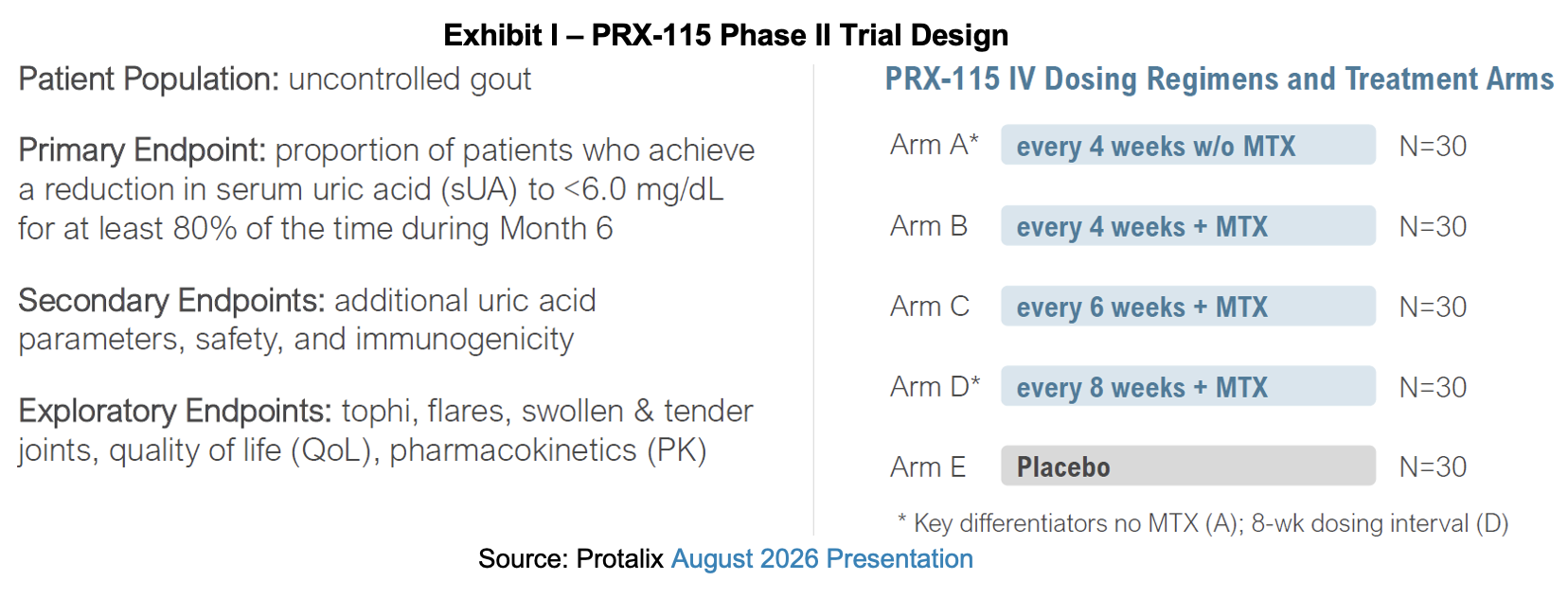
The primary endpoint is the proportion of patients who achieve a reduction in serum uric acid to less than 6.0 mg/dL for at least 80% of the time during month six. Secondary endpoints will measure additional uric acid parameters, safety, and immunogenicity. The study will additionally record tophi, flares, swollen and tender joints, quality of life, and pharmacokinetics.
Participants will receive PRX-115 by intravenous (IV) infusions according to different treatment schedules, with and without MTX. MTX itself does not reduce uric acid levels or manage flares directly but instead is used in combination with treatments that may activate antibodies and an immune response. In a study evaluating pegloticase, MTX was used to reduce antidrug antibody development and infusion reactions as well as improve efficacy. The use of MTX with pegloticase improved the response rate for gout patients compared to the use of pegloticase alone.[1]
PRX-115 Background
The PRX-115 Phase I study was completed in 2024, generating data that was presented at conferences including ACR Convergence. Results from the trial supported advancement to the next stage of development. Planning for the PRX-115 Phase II trial was conducted during 2025, and an investigational new drug (IND) application was filed with the FDA in October. It was cleared in November, and the Phase II started shortly after, enrolling subjects in 1Q:26.
PRX-115 is a plant-cell expressed recombinant PEGylated uricase (urate oxidase) intended to treat uncontrolled gout. Protalix has identified a market of 11.3 million gout patients, with about 300,000 suffering from the uncontrolled form.
European Commission Approval of Elfabrio Four Week Dosing
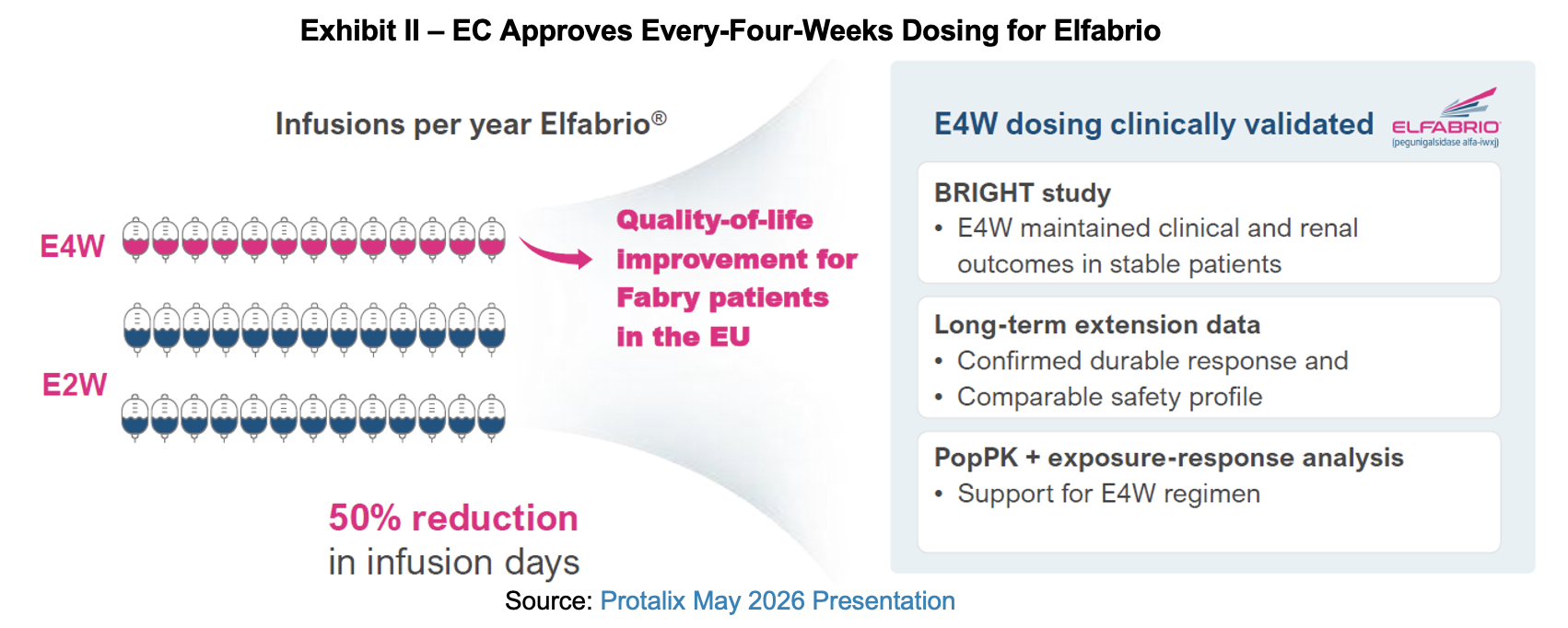
On March 9th, Protalix announced that the European Commission (EC) approved the 2.0 mg/kg every-four-weeks dosing regimen for Elfabrio in Fabry disease. The addressable population is adult patients who are stable on enzyme replacement therapy (ERT). Protalix has received a $25 million milestone payment from Chiesi following the approval.
While the four-week dosing regimen has been approved, it will take time for patients to make the shift. There are country-specific logistics and regulatory requirements that must be satisfied before patients and providers can make the change.
The Phase III BRIGHT study generated the supportive data to justify extended dosing. Elfabrio offers a prolonged half-life, which enables the change. Adults with Fabry disease already stable on biweekly ERT (agalsidase alfa or beta) for more than three years switched to intravenous pegunigalsidase alfa (Elfabrio) 2.0 mg/kg every four weeks for 52 weeks. Kidney function in the stable ERT-experienced group was maintained over a year. There was also an extension to the BRIGHT study which allowed patients to continue on this regimen. Longer-term data from the extension group demonstrated that the change did not increase immunogenicity or create new administration risks.
Background on CHMP Opinion
In December 2024, Protalix’ partner Chiesi submitted a Variation Application to the EMA that requested a change in the dosing regimen for Elfabrio. Based in part on the findings in the BRIGHT study and on new pharmacokinetic data, the sponsors sought a less frequent dosing regimen at a dose of 2 mg/kg body weight administered every four weeks in adult patients with Fabry disease in the European Union. Analysis of the BRIGHT study concluded that treatment with Elfabrio every four weeks could offer a new treatment option for patients with Fabry disease.[2]
On October 17th, 2025, Chiesi and Protalix announced that the Committee for Medicinal Products for Human Use (CHMP) of the European Medicines Agency (EMA) had issued a negative opinion on the request to approve the dosing regimen of 2.0 mg/kg body weight infused every four weeks for Elfabrio.
Two and a half weeks after the negative opinion, Chiesi and Protalix issued a press release stating that they would seek re-examination of the EMA’s negative opinion for Elfabrio regarding the four-week alternative dosing regimen. The process requires that the sponsor submit a written notice to the EMA within 15 days of the CHMP opinion and, 60 days later, submit the grounds for examination. A different rapporteur and co-rapporteur were appointed to conduct the re-examination. Chiesi and Protalix employed consultants and dedicated internal personnel with EMA and CHMP experience who developed the argument for four-week dosing. Following re-submission, the CHMP gave a positive opinion, and the EC approved the new dosing regimen.
Pipeline
- Positive opinion from CHMP for Elfabrio four-week dosing – January 2026
- PRX-115 Phase II trial start – 1Q:26
- EC approval of Elfabrio four-week dosing – March 2026
- Receipt of $25 million milestone for EU approval of Elfabrio four-week dosing – 1Q:26
- Elfabrio patent (#9,194,011) term extension to November 17th, 2035 – May 2026
- Elfabrio receives orphan drug designation and marketing authorization in South Korea – May 2026
- USPTO issued patent #12,674,146 for PRX-115 – July 2026
- Ongoing enrollment in Phase II RELEASE trial for PRX-115 - 2026
- Ongoing enrollment in Japanese RISE study (Elfabrio) - 2026
- Pediatric FLY study active for Fabry disease (Elfabrio) - 2026
- Topline results from PRX-115 Phase II study – 2H:27
SUBSCRIBE TO ZACKS SMALL CAP RESEARCH to receive our articles and reports emailed directly to you. Please visit our website for additional information on Zacks SCR.
DISCLOSURE: Zacks SCR has received compensation from the issuer directly, from an investment manager, or from an investor relations consulting firm, engaged by the issuer, for providing research coverage for a period of no less than one year. Research articles, as seen here, are part of the service Zacks SCR provides and Zacks SCR receives payments totaling a maximum fee of up to $50,000 annually for these services provided to or regarding the issuer. Full Disclaimer HERE.
________________________
[1] Botson, J.K., et al. A Randomized, Placebo‐Controlled Study of Methotrexate to Increase Response Rates in Patients with Uncontrolled Gout Receiving Pegloticase: Primary Efficacy and Safety Findings. Arthritis Rheumatology. December 2022.
[2] Holida, M., et al. A phase III, open-label clinical trial evaluating pegunigalsidase alfa administered every four weeks in adults with Fabry disease previously treated with other enzyme replacement therapies, Journal of Inherited Metabolic Disease. October 2024.