By John Vandermosten, CFA
NASDAQ: RADX
READ THE FULL RADX RESEARCH REPORT
Fiscal 2026 Activity and Cash Flows
Radiopharm Theranostics (NASDAQ: RADX) released its Quarterly Activities and Cash Report for its fourth quarter and fiscal year ending June 30th, 2026. Beyond the review of cash sources and uses for the fiscal year 2026, the report highlighted recent clinical trial achievements for RAD101. The Phase IIb trial reported 93% concordance with MRI, which sets up the RAD101 program for a Phase III launch in 4Q:26. The report additionally updated investors on progress for RAD204 and the company’s other pipeline assets. After the end of the financial measurement period, Radiopharm raised $12.5 million in gross proceeds, launched a $6 million share purchase plan, and received $5.9 million from Australia’s R&D tax credit. We adjust our valuation to reflect new shares issued and anticipated.
Financial Performance
During its latest fiscal year, Radiopharm’s operating and investing activities consumed $58.0 million for the twelve months ending June 30th, 2026. Net cash from financing activities was $33.2 million for the same twelve-month period.[1]
For fiscal 2026, relevant cash flows included:
- Customer cash receipts of $536,000;
- Research and development of $43.4 million related to the management of multiple clinical trials;
- Advertising and marketing costs of $392,000;
- Staff costs of $11.0 million;
- Administration and corporate costs of $4.2 million;
- Interest received of $485,000;
- Government grants and tax incentives of $4.5 million;
- Other miscellaneous cash operating contributions consisting of interest and (Goods and Services Tax) GST refunds totaling $954,000;
- Investing cash flows representing license fee liabilities of $5.4 million;
- Net cash from financing activities of $33.2 million related to proceeds from equity security issuance.
As of June 30th, 2026, Radiopharm held $4.1 million in cash compared to $29.1 million at the end of FY:25. Cash burn for 2026 was $58.0 million while net cash from financing was $33.2 million. Following the end of the quarter, Radiopharm executed a $12.5 million capital raise and received a $5.9 million tax rebate related to clinical trial activities. It has also established a $6.0 million Share Purchase Plan (SPP) that is already subscribed for up to $3.0 million and is expected to close following the September 2026 Extraordinary General Meeting.
Capital Raise and Access
A July 24th, 2026, press release announced that Radiopharm had executed a $12.5 million capital raise, selling 833.3 million underlying shares at a price of $0.015 per share. This represented a 21 to 23% discount to recent trading levels. The placement was comprised of an Australian component raising $6.7[2] million and a US component of $5.8 million. It includes a follow-on SPP that may raise an additional $6.0 million at the same or lower price as the July placement depending on future trading levels. A warrant was attached to each share at a 20% premium to the execution price or $0.018, which carries a three-year term. H.C. Wainwright served as the US placement agent.[3]
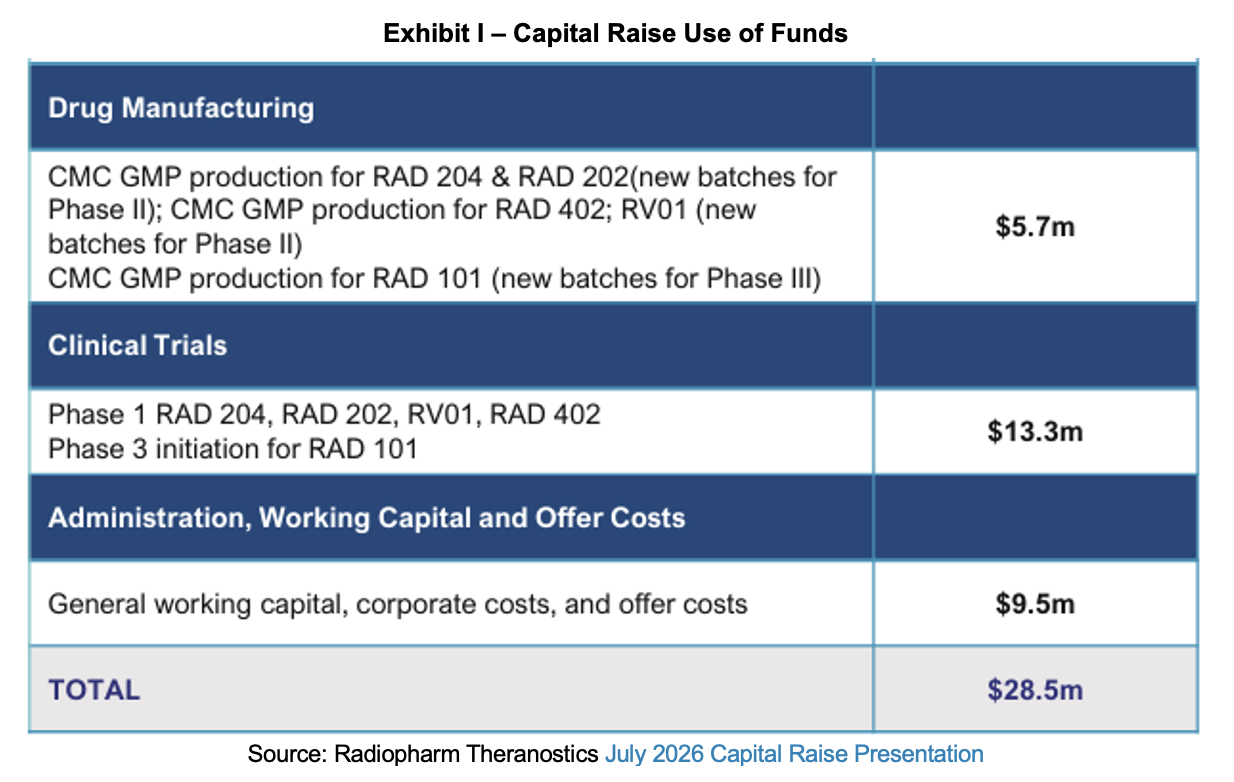
Proceeds from the capital raise will be used to fund the launch of the Phase III RAD101 trial and to progress the other pipeline programs. Over the next quarters, Radiopharm has identified a budget that combines the existing cash balance, R&D tax credit amounts, proceeds from the July 2026 capital raise and the anticipated capital from the SPP which is expected to total $28.5 million. Funds will be used to support drug manufacturing, clinical trials and general corporate expenses as shown in the following exhibit.
RAD101 Phase IIb Topline Results
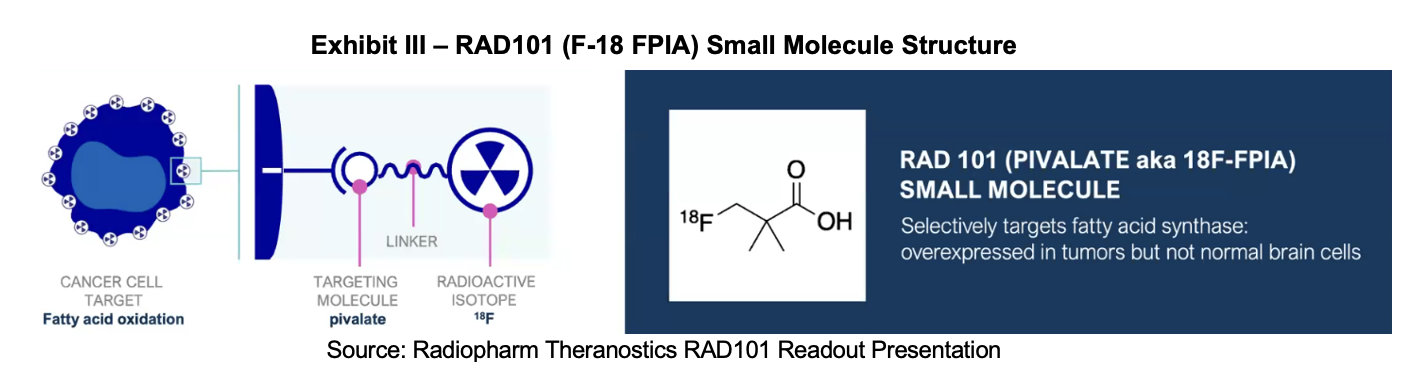
Following two interim readouts for the RAD101 imaging study of brain metastases, on July 22nd, Radiopharm reported results from the Phase IIb trial. RAD101 positron emission tomography (PET) scan results achieved 93% (28/30) concordance with magnetic resonance imaging (MRI) across all evaluable lesions, thereby achieving the trial’s primary endpoint. Patients are undergoing a six-month follow-up to evaluate sensitivity[4], producing a preliminary value of 86% (12 of 14 patients). Sensitivity measures an imaging test's ability to correctly identify patients with disease. The full sensitivity and specificity read-out is expected in 4Q:26.
The results demonstrated substantial and selective tumor uptake of RAD101 and confirm metabolic activity in PET compared to equivocal MRI findings. Standard-of-Care (SoC) imaging relies on MRI, but MRI does not fully differentiate between necrotic tissue and active tumor. Results from the Phase IIb trial support the launch of a Phase III pivotal trial in 4Q:26. Between now and then, we expect to see an FDA protocol meeting in September, which will help align Radiopharm and the FDA on trial design.
RAD101 Clinical Trial Progress
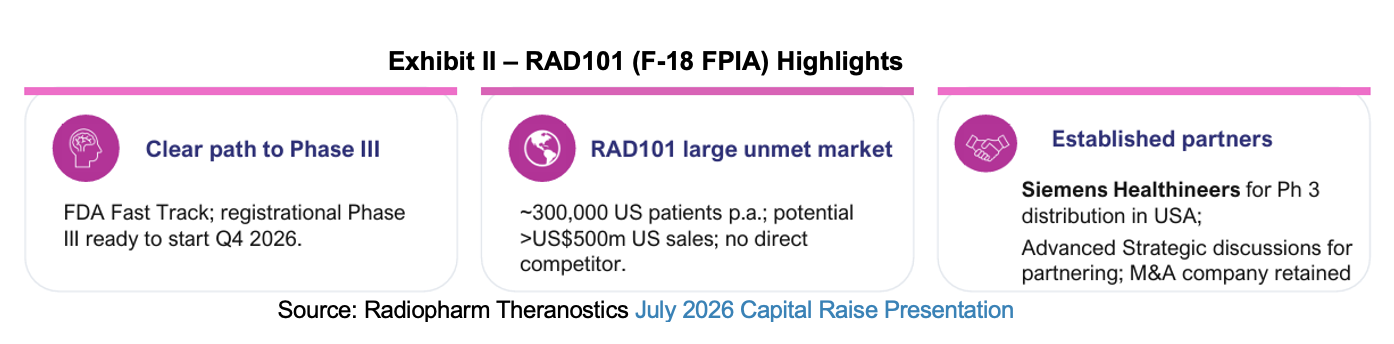
RAD101 has been the subject of preclinical work and Phase I and Phase II clinical trials. In research conducted to date, the trials have shown that high uptake of RAD101 is inversely correlated with survival and can act as an important biomarker for guiding treatment. The Phase IIb study has completed enrollment and reported topline results. Management has secured an agreement with Siemens Healthineers to manufacture and distribute doses of F-18-labeled RAD101 in support of the anticipated Phase III trial.
Management is validating the data from the Phase II trial following the report of topline in July. The team is developing the design of the Phase III trial and held an advisory board meeting to fine-tune the protocol. Radiopharm is anticipating its End of Phase II meeting with the FDA, which could be scheduled in the coming months. It will focus on endpoints and statistical powering. A Phase III study is planned and is expected to be a global study potentially evaluating 150 to 200 subjects. Patients that are already scheduled for biopsy or craniotomy will be considered for the study to provide access to tissue for evaluation. Management plans to establish 40 or 50 sites around the globe, which should be sufficient to recruit the target number of subjects in 15 months. To determine endpoints, a six-month follow-up is required after the scan.
The primary endpoint for the Phase II study was concordance between RAD101 PET imaging and MRI with gadolinium in detecting and characterizing brain metastases. Management expects that the primary endpoint for the pivotal study will change to sensitivity and specificity of RAD101 compared with a biopsy or six months of observation.
RAD202
RAD202, a Lu-177 bound nanobody targeting HER2, is being evaluated in the active HEAT trial for treatment of patients with Human Epidermal Growth Factor Receptor 2 (HER2)-positive advanced solid tumors. The trial is listed on clinicaltrials.gov under the NCT06824155 identifier. RAD202 was cleared to move to the next dose level of 130 mCi by the Data Safety and Monitoring Committee (DSMC) in early April. The principal investigators observed a favorable safety profile with no drug-related adverse events reported. Radiopharm expects to complete enrollment in Cohort 3 by 3Q:26 and finish with all escalation studies by 1H:27.
Radiopharm presented data in April from the Phase 0/1 study at the American Association for Cancer Research (AACR) 2026 Annual Meeting. As expressed in the materials, results “demonstrated meaningful tumor uptake of RAD202, [that] was generally well tolerated, included no dose-limiting toxicities, and organ-level absorbed radiation doses within the expected and clinically acceptable ranges.”
RAD204
RAD204 is a Lu-177 bound nanobody targeting PD-L1 being evaluated for treatment of non-small cell lung cancer (NSCLC), small-cell lung cancer (SCLC), triple-negative breast cancer (TNBC), cutaneous melanoma, head and neck squamous cell carcinoma (HNSCC), and endometrial cancer. The trial is listed on clinicaltrials.gov under the NCT06305962 identifier. The goal of the trial is to determine the safety and tolerability of RAD204 and to identify a recommended Phase II dose. The study employs a Bayesian Optimal Interval (BOIN) trial design.
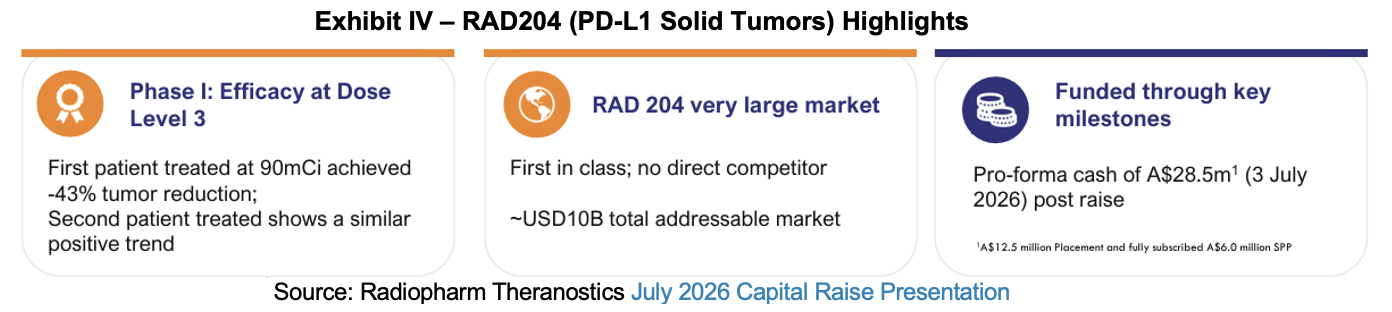
As described in a July 2026 press release, the RAD204 trial achieved confirmed durable partial response for the first two patients enrolled. RAD204 was well-tolerated, and investigators did not observe dose-limiting toxicities. Kidney uptake was limited (cumulative 8.1 Gy across the four cycles administered to Patient 1), and Radiopharm believes this does not represent a potential obstacle for escalation to the next higher dose level. The first patient achieved a durable confirmed RECIST[5] partial response through four treatment cycles. Below we summarize the details for the first two patients.
Patient 1
- Patient 1 has achieved a RECIST-confirmed Partial Response (PR) after the second treatment cycle, which has been maintained during continued therapy:
- 19% reduction in target lesions from baseline, observed after Dose 1
- 43% reduction after Dose 2, which meets the RECIST criteria for a PR
- 43% reduction maintained after Dose 3, indicating a confirmed PR per RECIST
- 35% reduction after Dose 4, while continuing to meet RECIST criteria for a PR
- The patient remains progression-free beyond seven months with continued follow-up
Patient 2
- Patient 2 has demonstrated an early 7% reduction in target lesions following the first treatment cycle
- The patient remains on treatment and is progression-free with continued follow up to assess further efficacy and safety
The third patient is cleared to start at a 90 mCi dose of Lu-177 and is undergoing screening evaluation. A fourth dose level of 120 mCi is planned. Completion of the dose escalation phase is expected in 4Q:26 or 1Q:27.
SUBSCRIBE TO ZACKS SMALL CAP RESEARCH to receive our articles and reports emailed directly to you. Please visit our website for additional information on Zacks SCR.
DISCLOSURE: Zacks SCR has received compensation from the issuer directly, from an investment manager, or from an investor relations consulting firm, engaged by the issuer, for providing research coverage for a period of no less than one year. Research articles, as seen here, are part of the service Zacks SCR provides and Zacks SCR receives payments totaling a maximum fee of up to $50,000 annually for these services provided to or regarding the issuer. Full Disclaimer HERE.
________________________
[1] Note that results are reported in Australian Dollars. The August 1, 2026, exchange rate between Australian Dollars and U.S. Dollars was $1.42 AUD to $1.00 USD.
[2] $0.6 million is expected to be raised in a second tranche held on or around September 11th, 2026.
[3] As part of the transaction, H.C. Wainwright was issued 64,082 agent warrants that have a three-year life and exercise price of USD$3.95.
[4] Sensitivity is the percentage of true positives over the sum of true positives and false negatives. Specificity is the proportion of true negatives divided by the sum of true negatives and false positives. Quantifying specificity takes longer due to the extended period required to determine if the lesion is in fact not there and has not returned.
[5] Response Evaluation Criteria in Solid Tumors