By David Bautz, PhD
NASDAQ: SNGX
READ THE FULL SNGX RESEARCH REPORT
Business Update
Interim Analysis for Phase 3 FLASH2 Trial in 2Q26
Soligenix, Inc. (NASDAQ: SNGX) is currently conducting the Phase 3 FLASH2 Trial of HyBryte™ (SGX301 or synthetic hypericin) in the treatment of cutaneous T cell lymphoma (CTCL). As of the latest update, the company has enrolled 66 of the planned 80 patients. The FLASH2 trial is very similar in design to the successful Phase 3 FLASH trial, as shown in the following figure, which provides a comparison between the two studies. One key difference between the trials is that in the FLASH trial patients were treated for three cycles of six-weeks each, with a two-week break in between cycles and the primary efficacy endpoint was measured after the first treatment cycle, while in the FLASH2 trial patients will be treated for 18 consecutive weeks before the primary efficacy endpoint is assessed. In addition, the overall blinded aggregate response rate remains consistent with what the company reported in November 2025 (48% for all patients that have completed the treatment phase of the study, discussed further below), which is higher than the overall response rate used to design the study (25%), thus our confidence is high that the study will have a positive readout. We anticipate an interim analysis from the study being conducted in the second quarter of 2026 and topline results being reported in the second half of 2026.
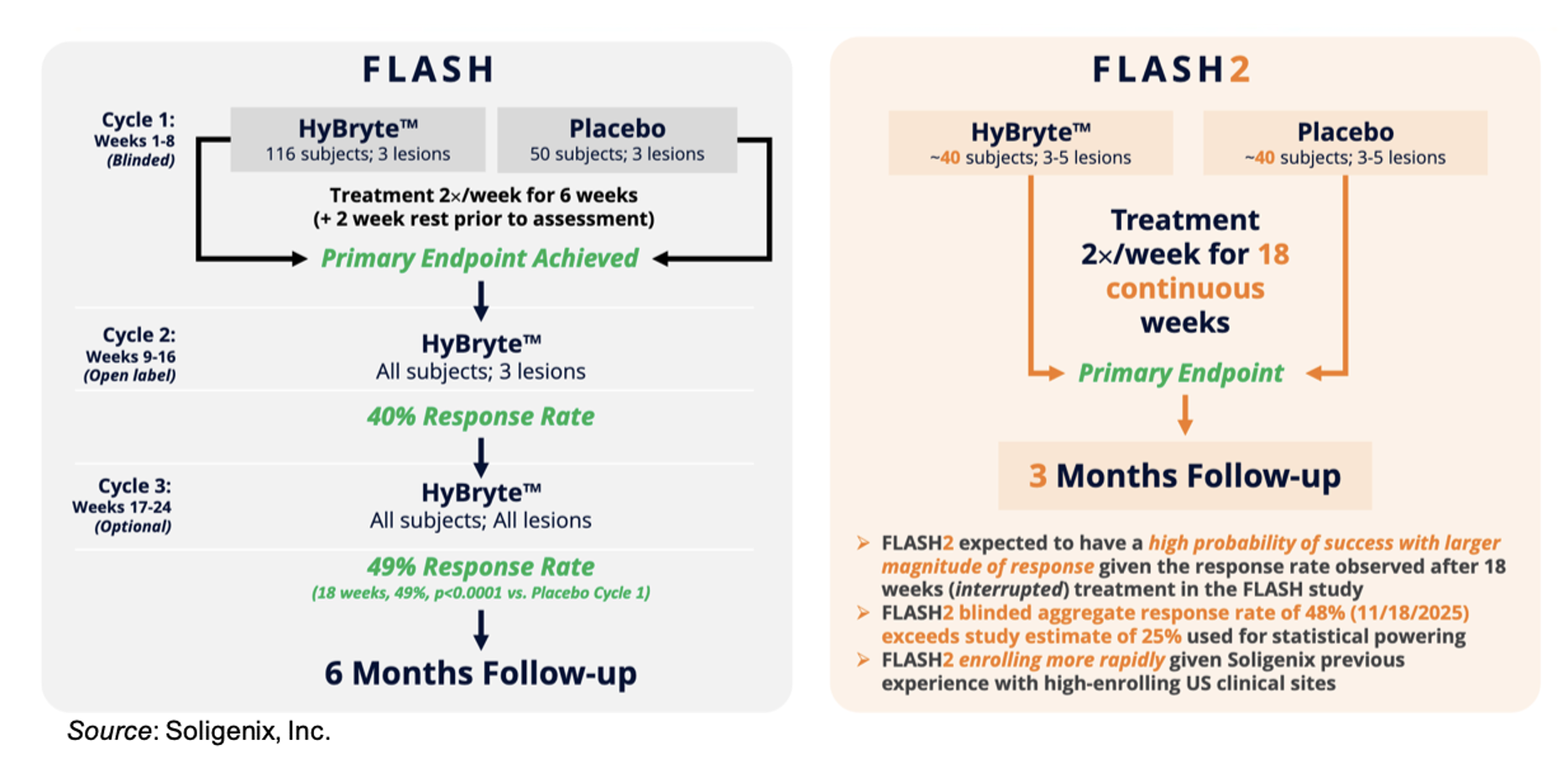
Soligenix powered the FLASH2 trial using an anticipated overall blinded study response rate of 25%, which included a very conservative 40% response rate in the HyBryte arm and a 10% response rate in the placebo arm through 18 weeks. Assuming an even number of patients were enrolled into each cohort, the 25% is calculated by combining the two response rates ((40%+10%)/2). Thus, in order for the blinded response rate to be 48%, we believe the treated cohort would need to be far exceeding the powering assumptions so long as the placebo response rate is not unusually high.
If the two cohorts in the blinded response rate analysis were equal, and the placebo response rate was 10% (the same that was used in the powering assumptions for the trial), that would mean the active response rate would be 86% ((86%+10%)/2=48%)! Thus far, Dr. Ellen Kim has seen a response rate of 75% after 18 weeks of treatment in the open-label, investigator-initiated study currently being conducted at the University of Pennsylvania, so 86% would even far exceed that. While the numbers may not be exact, the point of this exercise is to show that for the blinded response rate to be 48%, assuming there have been a relatively equal number of patients that have finished treatment from each cohort and unless the placebo response is drastically higher than previously seen, the active arm is likely exhibiting a very robust response rate. Of course, we will not know the details until the data are unblinded, however that update gives us a lot of confidence that the trial is at the very least trending in the right direction.
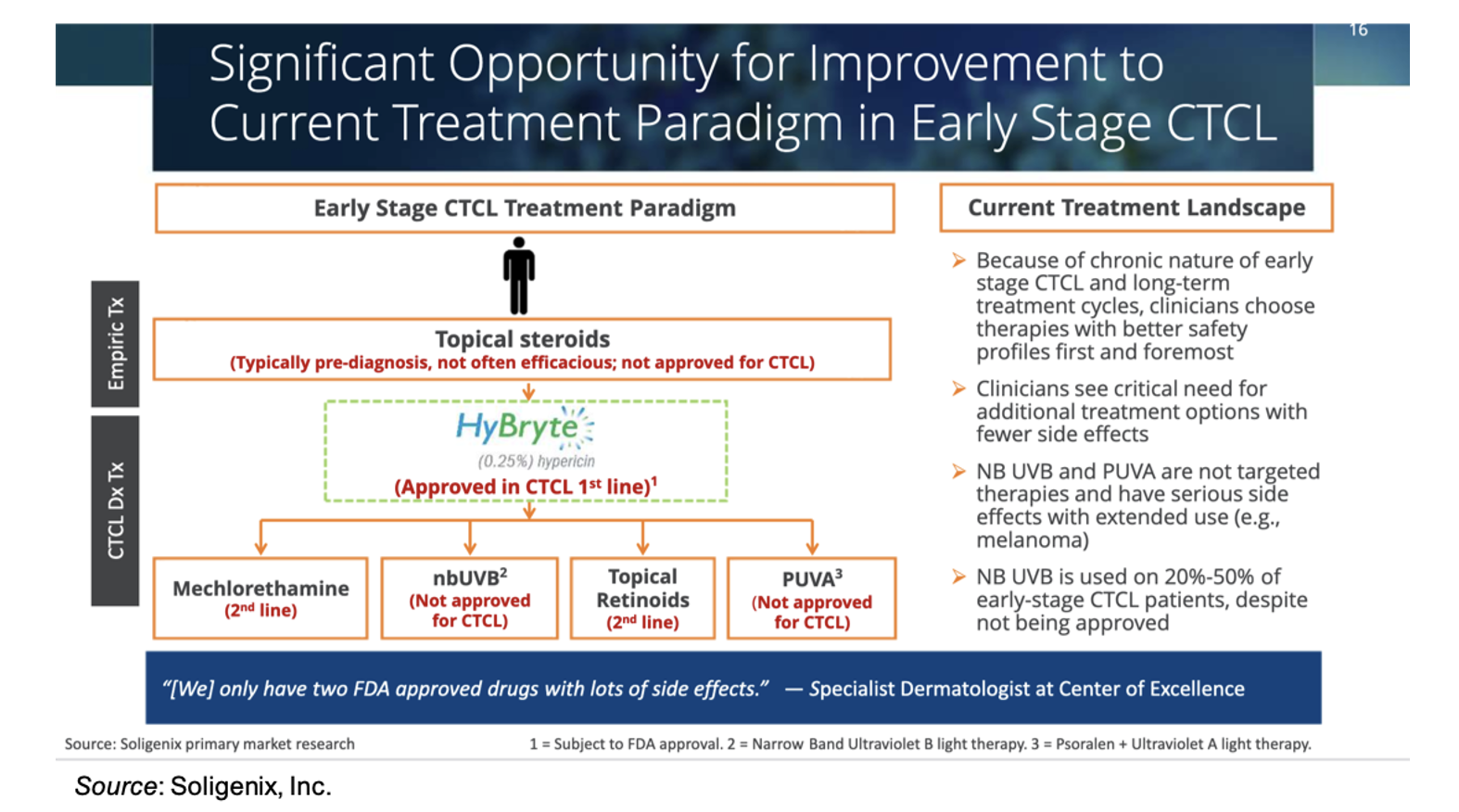
The market opportunity for HyBryte in CTCL, if approved, is substantial based on the fact that current treatment options are not highly effective and many of them are associated with significant side effects. For example, narrow-band ultraviolet B therapy (nbUVB) and psoralen + ultraviolet A light therapy (PUVA) are used on early-stage CTCL patients even though they are not approved for that indication. CTCL is a chronic disease necessitating long-term therapy, however long-term use of nbUVB and PUVA increases the risk for skin cancers, including melanoma. Thus, we believe a targeted and well tolerated therapy for CTCL such as HyBryte is likely to be utilized by many CTCL physicians and should help Soligenix achieve a sizeable share of the estimated $250 million worldwide CTCL market.
Results of Study Comparing HyBryte vs Valchlor® Published in Oncology and Therapy
On April 2, 2026, Soligenix announced the publication of results from a comparability study evaluating HyBryte versus Valchlor® for the treatment of CTCL were published in Oncology and Therapy (Poligone et al., 2026). The study was designed to obtain preliminary safety and efficacy data in a comparative assessment of HyBryte and Valchlor over 12 weeks of treatment by measuring 3-5 prospectively identified index lesions for each patient. Following 12 weeks of treatment, 60% of the HyBryte patients met the defined level of “Treatment Success” (≥50% improvement in their cumulative mCAILS score compared to baseline) compared to only 20% of the Valchlor patients. The results were not statistically significant due to the small sample size (n=10). The average cumulative improvement in mCAILS at 12 weeks was 52.5% in the HyBryte group and 34.7% in the Valchlor group. HyBryte was well tolerated in all patient while one of the five Valchlor-treated patients had to withdraw due to a clinically significant allergic contact dermatitis from Valchlor. In total, 60% of the Valchlor-treated patients had at least one adverse event “related” to therapy, including rashes, application site sensitivity, allergic contact dermatitis, and dermatitis. No such instances were reported in the HyBryte group.
Orphan Drug and Promising Innovative Medicine Designations for SGX945
Recently, Soligenix has announced that SGX945 (dusquetide) has received the following designations from European and UK regulatory agencies:
- On March 26, 2026, Soligenix announced that the European Commission, acting on the the positive recommendation from the European Medicines Agency (EMA) Committee for Orphan Medicinal Products (COMP), has granted orphan drug designation to dusquetide (SGX945) for the treatment of Behcet’s Disease. Orphan drug designation by the EMA provides a 10-year period of marketing exclusivity in the EU following approval. In addition, there are incentives for companies seeking protocol assistance from the EMA during development along with direct access to the centralized authorization procedure.
- On March 10, 2026, Soligenix announced that the Medicines and Healthcare Products Regulatory Agency (MHRA) in the UK granted Promising Innovative Medicine (PIM) designation to SGX945 for the treatment of Behcet’s Disease. This is the first step and a prerequisite towards inclusion in the UK Early Access to Medicines Scheme (EAMS), which offers severely ill patients with life-threatening conditions and seriously debilitating conditions the ability to try ground-breaking new medicines much earlier than they would normally be able to. To meet PIM designation, a product must meet three criteria, including treating a life-threatening or seriously debilitating disease with a high unmet medical need, the product needs to offer a major advantage over therapies that are currently used in the UK, and the potential adverse effects of the product are likely to be outweighed by the potential benefits.
Financial Update
On March 31, 2026, Soligenix announced financial results for the year ending December 31, 2025. The company did not report any revenues in 2025 compared to revenues of $0.1 million for 2024. The decrease was primarily due to the conclusion of the zero-margin grant for the HyBryte investigator-initiated study. R&D expenses were $7.5 million in 2025, compared to $5.2 million for 2024. The increase was primarily due to cost associated with the Phase 2a study in Behcet’s Disease and the ongoing second confirmatory trial Phase 3 CTCL study. G&A expenses in 2025 were $4.4 million compared to $4.2 million in 2024. The increase was primarily due to increases in various franchise taxes and stock related expenses partially offset by a decrease in professional fees.
Soligenix exited 2025 with approximately $7.9 million in cash and cash equivalents. We estimate the company has sufficient capital to fund operations into the fourth quarter of 2026. As of March 24, 2026, Soligenix had approximately 10.3 million shares outstanding and, when factoring in stock options, warrants, and the potential convertible debt, a fully diluted share count of approximately 18.0 million.
Conclusion
In addition to the readouts from the Phase 3 FLASH2 trial expected this year, we also anticipate additional scientific publications around HyBryte this year along with updates for the company’s Behcet’s disease program for SGX945 (dusquetide) and the psoriasis program for SGX302. Soligenix is planning to reformulate SGX945 to enable home-based treatment before interacting with regulators regarding a follow-on Phase 2b trial later in 2026. The company will also be planning follow-up studies for the psoriasis program following the release of encouraging topline results from the Phase 2a trial of SGX302 in mild-to-moderate psoriasis. Lastly, the company is continuing to engage in partnering discussions for ex-U.S. markets for HyBryte in CTCL in order to pursue marketing authorizations worldwide. We continue to have high confidence in the chances for a successful Phase 3 readout later this year, however given the continued weakness in the stock we have factored in for additional dilution for future financings, which has decreased our valuation to $20 per share.
SUBSCRIBE TO ZACKS SMALL CAP RESEARCH to receive our articles and reports emailed directly to you each morning. Please visit our website for additional information on Zacks SCR.
DISCLOSURE: Zacks SCR has received compensation from the issuer directly, from an investment manager, or from an investor relations consulting firm, engaged by the issuer, for providing research coverage for a period of no less than one year. Research articles, as seen here, are part of the service Zacks SCR provides and Zacks SCR receives payments totaling a maximum fee of up to $50,000 annually for these services provided to or regarding the issuer. Full Disclaimer HERE.