By David Bautz, PhD
NASDAQ: TNXP
READ THE FULL TNXP RESEARCH REPORT
Business Update
$11.0 Million in Net Revenue for Tonmya® in 2Q26
Tonix Pharmaceuticals Holding Corp. (NASDAQ: TNXP) is continuing the commercial launch of Tonmya® following its approval in August 2025 and commercial launch in November 2025. Sales metrics for the second quarter of 2026 continue to show substantial growth in prescriptions, new patients, and refills:
- 2Q net sales were approximately $11.0 million, which was up 194% compared to the first quarter of 2026
- 12,592 prescriptions, which was up 100% compared to the first quarter of 2026
- A 36% increase in new patients compared to the first quarter of 2026
- Refills increased 207% compared to the first quarter of 2026
The disparity between prescription growth (doubled) and revenue growth (nearly tripled) is potentially meaningful. It likely reflects a growing proportion of prescriptions converting from bridge access into reimbursed commercial prescriptions, along with refill activity among patients who have already initiated treatment. The 207% increase in refills is particularly encouraging since recurring utilization is more indicative of durable commercial demand than gross prescription volume alone. Future quarters should provide additional insight in order to distinguish between initial market uptake and a recurring patient base.
Tonix continues payer engagement to increase market access. In July 2026, Tonix announced a major managed Medicare agreement for Tonmya that will add approximately nine million Medicare lives when the new agreement goes into effect on January 1, 2027. When combined with the two prior commercial coverage agreements with leading group purchasing organizations (GPOs), and Medicaid availability in most states representing approximately 73 million lives, on January 1, 2027, pharmacy coverage will total approximately 145 million individuals.
The timing of the payer expansion is important. The majority of the 2Q26 revenue increase occurred while Tonix was still building commercial access, suggesting that the approximately $11.0 million quarterly revenue base does not necessarily represent the ceiling for the current launch infrastructure. Tonix expects to deploy an additional 50 sales representatives by September 2026, increasing its sales force to approximately 150 representatives.
At this point, we believe the key commercial question has begun shifting from whether Tonmya can generate prescriptions to whether the company can convert those prescriptions into a large, persistent, reimbursed patient population. The large increase in refills is an early positive indicator. Refill trends, monthly prescription growth, the conversion of bridge prescriptions to reimbursed prescriptions, and the productivity of the expanded sales force will be the most important commercial metrics to monitor over the next several quarters.
Update on TNX-4800
Tonix is developing TNX-4800 (formerly 2217LS), a long-acting, human monoclonal antibody (mAb) prophylactic treatment for the prevention of Lyme disease. It is being developed for annual seasonal use in the spring to protect against Lyme disease through the entire tick season in the U.S. There are currently no FDA-approved vaccines or prophylactics to protect against Lyme disease.
The company recently conducted a Type C meeting with the FDA early in the third quarter of 2026, with the final meeting minutes showing agency support for an adaptive Phase 2 field study in 1Q27, subject to final FDA review and agreement on the study protocol. It will be a randomized, double blind, placebo controlled, adaptive Phase 2 field study to evaluate the efficacy of a two-dose subcutaneous regiment of TNX-4800 in preventing the first occurrence of confirmed Lyme disease during the primary efficacy surveillance period (Day 3 through Month 6 following administration). Each fixed dose is expected to provide exposures comparable to the 5 mg/kg dose evaluated in the Phase 1 trial. The first dose will be administered in the spring, and the second booster dose will be administered three months later. Eligible participants will be adults and adolescents 16 years of age and older in Lyme-endemic areas in the U.S. The primary endpoint will be the prevention of Lyme disease for six months (comparison of TNX-4800 group and placebo group) from the initial dose. A key secondary endpoint will be protection through three months.
Background on TNX-4800
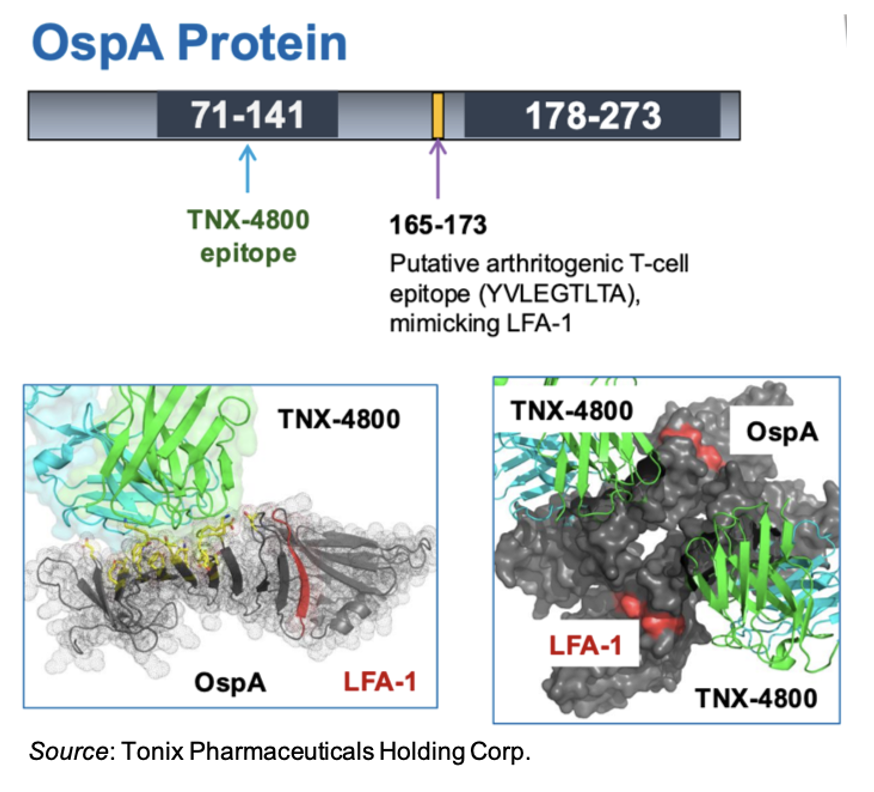
TNX-4800 was developed by researchers at UMass Chan Medical School. It is directed against the outer-surface protein A (OspA) expressed on Borrelia burgdorferi, the bacteria that causes Lyme disease. The OspA protein contains an epitope that mimics human leukocyte function-associated antigen 1 (LFA-1) (Steere et al., 2003). Thus, antibody treatments targeting the OspA protein need to avoid that region in order to decrease the chances for potential autoimmune cross-reactivity. LYMErix™ was an FDA-approved vaccine to prevent Lyme disease; however, it was voluntarily pulled from the market due in part due to concerns over a possible link to an arthritogenic autoimmune condition that may have been triggered by cross-reactivity to LFA-1 (Nigrovic et al., 2007). Importantly, TNX-4800 does not bind to that same epitope, but instead binds to the 71-141 region of the OspA protein, which has no human homologue.
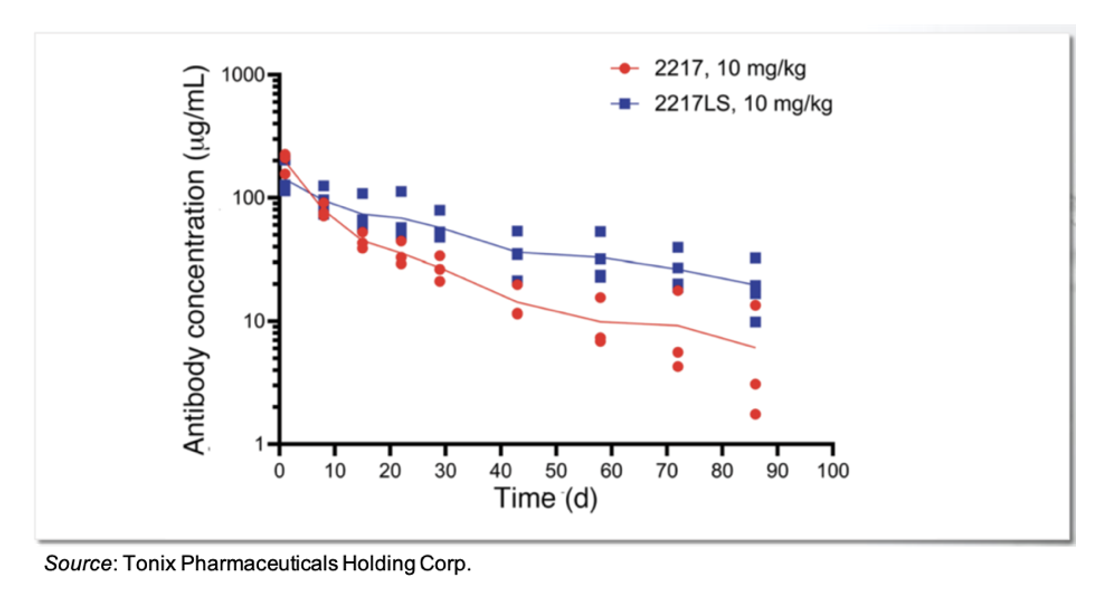
The mAb 2217LS was derived from mAb 2217 by amino acid substitutions to prolong the serum half-life. The following image shows the serum concentration of both mAb 2217 and 2217LS over a 90-day span following injection into nonhuman primates (NHPs).
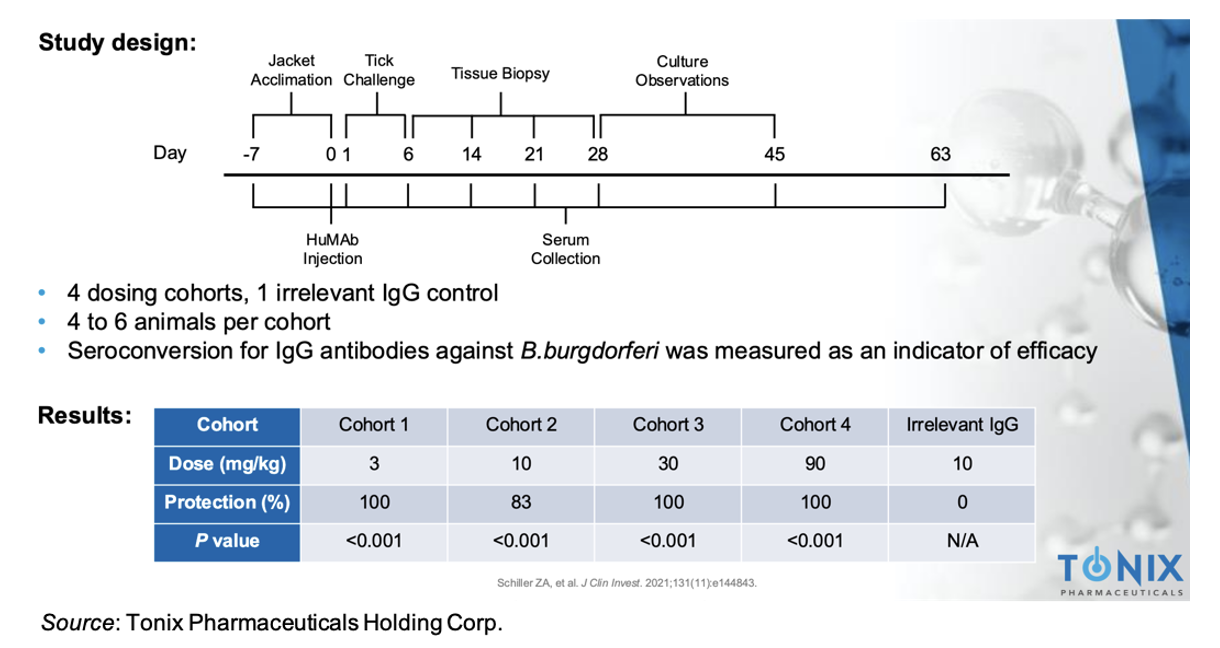
The antibody was tested in an NHP challenge model, in which animals were first dosed with 2217LS before multiple B. burgdorferi-infected ticks were placed on their backs for six days (Schiller et al., 2021). The study included five dosing cohorts: four different doses of 2217LS (3, 10, 30, 90 mg/kg) and a sham IgG (10 mg/kg). The results showed that of the 20 NHPs treated with 2217LS, only one became infected. An overview of the study is given below.
Background on Lyme Disease
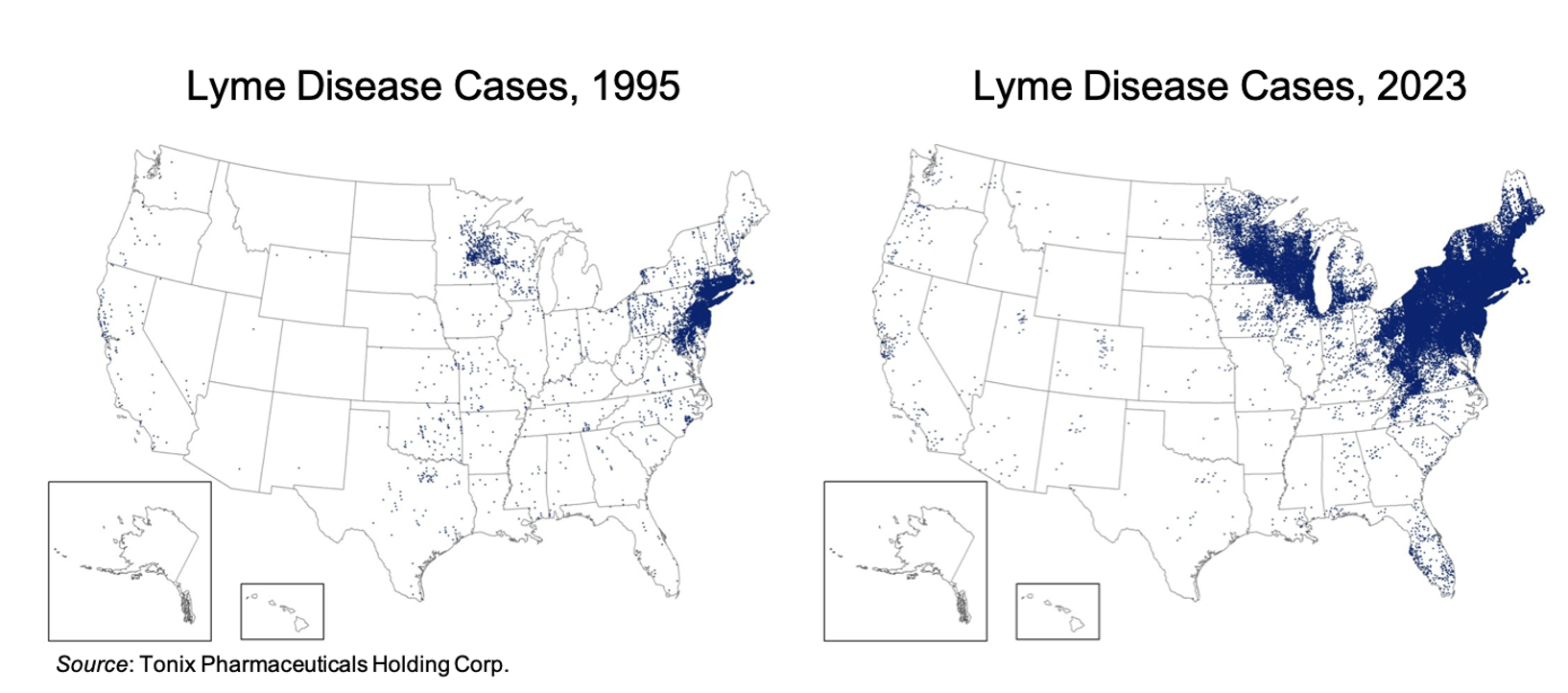
Lyme disease is caused by the bacterium Borrelia burgdorferi. While it can occur all across the U.S., it is reported most often in the Northeast and Midwest. The overall prevalence of Lyme disease has been increasing over time, as shown by the following maps of reported cases from 1995 and 2023 (CDC). There are approximately 80 million individuals in the U.S. that are at risk for Lyme disease.
There are a number of different signs and symptoms for Lyme disease, with the most telling being a rash, which occurs in 70-80% of people (CDC). Additional symptoms of early disease include fever, chills, headache, fatigue, muscle and joint aches, and swollen lymph nodes. Later signs of the disease include severe headaches and neck stiffness, arthritis, intermittent pain in tendons, joints, and bones, heart palpitations, and nerve pain.
- burgdorferi bacteria live in the mid-gut of ticks and adhere through the outer membrane protein OspA (de Silva et al., 1996). Following a tick bite, iron from the blood of the host downregulates OspA, which causes the bacteria to migrate from the midgut to the salivary glands for transmission (Radolf et al., 2012). While OspA is essential for transmission, it is expressed at very low levels in the human host once transmission has occurred; thus, the immune system does not mount an immune response or produce antibodies to OspA. Following administration of an anti-OspA mAb (e.g., TNX-4800), the circulating antibody is ingested by the tick, and it then blocks OspA on B. burgdorferi inside the tick and prevents transmission of the bacteria from the tick to the human host.
Competitive Analysis
Multiple monoclonal antibody preventive treatments have recently been accepted by the FDA and the market. Enflonsia™, Beyfortus®, and Pemgarda™ are monoclonal antibody prophylaxis treatments that have been approved for respiratory syncytial virus (RSV) and COVID-19. Enflonsia, Beyfortus, and Pemgarda are estimated to have 2030 revenues of $955 million, $2.9 billion, and $570 million, respectively (EvaluatePharma). Thus, we view a preventative monoclonal antibody treatment for Lyme disease as a potential blockbuster.
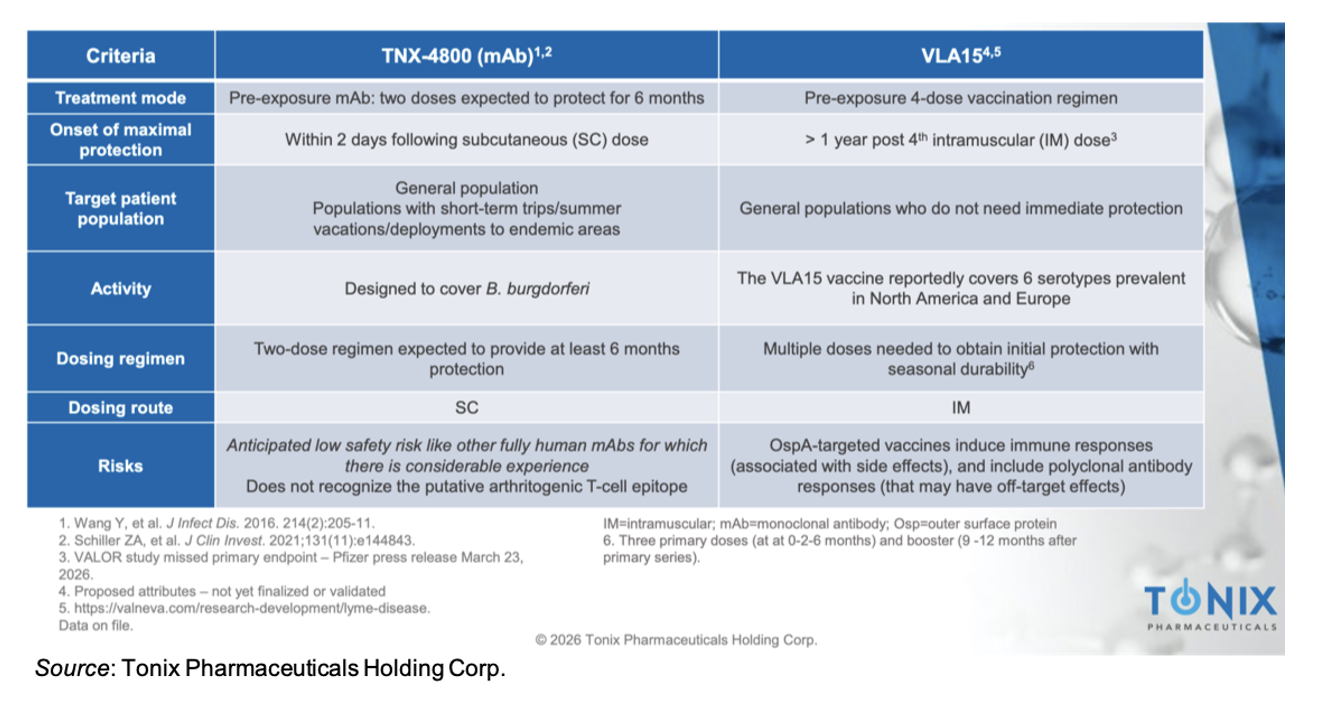
Pfizer is developing VLA15, a vaccine for the prevention of Lyme disease. TNX-4800 has a number of advantages compared to VLA15, which are summarized in the table below. We believe the greatest advantages lie with the rapid onset of protection (~2 days compared to 6-7 months post 3 vaccinations) and only two administrations that provide protection for ≥6 months compared to three administrations needed to obtain protection with uncertain durability.
HORIZON Trial in MDD Underway
In June 2026, Tonix announced that the first patient was enrolled into the HORIZON trial. It is a randomized, double blind, placebo controlled Phase 2 study that is evaluating TNX-102 SL 5.6 mg as a first-line monotherapy in adults with major depressive disorder (MDD). Approximately 360 patients are expected to be enrolled across approximately 30 U.S. sites. The primary endpoint is the change from baseline in the Montgomery-Asberg Depression Rating Scale (MADRS) total score at Week 6. Tonix has positioned this study as “potentially pivotal”, thus, instead of functioning as an exploratory proof-of-concept study, the trial is designed to generate data that could potentially support a regulatory pathway with fewer additional clinical steps if the results are sufficiently robust and the FDA agrees with the development strategy.
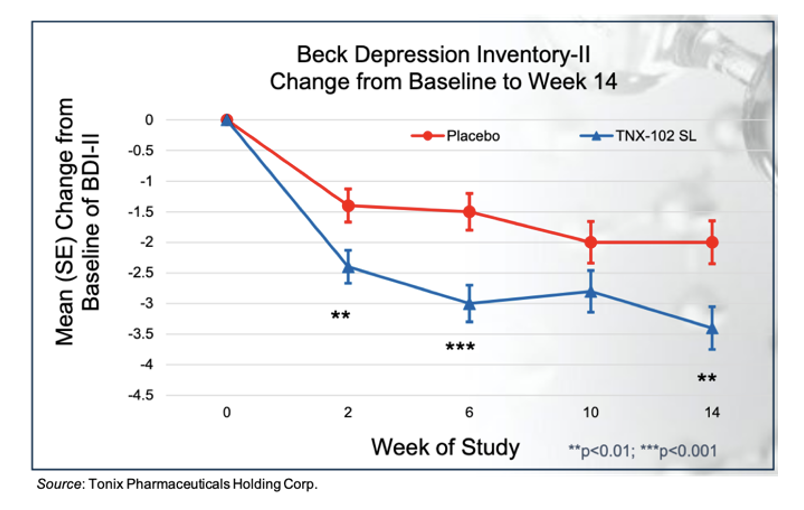
The support for evaluating TNX-102 SL as a treatment for depression stems from results of TNX-102 SL in fibromyalgia and post-traumatic stress disorder (PTSD) clinical trials. For example, in the RESILIENT Phase 3 trial, there was a greater reduction in the total Beck Depression Inventory-II score in the TNX-102 SL cohort compared to placebo at Week 14 with an effect size of 0.27, as shown in the following figure.
Financial Update
On August 10, 2026, Tonix announced financial results for the second quarter of 2026. Net product revenues for the second quarter of 2026 were approximately $13.5 million compared to $2.0 million for the second quarter of 2025. Net revenue from sales of Tonmya for the second quarter was approximately $11.0 million, while net revenue from sales of Zembrace and Tosymra was approximately $2.5 million. Cost of sales in the second quarter of 2026 was approximately $0.7 million compared to $3.3 million for the same time period in 2025. The decrease in the cost of sales was primarily due to a change in product mix and a write-off related to the migraine products in 2025.
R&D expenses for the second quarter of 2026 were $19.4 million, compared to $10.8 million for the second quarter of 2025. The increase was primarily due to higher manufacturing and clinical trial costs associated with advancing the company’s prioritized pipeline programs, along with increased employee-related costs reflecting increased headcount. G&A expenses for the second quarter of 2026 were $36.0 million, compared to $16.2 million for the second quarter of 2025. The increase was primarily due to spending on sales and marketing related to Tonmya, along with increased employee-related and professional expenses.
As of June 30, 2026, Tonix had approximately $176.2 million in cash and cash equivalents. Subsequent to the end of the quarter, the company raised approximately $3.7 million in proceeds utilizing its at-the-market (ATM) facility. We estimate that the company’s current cash position will finance operations into early second quarter of 2027 but not beyond. As of August 7, 2026, Tonix had approximately 17.2 million shares outstanding and, when factoring in stock options and warrants, a fully diluted share count of 20.1 million.
Conclusion
Tonix is entering what we believe is a potentially transformative phase of its evolution as Tonmya transitions from a newly launched product into a growing commercial franchise. The rapid sequential increase in Tonmya revenue, prescriptions, and refills, combined with the expanded payer coverage and a planned 50-person increase in the sales force, provides increasing evidence that the company can establish a meaningful presence in the large fibromyalgia market. In addition, the advancement of TNX-4800 toward a Phase 2 study in the prevention of Lyme disease and the initiation of the potentially pivotal HORIZON study of TNX-102 SL in MDD provide additional avenues for substantial pipeline value creation.
Tonmya revenues came in well above our estimates for the quarter, and we have increased our estimates for the third and fourth quarter of 2026 as we may have underestimated the initial demand curve. However, we have also increased our estimate for SG&A expense as the company adds an additional 50 sales representatives by the beginning of the fourth quarter of 2026. While substantial cash consumption remains an important risk, we believe this may be offset by the emerging value of the commercial franchise. At the company’s current valuation, we believe the market is assigning very limited value to Tonmya’s future growth or the broader pipeline. For risk-tolerant investors, this creates an attractive risk/reward profile as continued execution on Tonmya could provide a path toward substantial revenue growth while positive clinical development in MDD or Lyme disease could add significant incremental value. Our current valuation is $64 per share.
SUBSCRIBE TO ZACKS SMALL CAP RESEARCH to receive our articles and reports emailed directly to you. Please visit our website for additional information on Zacks SCR.
DISCLOSURE: Zacks SCR has received compensation from the issuer directly, from an investment manager, or from an investor relations consulting firm, engaged by the issuer, for providing research coverage for a period of no less than one year. Research articles, as seen here, are part of the service Zacks SCR provides and Zacks SCR receives payments totaling a maximum fee of up to $50,000 annually for these services provided to or regarding the issuer. Full Disclaimer HERE.