By M. Marin
NASDAQ:DBGI
Digital Brands Group (NASDAQ:DBGI) is an emerging apparel retailer that holds a broad portfolio of brands and recently launched several growth initiatives, including entering into a new high margin licensing deal with TJ Maxx, one of the country’s largest discount retailers, and entering the NIL (Name, Image and Likeness) college apparel market (see below) with expansion planned within that category. The company also plans to introduce a portfolio of technology solutions to support its own e-commerce activities and generate a new revenue stream by licensing the tools to third-party retailers. To support its growth strategies and execute on these multiple measures, DBGI’s strategy is to reduce debt in order to have greater financial flexibility.
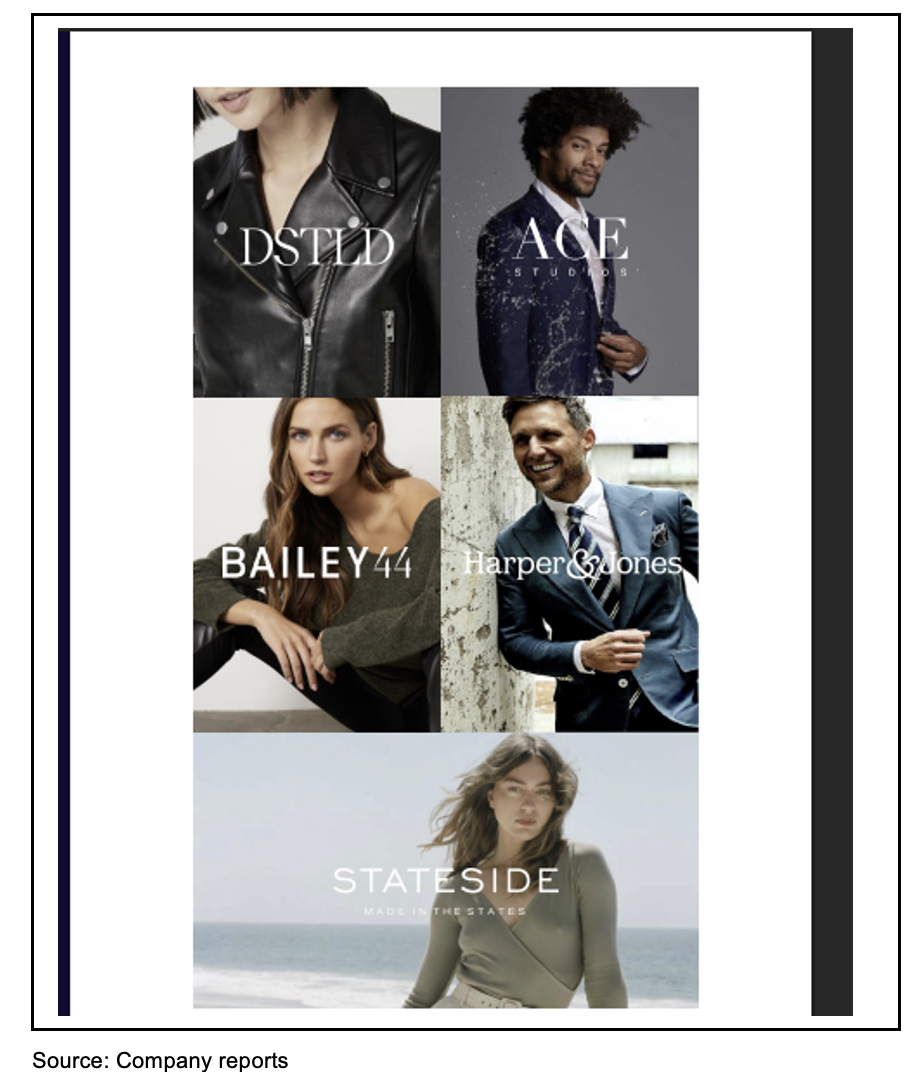
While the company focuses on its new licensing and private label activities, it concurrently aims to expand its legacy business. DBGI is pursuing a strategy to offer a wide array of apparel options through direct-to-consumer (DTC) and wholesale channels, as well as licensing partnerships and is leveraging its digital capabilities to support its growth initiatives. This strategy includes using data analysis to better understand customers’ buying patterns to offer customized, targeted clothing and accessories suggestions in order to capture a greater percentage of what DBGI calls "closet share," boost customer retention, and lower customer acquisition cost (CAC).
Core brand portfolio plus new licensing initiatives
The company’s portfolio of brands includes Bailey 44, DSTLD, Harper and Jones (H&J), Stateside, ACE Studios, Avo, and Sundry. DBGI has grown its brand portfolio via several strategic M&A transactions. For example, the company purchased Bailey 44 in February 2020, the Stateside brand in August 2021, and the Sundry label in December 2022. Sundry added several categories of women’s clothing to the portfolio – including dresses, shirts, accessories – and strengthened DBGI’s position in the athleisure category, which has been among the fastest growing product categories in womenswear. DBGI believes it has multiple opportunities to grow its brands by cross-promotional initiatives with other labels in the portfolio.
Among the expected growth drivers underlying its strategy, DBGI is optimistic about potentially entering into high-margin licensing deals to expand sales of legacy brands, such as the one it just formed with TJ Maxx for its Sundry brand. The TJ Maxx licensing deal marks a substantial increase in DBGI’s distribution within the TJ Maxx network and, in success, could serve as a model for other opportunities down the road.
Specifically, in 2Q25, DBGI formed a license agreement with The TJX Companies (NYSE:TJX), giving TJX a license to sell Sundry-branded apparel and use the Sundry trademark on specified women’s apparel and accessories categories in exchange for licensing royalty payments based on TJX’s cost of licensed merchandise.
With a 48-year operating history, The TJX Companies is a Fortune 100 company and, according to TJX, “the leading off-price retailer of apparel and home fashions in the U.S.” TJX operates several retail chains and stores in nine countries across three continents, including T.J. Maxx, Marshalls, HomeGoods, and HomeSense domestically. The initial term of the DBGI-TJX agreement is through January 27, 2029, with automatic two-year renewals thereafter. DBGI is optimistic about this expanded relationship with TJX.
NIL college apparel market represents a sizable potential opportunity
DBGI intends to reinvest cash flow from its existing brand portfolio and core business into new initiatives in order to grow overall consolidated operating performance. The company believes its recent entry into the Name, Image, and Likeness (NIL) collegiate apparel category and planned expansion in that sector have significant growth potential.
Specifically, Digital Brands recently launched a private label strategic initiative within the NIL college apparel sector. The NCAA changed the regulations in 2021 to enable college athletes to profit from their name, image, and likeness commercially. While restrictions on promoting certain products still exist, the aggregate value of NIL deals has grown, and that trajectory is expected to continue. The NIL segment comprises part of the roughly $34 billion global licensed sports merchandise space, which market research firm Grand View Research estimates will reach $49.0 billion by 2030.
As a core step to advance this initiative, DBGI recently formed an exclusive three-year private label manufacturing agreement with AAA Tuscaloosa, LLC d/b/a Yea Alabama, which is the official University of Alabama NIL program designed to capture NIL opportunities for University of Alabama student-athletes.
Reflecting the target addressable market, the revenue opportunity for DBGI could be significant. The University of Alabama’s incoming class of Fall 2025 reached a record 42,360 freshman class students, which represents a 3.7% year-over-year increase compared to Fall 2024. Moreover, the university is known for the school spirit of its enrolled students, alumni, and parents, particularly for the University of Alabama Crimson Tide college football team.
The company’s private label products with U of A logos are being sold at the University of Alabama bookstores and through the online e-commerce channel. The company seeks to position itself in the college apparel sector using a model that is similar to that which Warby Parker uses for eyewear and built on data-driven manufacturing and distribution through a combination of DTC and selective brick-and-mortar locations. For the collegiate market, the company expects the in-store traffic that college bookstores attract represents a strong brick-and-mortar option. DBGI also believes the model is highly scalable and can be replicated at numerous other colleges and universities.
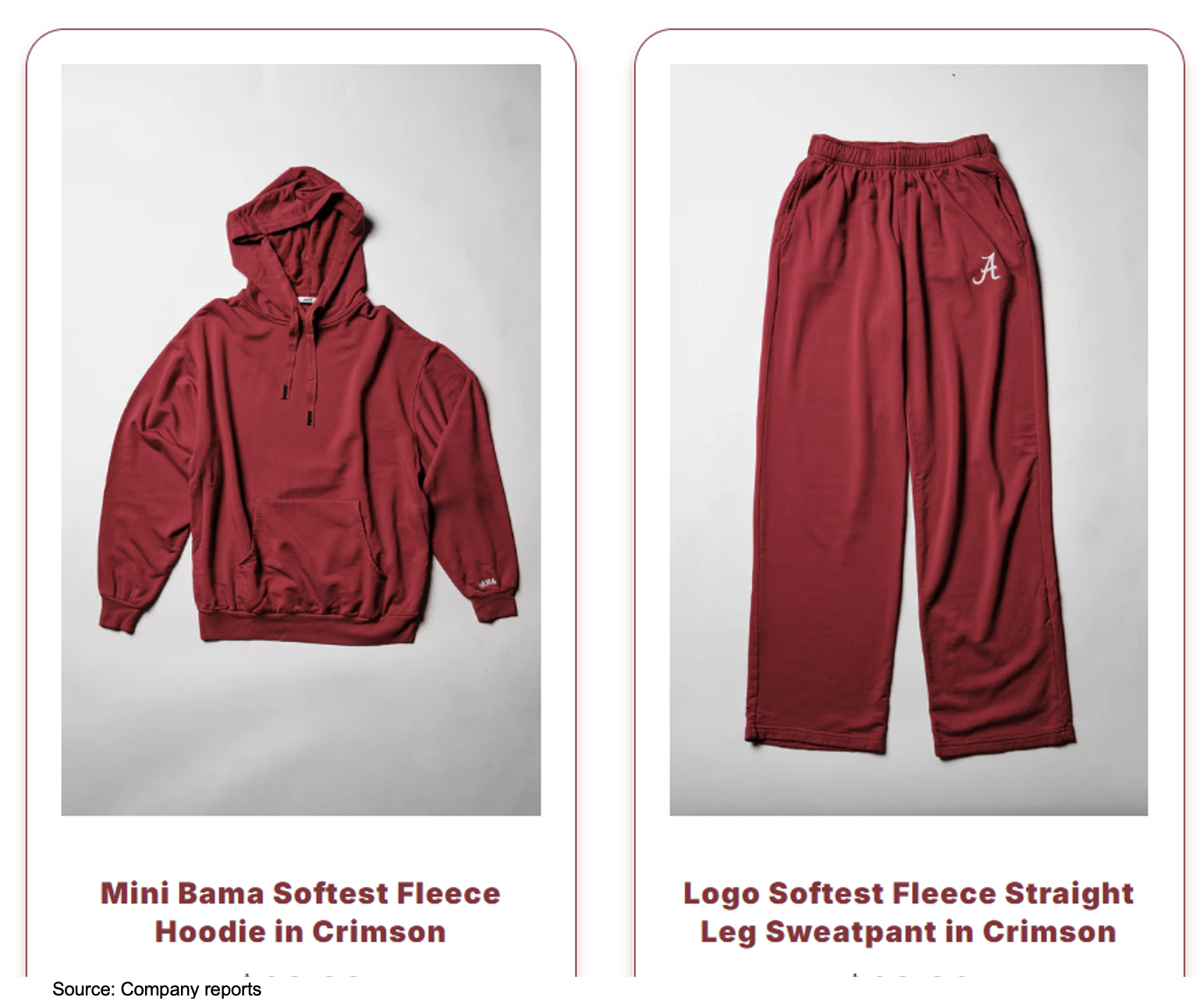
The company’s focus will be the DTC channel, and it will leverage its technology capabilities (see below) to benefit from the above-noted data-driven model. The company expects to launch a customized collegiate gear program in January 2026, followed by a loyalty program. These features would also likely be incorporated in future partnership agreements with other colleges and universities. Consistent with its existing strategy to cross-promote its portfolio of proprietary brands, DBGI believes there are also cross-promotional opportunities within the collegiate business, as well.
Recent launch of College Influencer Tour as DBGI looks to expand NIL college apparel model to additional schools
Other schools that Digital Brands intends to target for this business model include Big 10 colleges, where collegiate sports are extremely important and where the company might use a university influencer model to promote the product line and lower CAC. The influencers would be expected to benefit, as well. DBGI recently launched its first AVO College Influencer Tour at the University of Alabama for the Alabama Crimson Tide game. The tour featured influencers and athletes, including Hallie Batchelder, who has 259K Instagram followers, Sydney Thomas, and University of Alabama graduates Sarah Ashlee Barker, Ha-Ha Clinton Dix, and Mary Sergi. The tour gave game attendees and others the opportunity to meet these influencers and athletes.
DBGI has indicated that it is in discussions to expand the model to other institutions under agreements that are similar to the one with Yea Alabama. The company sees multiple benefits for both partners under this structure, including:
- The ability to offer high-quality merchandise at competitive prices, leveraging distribution directly through university-affiliated channels.
- Partnering with DBGI can enable universities to receive 20% royalties on merchandise sales.
- DBGI is committed to supporting NIL opportunities for female student athletes, which the company believes would represent an early NIL initiative specifically for women college athletes.
The company also believes that through its ability to leverage primarily domestic manufacturing and direct customer data, it can respond more quickly to emerging trends compared to competitors.
Plan to introduce e-commerce technology solutions
The company also views its growing technology capabilities as another competitive advantage. DBGI was accepted into the NVIDIA Connect Program and has also joined the Oracle PartnerNetwork (OPN), which gives it access to Oracle’s cloud infrastructure, applications, and other resources to help accelerate the development and delivery of its strategy to leverage technology tools for apparel and offer these tools to external partners through potential licensing deals. The company intends to offer AI-powered intellectual property protection, automated marketing, and next-generation data security, among other solutions, to support e-commerce brands.
The tagline for this initiative is “delivering style, protection, and growth through a suite of tools.” The company believes Oracle’s infrastructure and applications will help accelerate the rollout of this initiative. At the same time, DBGI also continues to discuss opportunities with other leading technology firms to further broaden its capabilities.
Clean balance sheet
To support its growth strategies and execute on these multiple measures, DBGI recently strengthened its balance sheet in order to have greater financial flexibility. In 3Q25, DBGI raised $9 million through a PIPE (private investment in public equity) offering of convertible preferred stock, with funds earmarked to repay debt. Recently, the company expanded the offering to provide for an additional roughly $1.5 million in gross capital.
Tariffs – much of DBGI’s merchandise is produced domestically
Many of DBGI’s products are produced domestically. For instance, many Sundry products are produced primarily in Los Angeles. The Stateside brand is designed and produced in Los Angeles, as well. For production of other brands, DBGI relies on third-party contract manufacturers operating primarily in Europe, the U.S., and the Asia Pacific region, and its merchandise is then stored primarily at DBGI’s Los Angeles corporate warehouse and distribution center, which handles all warehousing, fulfillment, outbound shipping, and returns processing.
Last quarter, DBGI and Amaze Holdings (NYSE:AMZE), which have launched e-commerce stores that attract an aggregate 1.2+ billion unique visitors, announced an expanded partnership to enable Amaze to leverage Digital’s Los Angeles-based facilities to produce custom apparel and athleisure wear in the U.S.
Management has experience growing early-stage companies
Chief Executive Officer (CEO)
Chief Executive Officer (CEO) John Hilburn Davis IV, “Hil,” is a former equity research analyst who covered the retail sector at Thomas Weisel Partners, SunTrust Robinson Humphrey, and Citadel Investment Group. He has served as the company’s CEO since March 2019, having joined DS LTD in March 2018 to overhaul its supply chain. Prior to that, Mr. Davis founded two companies, BeautyKind, where he served as CEO from October 2013 to January 2018, and J.Hilburn, where he was CEO from January 2007 to September 2013, growing it from the pre-revenue stage to $55 million in revenues in six years.
Risks
Among the risks DBGI faces is that of increased competition, as potential new players enter the bricks-and-mortar and/or online retailer channels, and if other better-capitalized players increase their marketing efforts and brand extensions. The company also faces possible increased competition for new initiatives such as collegiate apparel and NIL one, and potentially might need to raise funds earlier than management currently anticipates if it does not reach its cash flow generation targets as early as management expects. Potential fundraising initiatives could be dilutive to current shareholders, among other risks.
SUBSCRIBE TO ZACKS SMALL CAP RESEARCH to receive our articles and reports emailed directly to you each morning. Please visit our website for additional information on Zacks SCR.
DISCLOSURE: Zacks SCR has received compensation from the issuer directly, from an investment manager, or from an investor relations consulting firm, engaged by the issuer, for providing research coverage for a period of no less than one year. Research articles, as seen here, are part of the service Zacks SCR provides and Zacks SCR receives payments totaling a maximum fee of up to $50,000 annually for these services provided to or regarding the issuer. Full Disclaimer HERE.